Coating wear resistance is one of the important indicators that cannot be ignored in the evaluation of material properties. During the use of coatings, they are often affected by various mechanical forces, resulting in wear and tear on their surfaces. In order to ensure the stability and durability of the coating in practical applications, it is particularly important to scientifically and accurately evaluate its wear resistance. This article will introduce several common coating abrasion resistance test methods, including rubber wheel abrasive wear test, pin disc abrasive wear test, friction wear test and sandblasting test, aiming to provide reference for coating wear resistance research and application.
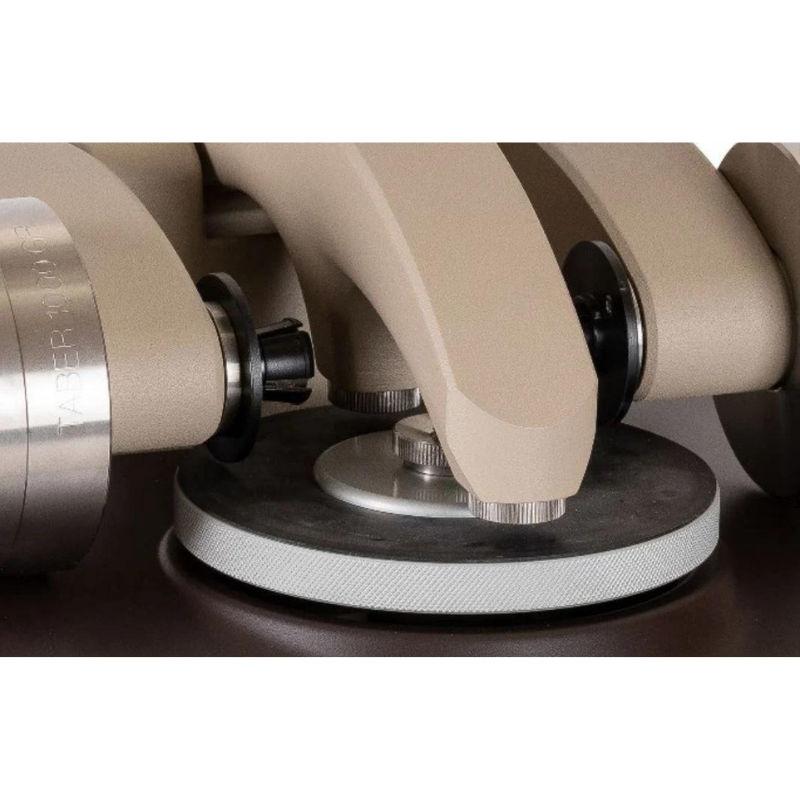
1. Abrasive abrasive test of rubber wheels
The principle of the test
This test method simulates an actual wear environment by placing the abrasive between the rotating rubber wheel and the specimen at a fixed speed. The rim of the grinding wheel is rubber of specified hardness, and the specimen is pressed against the grinding wheel by a lever system with a certain pressure. The abrasive creates low-stress wear on the specimen during rotation. The wear resistance of the coating is assessed by measuring the amount of wear of the specimen.
Specimen requirements
The specimen size is usually 50mm x 75mm, the thickness is 10mm, and the surface needs to be flat and free of buildup or defects.
Abrasion resistance evaluation
According to the weight loss of the specimen, the wear resistance of the coating is evaluated.
2. Pin disc abrasive wear test
The principle of the test
In this test, sandpaper or abrasive cloth is mounted on a disc as an abrasive, and the specimen is made into a pin type and pressed against the disc sandpaper under a certain load pressure. When the disc rotates, the specimen moves in a straight line along the radial direction of the disc, and the wear resistance of the coating is evaluated by measuring the weight loss of the specimen.
Specimen requirements
The specimen is a cylindrical rod of φ4mm, and the end face should be flat without attachments or defects.
3. Friction and wear test
The principle of the test
The friction and wear test is performed by forming a friction pair between an annular specimen and a matching component (e.g. GCr15 or cast iron). The test can be done using dry friction or lubrication friction. The wear resistance of the coating is evaluated by measuring the weight loss of the specimen.
Specimen requirements
The specimen is a φ40mm x 10mm ring, and the surface should be flat without attachments or defects.
4. Sandblasting test
The principle of the test
The blasting test uses an injection-suction blast gun to spray an abrasive (e.g., corundum sand) onto the surface of the specimen, simulating the erosion and abrasion of the coating by a gas or liquid carrying hard particles. After the test, the weight loss of the specimen is determined to evaluate the erosion and wear resistance of the coating.
Test setup and conditions
The test setup is made of materials such as glass, brass or stainless steel and consists mainly of two coaxially fixed tubes. The flow rate of the supplied gas is strictly controlled by the control valve. During the test, the specimen is fixed on the test frame and the abrasive is sprayed on the surface of the specimen through an inner tube.
Evaluation methodology
The abrasion coefficient and the average wear resistance are two commonly used evaluation indicators. The spraying coefficient is calculated from the original film thickness and abrasion resistance parameters of the standard specimen. The average wear resistance is based on a standard specimen and is expressed by measuring the amount of wear on the specimen.
There are a variety of coating abrasion resistance test methods, each with its own characteristics. The rubber wheel abrasive abrasive test and the pin disc abrasive abrasive abrasive test are suitable for low-stress wear environments; The friction and wear test can simulate the actual use conditions; The abrasive blasting test is suitable for erosion environments where gases or liquids carry particles. Through the proper selection and application of these test methods, the wear resistance of the coating can be comprehensively evaluated, thereby improving the service life and performance of the material.
