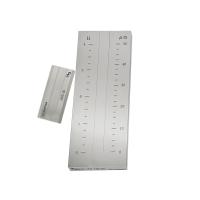
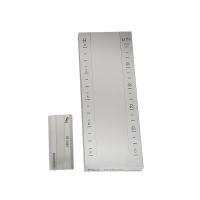
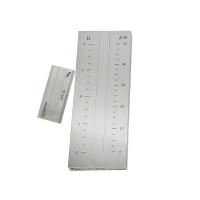
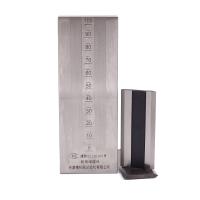
The scraper Fineness Meter is used to measure the pigment and particle size and dispersion degree in paint, paint paste, ink and other liquids and slurries, so as to control the quality of dispersed products in production, storage and application. Used in fields such as plastics, pigments, printing inks, paper, ceramics, medicine, and food.
The scraper Fineness Meter consists of a scraper and a scraper. There are one or two inclined grooves with parallel long sides on the scraper, with a given depth at one end and zero at the other end. (see picture 1)


1. Selection of scraper
When the fineness is 10 μm and below 10 μm, a scraper Fineness Meter with a range of 15 μm should be used; when the fineness is 20 μm and below 20 μm, a scraper Fineness Meter with a range of 25 μm should be used; when the fineness is 30 μm and below 30 μm, A scraper Fineness Meter with a measuring range of 50 μm should be selected; if the fineness is above 30 μm, a scraper Fineness Meter with a measuring range of 100 μm should be selected.
2. Use
When using, first clean the front and back of the scraper with a solvent, dry it with cotton yarn, fully stir the sample that meets the product standard viscosity index with a paint knife, take an appropriate amount of sample and smear it on the deepest part of the groove to fill the groove And a little excess is advisable. Then hold the scraper with the thumbs, index fingers and middle fingers of both hands, the angle between the scraper and the scraper is about 85°, and scrape from the depth of the groove to the shallow part of the groove at an appropriate speed, so that the sample is filled with the groove and not on the plate. Leave too much sample (not more than 3 seconds). Immediately (not more than 5 seconds) after smearing, hold the fineness plate horizontally and tilt it so that the line of sight and the groove plane form an angle of 15~30°, observe the scale value at the place where the particles in the groove are evenly exposed to the light, and the reading value will be read. The fineness of the measured object. If the test object is printing ink or a liquid of similar viscosity, the time for the scraper to pass through the entire chute should not be less than 5 seconds, and a certain force should be applied. For example, data with high consistency cannot be read out manually.
3. Reading
Observe the place where the sample first appears the cheat particle point, which contains 5-10 particle points within a range of 3mm across the chute, see the position in Figure 2 and Figure 3. Scattered dots may appear above where dense particle dots appear, which can be ignored. After determining the 3mm position, take the upper limit of the nearby value and read according to the following accuracy:

4. Matters needing attention
(1) Do not scratch the surface of the fineness gauge, and protect the blade of the scraper;
(2) Wash off and apply Vaseline after use;
(3) When measuring the fineness of thick paint, the clear oil that meets the product standards should be adjusted and then measured;
(4) Regularly (1 year) check the straightness of the knife edge and the fineness plate, and if it is found to be uneven or worn, it needs to be calibrated by the national metrology and verification agency before it can be used.
(5) How to judge whether the edge of the scraper is intact. Place the blade of the scraper on the opposite side of the scraper, facing the light source, and swing the scraper back and forth to see if there is light leakage. If there is light leakage, it means that the blade of the scraper is damaged and needs to be returned to the factory for regrinding.
Scraper Fineness Meter manual download
 Pushin scraper Fineness Meter operation manual.pdf