introduction
Oral solutions are widely used in the pharmaceutical industry, and their viscosity is an important parameter that affects the quality of drugs and the patient experience. Viscosity is not only related to the flow, stability and uniformity of the drug, but also affects the patient's experience, especially during swallowing. Therefore, accurate determination of the viscosity of oral solutions is of great significance to ensure the quality and safety of drugs.
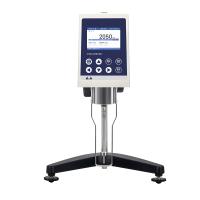
Rotational viscometer is a commonly used viscosity testing equipment, which is widely used in viscosity measurement of various liquids because of its advantages of easy operation, high test accuracy and wide range of application. This article will introduce in detail the application of Rotational Viscometer in viscosity testing of oral solutions, including experimental preparation, operation steps, data analysis and precautions, etc., aiming to provide systematic experimental methods and technical support for pharmaceutical companies and researchers.
Experimental principle
A Rotational Viscometer calculates the viscosity of a liquid by measuring the resistance experienced by a rotating object as it moves through it. When a rotating body rotates in a liquid, the resistance exerted by the liquid on it is directly proportional to the viscosity of the liquid. A Rotational Viscometer is usually driven by a motor that calculates the viscosity of a liquid by controlling the rotational speed and measuring the resistance moment.

Experiment preparation
Instruments & Reagents
Rotational viscometer: Choose a Rotational Viscometer that is suitable for the measuring range, such as the DV2T Rotational Viscometer.
Oral solution samples: Prepare oral solution samples with different formulations and concentrations according to actual needs.
Thermostatic Water Bath: used to control the temperature of the sample during testing.
Test tubes, beakers, pipettes and other laboratory utensils.
Sample preparation
Preparation of samples: According to the needs of the experiment, oral solutions with different concentrations and formulations are prepared.
Constant temperature treatment of the sample: The sample is placed in a constant temperature Water Bath and maintained at a certain temperature to ensure the accuracy and repeatability of the test results.
Experimental Procedure
Turn on the power of the Rotational Viscometer for self-test and warm-up.
Select the appropriate rotor and rotational speed to select the appropriate range based on the expected viscosity of the sample.
The instrument is calibrated with a standard viscosity solution to ensure the accuracy of the instrument.
Take an appropriate amount of sample and place it in a test container to ensure that the sample liquid level meets the measurement requirements of the rotor.
Place the test vessel in the measuring position of the Rotational Viscometer and adjust the rotor below the sample level.
Set the appropriate rotational speed, start the Rotational Viscometer, and record the resistance torque as the rotor rotates in the sample.
The viscosity value of the sample is read and recorded via the display of the rotating viscometer or a connected computer.
Multiple measurements were taken on each sample, and its average value was taken as the final test result.
According to the purpose of the experiment, the viscosity of the samples with different formulations and concentrations was compared.
The data were analyzed using statistical software to determine the stability and uniformity of the viscosity of the sample.
Experimental results and discussion
Viscosity analysis of oral solutions of different formulations
The experimental results showed that the viscosity of different formulations of oral solutions was significantly different. For example, three common oral solution formulations A, B, and C have viscosities of 2.5 cP, 4.0 cP, and 6.8 cP, respectively. This indicates that the type and concentration of ingredients in a formulation directly affect the viscosity of the solution.
Effect of temperature on the viscosity of oral solutions
The viscosity change of the samples was determined by controlling the temperature of the samples at 25 °C, 30 °C and 37 °C in a thermostatic Water Bath, respectively. The results showed that the viscosity of the oral solution decreased with the increase of temperature, which was in line with the basic law that the viscosity of the liquid decreased with the increase of temperature. For example, the viscosity of Formula B at 25°C, 30°C, and 37°C is 4.0 cP, 3.5 cP, and 3.0 cP, respectively.
Viscosity stability analysis
Multiple measurements were taken of the same lot of oral solution to assess the stability of its viscosity. The results showed that the viscosity of the same batch of samples changed slightly, indicating that the uniformity of the samples and the reproducibility of the experiments were good. For example, the viscosity values of formula A are 2.5 cP, 2.6 cP, and 2.5 cP in multiple measurements, indicating good viscosity stability.

conclusion
Rotational viscometers have important application value in the viscosity testing of oral solutions. The following conclusions can be drawn from the experiment:
There are significant differences in the viscosity of oral solutions in different formulations, and the composition of the formulation is the main factor affecting the viscosity.
Temperature has a significant effect on the viscosity of oral solutions, and usually increased temperature leads to a decrease in viscosity.
The viscosity of the same batch of samples has good stability, indicating the reliability and repeatability of the measurement results of the Rotational Viscometer.
In practical applications, pharmaceutical companies should select the appropriate Rotational Viscometer according to their specific needs and strictly control the experimental conditions to ensure the accuracy and repeatability of the test results. In the future, with the continuous advancement of technology, the measurement accuracy and application range of Rotational Viscometers will be further improved, providing more powerful technical support for the quality control of oral solutions and other liquid drugs.