I. Introduction
Viscosity is a measure of the internal resistance experienced by a liquid as it flows, and directly reflects the fluidity or consistency of the liquid. In the coatings industry, viscosity is an important parameter for evaluating the performance of coatings, which determines the flowability, applicability and final coating quality of the coating. Paints that are too viscous can cause difficulty in application, poor leveling, and surface marks or wrinkles, while coatings that are too low in viscosity can lead to sagging, too thin coatings, or the need for multiple coatings, affecting the final result and durability.
The viscosity of the coating directly affects the effectiveness and efficiency of the application process. In coating applications, the proper viscosity ensures that the coating is evenly applied to the substrate and that a uniform coating is formed during the drying process. By precisely controlling the viscosity of the coating, the appearance and performance of the coating can be improved, the ease of application can be improved, and the durability and aesthetics of the coating in actual use can be ensured.
Second, the basic principle of Viscosity Cup
1. What is viscosity?
Viscosity is a physical quantity that describes the frictional resistance inside a liquid, reflecting how "heavy" the liquid is when it flows. Specifically, viscosity indicates the ability of a liquid to resist shear forces during flow. For coatings, the higher the viscosity, the less fluid the paint is, meaning the greater its internal resistance; Conversely, the lower the viscosity, the better the fluidity of the coating and the less internal resistance. Common viscosity measurement methods include the use of Viscosity Cups, which are devices that can help accurately determine the flow characteristics of liquids.
2. The influence of viscosity on the performance of coatings
The viscosity of a coating has a significant impact on how well it is applied. First, the right viscosity ensures that the coating evenly covers the substrate when applied, resulting in a smooth, uniform coating. If the viscosity is too high, the coating may cause construction difficulties, it is difficult to evenly coat, and problems such as brush marks and poor leveling may occur; If the viscosity is too low, the coating may cause sagging, the coating is too thin or needs to be applied multiple times, affecting the thickness and protection of the coating. Thus, by precisely controlling the viscosity of the coating, the application performance of the coating can be optimized and the final coating quality can be ensured.
3. Classification of Viscosity Cups
1. Coating - 1 cup
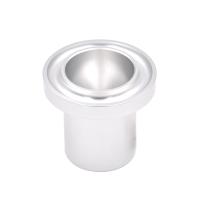
Tu-1 cup is an early equipment used to determine the viscosity of coatings, and has been basically eliminated. Its main technical indicators include a capacity of 50ml, with an inner diameter of Φ51±0.01mm cylinder, the height from the bottom line of the cylinder to the engraved line is 46±0.2mm, the angle of the inner cone is 101º±30', and the length of 14±0.02mm, the inner diameter of the hole is Φ5.6±0.02mm, the material is aluminum. In order to convert the outflow time (t) to kinematic viscosity (v), the formula t = 0.053v + 1.0 can be used.

2. Tu - 4 cups
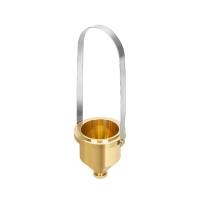
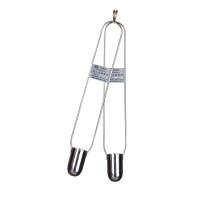
Tu4 Viscosity Cup is a Viscosity Cup designed in accordance with the national standard GB/T1723, there are two kinds of desktop and portable, which can measure the fluid viscosity in the range of 30s to 100s, Tu-4 cup is the upper cylindrical, the lower conical container, the capacity is 100mL, and there is a stainless steel leak nozzle with a standard hole of 4mm at the bottom of the cone, which is why it is called Tu-4 cup. It is widely used in laboratories or production sites in coatings, paints, inks and other industries.

3、ISO outFlow Cup
The ISO outFlow Cup is designed according to ISO 2431-1993 and GB/T 6753.4-98, which is a commonly used tool for testing the viscosity of products in the world, and is used to measure the outflow time of Newtonian or similar Newtonian liquids (outflow time 100 seconds).

Correction of ISO outFlow Cups
The outFlow Cups with different pore sizes have the following correction formula:
3 mm outFlow Cup V = 0. 443 t - (200/ t)
4 mm outFlow Cup V = 1. 37 t - (200/ t)
5 mm outFlow Cup V = 3. 28 t - (200/ t)
6 mm outFlow Cup V = 6. 90 t - (200/ t)
| Filter diameter | Viscosity Range (cst) | Flow Time(s) | type | standard |
| 3mm | 7-42 | 30-100 | Handheld Benchtop | ASTM D512 ISO 2431 |
| 4mm | 34-135 | 25-100 | ||
| 5mm | 91-326 | 25-100 | ||
| 6mm | 188-684 | 25-100 | ||
| 8mm | 600-2000 | 25-100 |
4. JIS Iwata Cup
JIS Iwata Cup is designed according to Japan (JIS) standards, suitable for rapid measurement of the viscosity of the paint to be sprayed on the construction site;
It is widely used in the electronic products and plastic coatings industry.

5. ZAHN Tsaien Cup
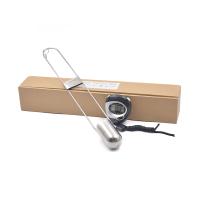
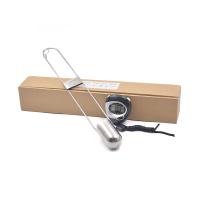
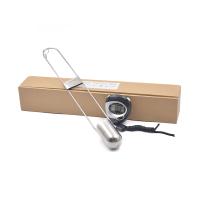
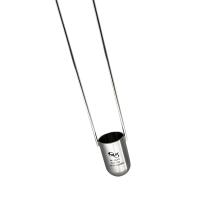
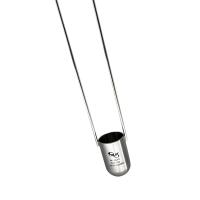
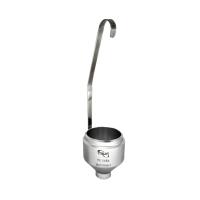
The Tsaien Cup (ASTM) (Chai Cup/ZAHN Cup) is designed to ASTM D4212-93 to measure the viscosity of Newtonian or near-Newtonian liquids. It can be used anywhere on the shop floor, in the factory and in the laboratory, to quickly check and adjust the viscosity of many different fluids.
Filter diameter | Viscosity Range (cst) | Flow Time (sec) | The material of the sample to be tested | type |
2.0mm | Max 60 | 35-80 | Liquids with lower viscosity | Handheld, immersive |
2.7mm | 20-250 | 20-80 | Thin oils with low viscosity, mixed paints, paints | |
3.8mm | 100-800 | 20-80 | Medium viscosity oils, mixed coatings, ceramics | |
4.3mm | 200-1200 | 20-80 | Viscous liquids and mixtures | |
5.3mm | 400-1800 | 20-80 | Viscous liquids and mixtures |

6. Ford Cup
The Ford Cup is United States designed to ASTM D1200 standards. The function and use method are the same as those of other Viscosity Cups.
| FORD number | Filter pore size (mm) | Viscosity Range (cst) | Flow Time(s) | standard |
| Number 1 | 1.9 | 10-35 | 55-100 | ASTM D1200‘FORD’ |
| No. 2 | 2.53 | 25-120 | 40-100 | |
| Number 3 | 3.4 | 49-220 | 30-100 | |
| Number 4 | 4.1 | 70-370 | 30-100 | |
| Number 5 | 5.2 | 200-1200 | 30-100 |

7. DIN cup
| Filter diameter | cup | spouts and their retainers | Flow time | Viscosity range | Meets standards | type |
| 2mm | Titanium anodized aluminum, 100 cc | stainless steel | Approximate to DIN 53211 | Handheld, immersive | ||
| 3mm | ||||||
| 4mm | 25-150sec | 96-683cst | ||||
| 5mm | ||||||
| 6mm | ||||||
| 8mm |

Fourth, operation and maintenance
1. How to use the Viscosity Cup correctly
When using Viscosity Cups, first make sure that the device is clean and free of damage. Pour the liquid to be measured into the Viscosity Cup, noting that the liquid level should reach the specified line. Depending on the type of Viscosity Cup, invert the cup and start the timer, recording the time when the liquid has completely flowed out. To ensure accuracy, operate at a stable ambient temperature and try to avoid air bubbles or other impurities affecting the measurement results. After the measurement is completed, the outflow time is converted to a viscosity value according to the standard formula for subsequent analysis or adjustment.
2. Cleaning and maintenance suggestions
Viscosity cups should be cleaned immediately after each use to prevent residues from interfering with the next measurement. Wash the cups and spouts with a suitable solvent to ensure thorough removal of liquid residues. You can use a brush or soft cloth to wipe gently, but avoid using abrasive materials that can damage the device. After cleaning, the device should be air-dried or wiped dry with a lint-free cloth to avoid moisture residue affecting the measurement accuracy. Regularly inspect the Viscosity Cup for wear or damage to ensure it is in good working order, calibrate or replace parts if necessary.
5. Application examples
Applications in the coatings, paints and inks industry
In the coatings, paints and inks industry, viscosity measurement is a critical part of ensuring product quality. By using equipment such as Zahn cups, Ford cups and ISO outFlow Cups, industry practitioners are able to precisely control the flow of liquids. Proper viscosity helps to achieve a uniform coating, improves ease of application, and reduces defects in the coating during application. For example, Ford #4 Cups can be used to measure higher viscosity paints, while ISO flow-out cups are suitable for lower viscosity liquids, helping to adjust formulations to meet different application needs.
Practical applications in the laboratory and on the production site
Viscosity cups are widely used in the R&D and quality control phases in a laboratory setting. By testing the viscosity of coatings in different formulations and batches, laboratories can evaluate their flowability, drying time, and final performance to ensure that the product meets the technical specifications. At the production site, Viscosity Cups are used to monitor the production process in real time and adjust the recipe in time to cope with possible changes in the production process. Regular viscosity testing helps the production line maintain consistent product quality and improve production efficiency.
6. How to choose?
When choosing a Viscosity Cup, first determine the type that suits you. Common types of Viscosity Cups include Tu-4 cups, Zahn cups, ISO outFlow Cups, Ford cups, etc. Each type is suitable for different viscosity ranges and testing needs, so it is important to choose the right type based on specific liquid properties and industry standards.Consider the shape and material of the Viscosity Cup. Viscosity cups can be handheld or benchtop, depending on the actual usage needs of the laboratory environment or production site. In terms of materials, stainless steel, aluminum and copper materials are commonly used, and it is necessary to choose the appropriate material according to the requirements of the test sample.Also, pay attention to the maximum viscosity value of the Viscosity Cup and the diameter of the flow hole. The maximum viscosity value should match the viscosity range of the liquid to be measured, and the pore diameter should match the fluidity of the liquid. Ensure that the Viscosity Cup selected provides accurate measurements and complies with the relevant test standards and error ranges.