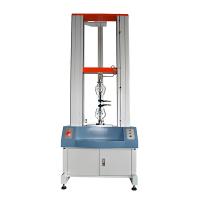
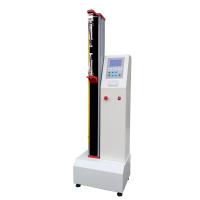
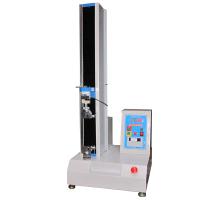
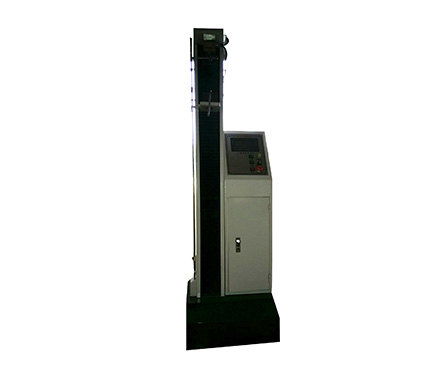
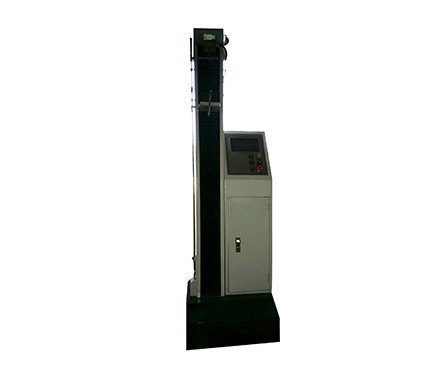
The control of metal stretching speed will affect the yield strength to varying degrees. Too fast or too slow will result in quality problems to a certain extent. So what is the most suitable range to control the stretching rate of the metal? This article studies and understands this content. The WE-60 Tensile Testing Machine has developed a number of grids (0.6 grids to 6 grids/second) that the pointer traverses per unit time, which can solve the problems existing in the old Tensile Testing Machine. rate control problem.
The control of the tensile speed in the tensile test of metal materials is very important. Because the weld deposit metal contains more hydrogen, the stretching speed is too slow, and more "fish eyes" (holes formed by the diffusion and aggregation of hydrogen under the action of stress) will be formed. It will reduce the elongation and area shrinkage of the material; if the stretching speed is too fast, it will increase the yield point σs and tensile strength σb because the hardening cannot be recovered, just like steel. Especially for those materials whose yield point σs (or tensile strength σb) is on the edge of the technical standard, the objectivity of the measured results is not very reliable.
G B228-87 metal tensile test method stipulates: the elastic modulus E of the material is more than or equal to 1. 5×10⁵N/mm2 (the elastic modulus of the general material is E= 19. 6×10⁵~20. 6×10⁵N/mm 2 or more (Elastic modulus E of general material =19. 6 ×10 5 ~ 20. 6 ×10 5 N/mm 2 ), the tensile rate should be controlled at 3N/mm 2 ·s -1 ~30N/mm 2 ·s Between -1. Since the Tensile Testing Machine in our unit is an old-fashioned hydraulic transmission (WE60), the test operation cannot reflect the size of the applied force per unit area and unit time, which brings certain difficulties to the work. After repeated testing and exploration , we use the pointer on the dial of the testing machine to pass the number of grids per unit time (or control the time from adding force to yielding), which meets the test requirements and meets the standards stipulated in GB228-87. Thus solving the problem in actual operation difficulty.
Now introduce as follows:
The yield point σs measured by long-term statistics of a certain material is
360N/mm2
Then: 360N/mm2÷3N/mm2=120 seconds
In the formula: 3N/mm2 is the minimum specified in GB228-87
The force per unit area in a small stretching rate of 3N/mm2s-1.
360N/mm2÷30N/mm2=12 seconds
In the formula: 30N/mm2 is stipulated in GB228-87
Force per unit area at maximum stretch rate.
The test bar is a standard sample of Υ10mm, and the cross-sectional area is 78.54mm2, then the yield force of the sample
Fs=360N/mm2×78.54mm2
=28274N=28.27kN
WE60 type tension machine hangs A weight, and the position corresponding to 28.27kN in the inner ring is 70.7 grids (each small grid in the inner ring is 0.4kN). If the pull test is carried out at a speed of 3N/mm2 s-1,
Then: 70.7 grids ÷ 120 seconds ≈ 0.6 grids/s
If the pull test is carried out at a rate of 30N/mm2 s-1,
Then: 70.7 grids ÷ 12 seconds ≈ 6 grids/s.
To be on the safe side, 3N/mm2·s-1 can be used for actual measurement
The intermediate value of ~30N/mm2·s-1, such as taking: 15N/mm2·s-1 rate,
360N/mm2÷15N/mm2=24 seconds
70.7 grids÷24s≈3 grids/s;
If take 10N/mm2 s-1 rate
360N/mm2÷10N/mm2=36s
70.7 grids÷36s≈2 grids/s
It can be seen that the tensile test is carried out at a rate of 10N/mm2·s-1, which is just in line with the tensile rate 1kgf/mm2·s-1 given by the old standard GB228-76.
Since the specimen is in an elastic state before yielding, its cross-section does not change, so the assumption of this method is feasible. Although the yield point σs is obtained by statistical methods, its reliability is high. It can fully meet the test requirements. Especially when the two extreme rates (3N/mm2·s-1 and 30N/mm2·s-1) are not used, it is more secure. Solve the use of old equipment to meet the requirements of the test tensile rate specified in the technical standards.
The above can also be achieved by recording the force increase and time continuation between the beginning of stretching and yielding, and finding the load per unit area and unit time to meet the tensile stress velocity 3N/mm2°s-1~30N/mm2 s -1 for the request.
Whether the metal stretching rate is too fast or too slow will have different effects on the results. It is a very important issue to control the metal stretching rate. The above are some summaries of the author on the control of metal stretching rate, hoping to provide some references for relevant industry personnel.