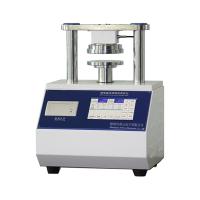
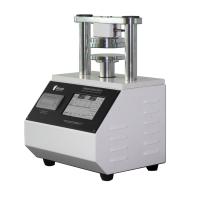
This article introduces the method of determining the annular compressive strength of paper and cardboard, including the definition of the annular compressive strength and the instrumentation required in the process of determining it. The working principle of the instrument, the calibration requirements, specimen preparation and testing procedures, as well as the calculation methods and precautions for the results are explained in detail. This process provides a scientific basis for the evaluation of material properties.
definition
Ring compressive strength
Annular compressive strength refers to the maximum compressive force that an annular specimen can withstand when compressed at the edges. This strength is expressed in kilonewtons per meter (kN/m) and reflects the compressive performance of paper and cardboard under stressful conditions.
Ring compressive strength index
The Ring Compressive Strength Index is the average ring compressive strength value divided by the quantification (unit area or unit weight) of the specimen and is expressed in square meters per gram (m²/g). This index is used to evaluate the strength efficiency of different quantities of materials and helps to compare the performance of materials at the same weight.
instrument
Cutting punch knife
The dimensional accuracy requirements are (152.0±0.2) mm in length and (12.7±0.1) mm in width to ensure that the specifications of the cut specimen meet the standard.
Specimen holder
The inner diameter of the specimen seat should be (49.30±0.05) mm and the groove depth should be (6.35±0.25) mm. The bottom of the groove should be parallel to the wall of the groove, and the wall of the groove should be at a right angle to the bottom of the groove to ensure the stability and fixation of the sample.
Compressor
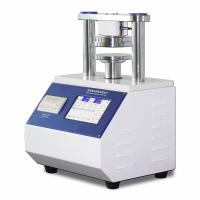
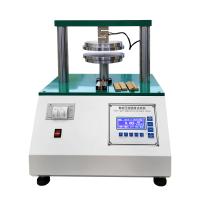
Fixed platen electronic compressor
The running speed is (12.5±2.5) mm/min, the parallelism deviation between the upper and lower pressure plates is not more than 1:2000, and the force measurement accuracy is 1% of the indicated value.
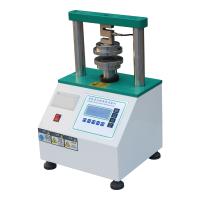
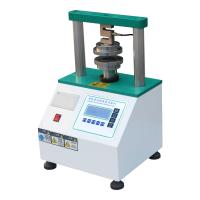
Curved beam compressor
The design principle is based on Hooke's law and the bending deformation theory of the beam, and the upper plate decreases at a rate of (12.5±2.5) mm/min during the test, and the force measurement accuracy is also 1% of the indicated value.
principle
Electronic compressor
The working principle is that the pressure is applied at a specified speed by the lower pressure platen, and the force sensor converts the applied pressure into a voltage signal, which is processed by the circuit and displays the pressure value.
Curved beam compressor
The instrument is based on Hooke's theorem and the theory of bending deformation of beams, the specimen is placed between the upper and lower pressure plates, the pressure on the specimen is determined, and the required compressive force is reflected by the deformation of the spring plate.
Instrument calibration
Parallelism calibration
The distance between the four corners of the upper and lower pressure plates is measured by the inner diameter dial gauge to ensure that the parallelism deviation is not greater than 1:2000 to ensure the accuracy of the test.
Compressor accuracy calibration
Use a pressure calibrator to apply pressure between the upper and lower pressure plates of the compressor, record the indicated values of different test points, and calculate the error to ensure that the calibration error does not exceed ±1%.
Experiment preparation
Sampling is carried out in accordance with the relevant standard methods to ensure the quality and uniformity of the specimens to ensure the reliability of the test results.
Specimens are treated under standard environmental conditions to avoid the effects of temperature and humidity changes on test results.
Specimens are cut with special cutting tools to ensure dimensional accuracy and avoid flashes or other defects during the cutting process.
According to the experimental requirements, longitudinal and transverse specimens are prepared respectively to facilitate the subsequent ring compressive strength test.
Test
Specimen thickness determination
Before testing, select the appropriate inner disc of the specimen holder according to the thickness of the specimen to ensure that the specimen can be placed securely and properly compressed.
Specimen placement
Carefully place the specimen holder in the center of the lower platen, ensuring that the specimen and specimen holder are positioned correctly to avoid errors in the test.
Pressure applied
The instrument is started for testing, the pressure value of the fixed plate electronic compressor is recorded, and the maximum deformation value will be displayed by the bending beam instrument to obtain the ring compressive strength of the specimen.
Repeat the test
To ensure the reliability and accuracy of the data, at least 10 specimens were measured in duplicate in each direction, and sufficient data was collected for statistical analysis.
Result calculation
First, test data is collected in each direction and the average of the longitudinal and transverse forces is calculated, measured in Newtons. This process ensures the representativeness and accuracy of the test results.
According to the force value obtained from the experiment, the ring compressive strength of the specimen is calculated using the corresponding formula to ensure that the calculation process conforms to the standard method to obtain reliable values.
The ring compressive strength index is calculated according to a specific formula, to one decimal place, measured in Newton · meters per gram. This index provides an important basis for evaluating the compressive properties of paper and cardboard.
In conclusion, the determination of ring compressive strength of paper and cardboard is a key part of evaluating the mechanical properties of materials, and through standardized test methods and instruments, it can accurately reflect the compressive capacity of materials in practical applications. Proper instrument use and specimen preparation are the basis for reliable test results, supporting material selection and quality control in industrial applications.