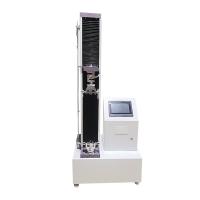
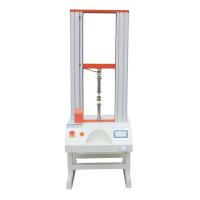
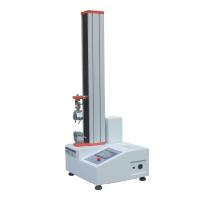
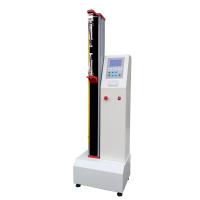
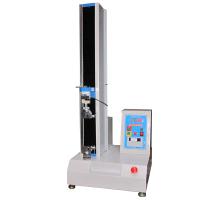
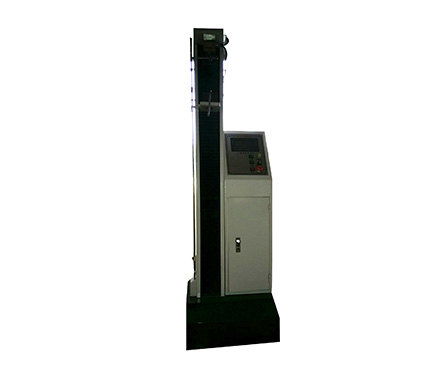
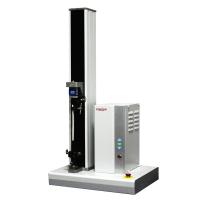
Through the comparison of JJG139-1999 and ASTM E4-03 (method C) standards, it is pointed out that the two standards are equivalent to the multi-functional Tensile Testing Machine in the verification method, and the multi-functional tensile force is used for steel pipes produced according to API Spec 5L standard The test machine provides a theoretical basis for verification.
APISpec5L is one of the general standards for inspecting steel pipes in the world, and its content refers to the standards of the American Society for Testing and Materials (ASTM). In APISpec5L (version 43) 9.10.2.2, it is stipulated: "The Tensile Testing Machine should be calibrated within 15 months before the test according to the ASTME4 "Testing Machine Load Calibration Method" standard." , The verification of the multifunctional Tensile Testing Machine is carried out according to the national measurement standard JJG139-1999, and there is no word ASTM E4 in the verification certificate. In this way, when producing export steel pipes that need to be in line with international standards, the verification results of the equipment may be questioned by users. For this reason, the author studies the verification method of the multifunctional Tensile Testing Machine. The results of the study suggest that JJG139-1999 and ASTME4-03 (method C: verification with elastic calibration device) are equivalent in verification methods.
1. Overview of Standards
The American Society for Testing and Materials (ASTM) standards are mainly formulated for the research on the performance of industrial materials and related technical conditions. More than 50% of American standards come from ASTM. In the ASTM E4-03 standard, there are three methods for the verification of the testing machine: ① verification with standard weights; ② verification with an isometric balance and standard weights; ③ verification with an elastic calibration device. These three methods are selective in practical applications.
The JJG139-1999 standard is promulgated by my country Quality and Technical Supervision Bureau
It is the measurement standard for the verification of the multifunctional Tensile Testing Machine, which is based on the actual situation of the development of testing machines in my country, and is calibrated by standard force measuring instruments. This verification method is similar to the ASTME4 standard (method C), and both belong to the verification of elastic devices.
2 Comparison of the two standards
According to the verification items of the multifunctional Tensile Testing Machine, JJG139-1999 and ASTME4-03 (method C) were compared in the form of comparison, see Table 1.

It can be seen from Table 1 that the two standards are basically the same in terms of test load selection, calibration procedures, error tolerance range, and error calculation methods. ASTME4-03 (method C) has more stringent regulations. It can be seen that these two standards are equivalent in the verification of the multifunctional Tensile Testing Machine.
3 Conclusion
(1) JJG139-1999 and ASTME4-03 methods (method C: use
Elastic Calibration Device Verification) is equivalent, so the multifunctional Tensile Testing Machine calibrated by the JJG139-1999 standard meets the requirements of the APISpec5L (version 43) standard.
(2) It is recommended to carry out classified research on all referenced standards of APISpec5L. For those that are equivalent to national standards, the national standards can be directly used; for standards that are quite different from the national standards, the corresponding standards should be selected according to the actual use.
(3) For those national standards that do not have an equivalent standard, it is recommended to speed up the research and formulation of national standards, speed up the introduction, absorption and adoption of international standards, and make it a relatively complete system.