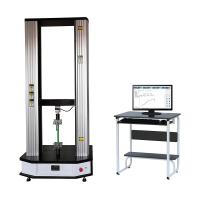
JJG1 57-2008 "Non-metal Tensile, Compression and Multifunctional Testing Machine" verification regulations, its new and old regulations are compared and understood, the new regulations not only have changes in the basis of the writing format, but also have new changes in the technical aspects, as follows:
1. Changes in the scope of application
The new regulations more precisely define non-metallic tensile, compressive and multi-functional testing machines (mainly including small-load material testing machines, micro-force testing machines, and leather, paper, rubber, plastic, fiber and other non-metallic material testing machines). Due to the rapid development of non-metallic materials, the new regulations no longer limit the maximum test force of the testing machine (not greater than 10MN).
For example, the diameter or side length of the rubber bearing manufactured according to the transportation industry standard JT/T4-2004 "Highway Bridge Plate Rubber Bearing" can be greater than 500mm, and the ultimate compressive strength Ru≥70MPa is required. If the side length is equal to 500mm, the ultimate compressive test force can reach 17.5MN and 13.744MN respectively, far exceeding the 10MN test force stipulated in the old regulations.
2. About the overview
The new regulations do not limit the structural form of the testing machine, but increase the requirements for measuring the deformation of the sample and the test operation status for the measurement system. In the new regulations, the test operation status mainly refers to the moving speed of the movable beam, test time, acceleration speed, strain rate, etc. during the test.
3. About measurement performance requirements
1. The level and expression of the testing machine
(1) According to the actual situation that my country does not produce and use level 2 testing machines at present, unlike the old regulations, the new regulations have a little room to keep the level of testing machines to level 2, and do not include level 3 testing machines. The reason is that the international standard still retains two levels of testing machines that are not produced in CHINA, Level 2 and Level 3. The new regulation keeps the level of testing machine to level 2, which not only satisfies the downgrading of the testing machine in the subsequent verification, but also provides a technical basis for the export trade of testing machine manufacturers.
(2) The old regulations express the testing machine of class 0.5 as class 0, and the new regulations express the testing machine of class 0.5 as class 0.5 according to GB/T16825. 1 -2008/ISO7500. 1:2004. This expression is more in line with the thinking habits of domestic readers, and there is no difference in actual content.
2. The discrimination threshold that cannot be underestimated is different from the old regulations. The new regulations list the discrimination threshold index in Article 4.1, which is as important as the relative resolution of the indication value. The main reason is that many testing machine manufacturers have different understanding of the function of this technical index. As a result, some testing machines, especially electronic non-metallic tensile, compressive and multifunctional testing machines, can only be tested under the condition of entering the test mode. test value. When the test mode is not entered, the zero indication value displayed at zero test force has no drift, change or sensitivity, which is completely an illusion; although the zero point display is very good, it cannot reflect the real situation of the testing machine’s measurement system. Therefore, the test results are credible only if the testing machine that meets the requirements of relative resolution and discrimination threshold is used.
3. Deformation measurement system
(1) Determination and reasons for indicators
① In the old regulations, when measuring the deformation of the sample by using the change of the distance between the end faces of the gripper, there are no specific technical indicators for the positioning and reset of the distance and the metrological performance requirements of the deformation measurement device, only the verification method and calculation formula. It brings inconvenience to the implementation of testing machine verification personnel.
② This situation was noticed during the revision of the new regulations, and some industry regulations and standards related to testing machines for non-metallic materials were retrieved. It is found that when measuring the deformation of the sample by using the change of the distance between the end faces of the gripper, the positioning and reset of the distance and the metrological performance requirements of the deformation measuring device have been stipulated in the verification regulations of JJG (Light Industry) 58.1-2000 "Pendulum Type Paper Tensile Testing Machine", JJG (Light Industry) 115-2000 "Carton Compression Testing Machine" has been refined and applied in the verification regulations. It can be seen that the technical requirements of the old regulations are scientific and reasonable. These requirements have been quantified under the in-depth research of relevant technical personnel in industry units, providing valuable basic materials for the revision of the new regulations.
③ According to relevant test method standards, in addition to using non-contact extensometer, the device for measuring sample deformation can also have two forms: using chuck spacing and contacting extensometer. At the same time, for the same material, no matter which method is used to test, the measurement results should be consistent. Therefore, under the condition of complying with the relevant requirements of the JJG762-2007 "Extensometer" verification regulations, the new regulations use the rationality of the requirements and the scientificity of the indicators to formulate the technical indicators for measuring the deformation of the sample using the chuck distance and make them consistent. , is not only scientific and reasonable, but also realistic and feasible.
(2) Measure the deformation of the sample by using the change of the distance between the end faces of the gripper
① Corresponding to JJG762-2007, the distance between the end faces of the gripper is equal to the gauge length of the extensometer, and the distance error is equal to the gauge length error of the extensometer; It is equivalent to the deformation indication error of the extensometer. Although the names of the indicators are different, the meanings are actually the same. The reset error is required to ensure the consistency of the gauge length during a large number of tests. Re-clamping the flat metal strip when verifying the distance is equivalent to reinstalling the extensometer every time. Therefore, the new regulations no longer involve reset alone. error indicator.
② Unlike JJG762-2007, which has both absolute error index and relative error index and requires a larger value, under the condition that the technical level can meet the requirement of relative error index in the new regulations, the test results are more comparable.
③ Since the division value of the deformed scale is mostly 1mm, rarely 0.5mm or below, the resolution that can be reliably estimated is not less than 0.2mm. When the electronic testing machine uses the chuck to measure the deformation of the sample, most of the sensors are used, and its graduation value can easily reach 0.01mm, and its relative resolution index can be achieved. Therefore, the new regulation does not distinguish whether the testing machine is mechanical or electronic, but puts forward technical requirements according to the level that the deformation measuring device should reach.
(3) Using an extensometer to measure the deformation of the sample
① Unlike the old regulations, only the number of JJG762-1992 is quoted in Article 6.3. The new regulations incorporate the technical indicators and requirements in JJG762-2007 into Article 4.2.2.
② Because in the catalog of measuring instruments newly released by the AQSIQ, the name of the extensometer originally classified in the mechanical category has also been simplified, which means that the production of extensometers does not need to apply for new products of measuring instruments Type evaluation. At the same time, because the function of the extensometer is to combine the force value detection of the testing machine to obtain the mechanical properties (such as strain, elastic modulus, etc.) .
③ For a testing machine, the function of the extensometer to measure deformation is the same as that of test force measurement, acceleration speed measurement, moving speed measurement, time measurement, etc. It is only a function of the testing machine. The new regulations clarify that the extensometer is One of the many additional functions of the testing machine is a part of the verification content of the testing machine. There is no reason and no need to make the check separately from other functions. At the same time, in order to avoid the illusion that the extensometer has independent national standards and verification procedures (GB/T12160-2002 "Calibration of Extensometers for Uniaxial Tests" and JJG762-2007), the new regulations will JJG762- It is appropriate to include the technical requirements and standards requirements in 2007.
④ It should be noted that the accuracy level of the testing machine has no correlation with the level of the extensometer, and the user can select and configure the extensometer of the required level and range according to the test object and test purpose.
4. General Technical Requirements
1. Retained original technical requirements
The content of the general technical requirements of the new regulation is partly written according to the content of the technical requirements of the old regulation, but the technical requirements of afterburning speed, moving speed, pulling coaxiality and other technical requirements have been quantified.
2. Deleted inspection items
The inspection of calibration value drift items of electronic non-metallic tension, compression and multi-function testing machine force measuring devices has been deleted in the old regulations. According to the current level of technological development, for the test machine, the inspection of this item is neither meaningful nor operable.
3. Newly added inspection items
(1) The new regulations add the provisions on peak function and force direction.
① Especially when the peak hold function is linked with the test program, if it cannot be released and there is no measurement program, it will cause great difficulty in the force value verification of the testing machine. Therefore, it is specially proposed that the test force peak hold function can be activated and released separately for convenience. Test and Metrology Verification.
② Considering that the reading of the standard dynamometer shall prevail and the indication value can be displayed when the reading of the digital indicating device of the testing machine is a positive error, it is necessary to increase the display upper limit of at least 3% of the maximum value. Similarly, if the "-" symbol cannot be displayed or the value less than zero cannot be displayed, the consequence is equivalent to the inability to clear the negative value to zero, which can directly affect the correctness of the measurement result.
(2) The inspection of the adhesion force of the contact-type large-deformation extensometer is added. In the latex film test, the influence of the adhesion force of the large-deformation extensometer on the tensile results of the sample is very significant and needs to be paid attention to.
4. Although the new regulations stipulate the technical index of the tensile coaxiality of the testing machine, it should be noted that the coaxiality index is related to the specification of the testing machine, the structure of the chuck and the inspection method, and has nothing to do with the accuracy level of the testing machine.
5. Verification method
The acceleration speed or strain rate can be checked by combining a timer with a dynamometer or a measuring tool, or a special instrument with the functions of timing, force measurement and length measurement after passing the examination can be used to verify the acceleration of the testing machine. Force velocity or stress rate, deformation velocity or strain rate, and movable beam moving speed and other indicators.
6. Test result processing
According to the requirements of the new regulations, a test machine that passes the test will be issued a test certificate, and a test machine that fails or has been adjusted for two consecutive test cycles will be issued a test result notice and indicate the unqualified items. When implementing the new regulations, please note the following points:
1. A verification certificate will be issued to the testing machine and supporting deformation measurement system that have been verified for the first time.
2. If the testing machine and supporting deformation measurement system for subsequent verification cannot reach the original level, it can be downgraded and issued a verification certificate according to the requirements specified by the user and the test method, but it must be noted in the conclusion that "downgrade to X level, Qualified." The verification conclusion of the matching deformation measurement system is placed on the inner page of the verification certificate.
3. If the testing machine is unqualified in the verification or the deformation measuring device that needs to be used in conjunction with the testing machine is unqualified, a certificate of verification result notification will be issued and the unqualified items will be indicated.
4. According to JJG762-2007, according to the verification results, a verification certificate or a verification result notification can be issued to the extensometer that can be used independently.
5. The scope of use of the testing machine and supporting deformation measurement system is the scope that has passed the metrological verification, and the scope that has not passed the verification cannot be used.