In the pharmaceutical industry, the quality control of licorice extract is crucial, especially its viscosity index, which is directly related to the quality and effectiveness of the drug and the ease of operation during processing. Viscosity, as an important characterization of material fluidity, has an important impact on the production, storage and use of licorice extract. Therefore, the viscosity detection of licorice extract is of great significance in quality control.
The basic properties of licorice extract and the importance of viscosity
Licorice extract is a concentrate extracted from licorice rhizomes through solvents such as water or ethanol, and is rich in active ingredients. The viscosity of licorice extract is an important manifestation of its rheological properties, which reflects the internal friction of the solution as it flows. The viscosity is closely related to the concentration, temperature, solvent type and molecular structure of the extract.
The viscosity of licorice extract directly affects its workability in the pharmaceutical process and the stability of the final product. Specifically, viscosity has an important impact on the following aspects:
1) Mobility and ease of use. Higher viscosity may cause poor fluidity of licorice extract during production, packaging, transportation and use, which is not convenient for processing and transportation; Conversely, a viscosity that is too low may result in inaccurate product concentration and even affect the efficacy of the drug.
2)Storage stability. Changes in viscosity are often a precursor to changes in the quality of licorice extracts. For example, an increase in viscosity may be a sign of reduced solubility or aggregation of components, which can lead to precipitation or turbidity, affecting the storage stability of the extract.
3)Consistency of the formulation. The viscosity stability of the licorice extract determines the quality of the final pharmaceutical formulation. For example, in the preparation of liquid formulations such as licorice oral liquid and licorice mixture, viscosity is an important parameter in the formulation, and too high or too low will affect the uniformity of the preparation and the patient's experience.

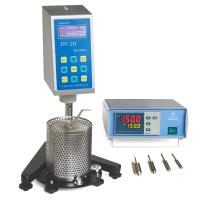
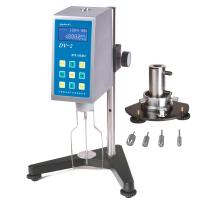
A viscometer for viscosity testing of licorice extract
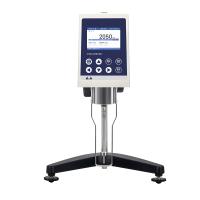
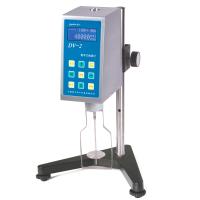
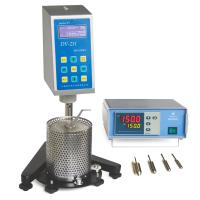
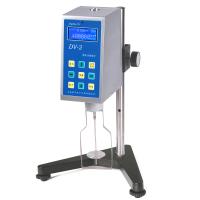
Viscosity is an important parameter that reflects the fluidity of liquids, so accurate viscosity testing is not only key to ensuring the quality of licorice extracts, but also can effectively improve production efficiency and reduce product rejection rates. In industrial production, viscosity control is generally achieved by selecting appropriate testing methods to ensure that the product meets the specified quality standards. The common test method is the rotameter test, and according to the properties of licorice extract, the RVDV-2 digital display Rotational Viscometer is selected for testing.
RVDV-2 Rotational Viscometer is a high-precision, fully automatic liquid viscosity testing instrument. It adopts 16-bit microcomputer processor core control circuit and stepper motor high subdivision drive, with the function of stepless speed change, and the speed range is 0.1~200 rpm. The equipment can accurately measure the viscous resistance and dynamic viscosity of liquids, and is widely used in oils, paints, food, chemicals, pharmaceuticals and other fields.

Key features of the viscometer include:
The measurement range is 40~40,000,000 millipa·second (mPa·s), which is suitable for viscosity detection of a variety of liquids.
The measurement accuracy is ±1 % (FS), which provides highly accurate viscosity data.
The rotational speed range is adjustable and can be measured under different rheological conditions.
The LCD screen of the equipment can display viscosity, shear rate, shear stress, speed, temperature and other parameters, and the operation is intuitive and convenient.
Optional thermostat heater and data acquisition software support temperature control and automatic data analysis.
Due to its high accuracy and wide measuring range, the RVDV-2 viscometer is a reliable tool for measuring the viscosity of a wide range of fluids, especially high-viscosity and non-Newtonian fluids such as licorice extract.
Viscosity test experiment of licorice extract
2.1 Preparation of experimental samples
In this experiment, licorice extract was selected as the test sample, and its viscosity change at different temperatures was measured. The experimental procedure is as follows:
1) Weigh 120g of licorice extract sample, add 30mL of hot water at 100°C, and stir thoroughly. It was observed that after the sample was dissolved, the volume of liquid was small, and 120g of licorice extract needed to be added again, and 30mL of hot water at 100°C should be added, and stirred again. Make sure that the sample is sufficiently dissolved and that it is in a homogeneous state.
2) Place the licorice extract solution in a thermostatic bath, preliminarily set the thermostatic temperature to 85 °C, and keep it for about 30 minutes. The purpose of this step is to allow the sample to reach thermal equilibrium at a lower temperature, ensuring that the solution is stable.
3) Continue to increase the temperature of the thermostat to 95 °C for 120 minutes. Through this process, the viscosity change of licorice extract at high temperature conditions can be simulated, reflecting the response of its rheological properties at different temperatures.
2.2 Device Operation
The operation process of the RVDV-2 Rotational Viscometer is relatively simple, but attention to detail is required:
1) Set the rotation speed: select the appropriate rotation speed according to the viscosity range of licorice extract. Since licorice extract is a highly viscous liquid, it is recommended to choose a lower speed (e.g. 10~20 rpm) to ensure measurement stability.
2) Select the appropriate rotor: According to the viscosity value of the sample, select the appropriate rotor for measurement. In general, licorice extract has a high viscosity and it is recommended to test with a standard rotor (e.g. Rotor 4 or Rotor 5).
3) Measurement: Pour the dissolved licorice extract solution into the sample cup to ensure that the liquid is highly suitable for rotor operation. Start the viscometer and observe the data displayed on the LCD screen, including viscosity, shear stress, rotational speed, etc.
4) Data recording: During the experiment, the LCD screen will display real-time data, including viscosity value, shear rate, shear stress, etc. at the current speed. Experimental data can be saved via the device's built-in storage function, or further analysis can be performed by connecting to a computer using data acquisition software.
2.3 Data analysis and process control
During the viscosity test of licorice extract, the experimental data showed a trend of viscosity as a function of temperature. During the experiment, it was observed that crusts formed on the surface of the licorice extract due to incomplete dissolution, resulting in fluctuations in the measurement results. In order to ensure the accuracy of the test data, it is necessary to stir the sample well before measurement to remove surface crusts.
In experiments, measurements over a short period of time will yield more consistent results, while if the crust on the surface of the sample is not removed in time, the viscosity data will fluctuate significantly as the crust breaks. In this case, special attention needs to be paid to the continuity of the testing process to ensure that the measurement is completed in a short time and to avoid erratic results.
III. Conclusion
The RVDV-2 Rotational Viscometer provides an efficient and accurate technical means for viscosity detection of licorice extract. Through the analysis of experimental data, it was found that the viscosity of licorice extract was greatly affected by temperature, and the viscosity gradually decreased with the increase of temperature. It was noted in the experiment that the presence of crusts on the surface of the sample could cause data fluctuations, so sufficient agitation was required before testing to ensure the accuracy of the measurement results.