With the wide application of surface film technology, it has become an important trend for materials to improve their surface properties through film layers. However, the performance of the film depends to a large extent on its bonding strength and load-bearing capacity with the substrate, especially in the application of micron-scale films, the interface bond between the film and the substrate becomes the key to evaluate the performance of the film. Although traditional test methods, such as the AE monitoring scratch method, can provide some information for the bond/base bonding strength, they are mainly based on quasi-static experiments, which are easily affected by factors such as film thickness and film base hardness differences, and the criterion is easily disturbed by errors.
Therefore, researchers have proposed a test method for dynamic condition simulation, combined with a comprehensive analysis of mechanical and energy changes, to improve the test accuracy and practicability. As a dynamic testing device, the single pendulum impact scratch meter can provide a more accurate evaluation of the film/substrate bonding performance by capturing the changes in force and energy during the scratching process.
Experimental principles and methods
Experimental principle

The basic principle of the single pendulum impact scratch meter is to use the principle of single pendulum motion, carry the scratch head on the surface of the sample, and record the dynamic changes of tangential force, normal force and energy loss in the process of scratching. In the process of scratching, the film undergoes elastic deformation, plastic deformation and brittle fracture, and as the scratch continues, the film layer gradually penetrates and touches the substrate, forming an interface damage between the film and the substrate. Changes in force and energy manifest as abrupt changes in this process, reflecting the strength of the bond between the film and the substrate.
Specifically, the tangential force reflects the slip and ploughing of the slash on the film and substrate. The energy loss includes friction energy, plasticization energy and interface failure energy, all of which provide an intuitive basis for evaluating the bonding performance of the film/substrate.
Experimental equipment
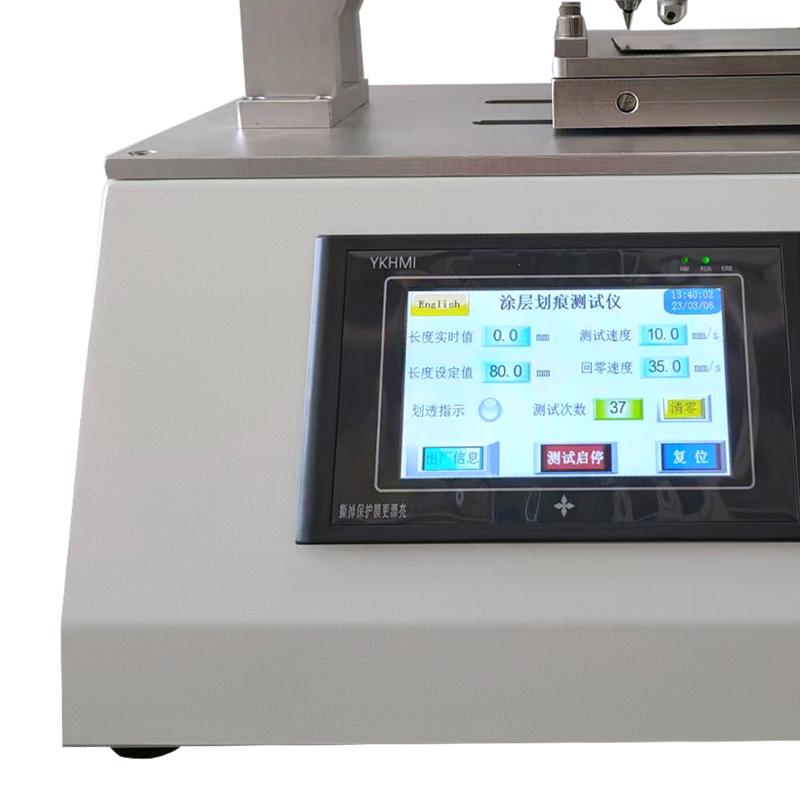
The single-pendulum impact scratch gauge used in this experiment is equipped with a carbide blade and the height of the sample stage is adjustable to ensure accurate monitoring of scratch depth and displacement. The data logging system records changes in force and energy synchronously for further analysis.
Sample preparation
The substrates used in the experiment were high-speed steel (HSS) and stainless steel (SS), and TiN layers of different thicknesses were prepared by hollow cathode ion plating (HCD) and magnetron reaction sputtering (MRS). All samples are finely polished to ensure that the surface roughness is controlled below 0.5 microns.
Experimental results and analysis
Scratch characteristics of the film
In the experiment, it was found that the scratch behavior of the film/base system was significantly different from that of a single material when the scratch length increased. When the film layer is penetrated and the substrate is exposed, there is a significant abrupt change in tangential force and energy loss. This indicates that the interface between the coating and the substrate has been damaged, especially after the coating has been broken, and the abrupt changes in force and energy further prove this phenomenon.
In the impermeable stage, the normal force reflects the resistance of the film to the slashing head, while the tangential force is affected by the plasticization and slip of the film. When the membrane penetrates, the tangential force and energy loss increase significantly, and the energy loss includes not only the fracture energy of the film, but also the failure energy of the interface between the film and the substrate.
Presentation of the criterion
Critical Normal Force - By observing the abrupt change point of the tangential force when the coating is broken, the corresponding normal force value is defined as the critical normal force. The critical normal force can be used to characterize the load-bearing capacity of a membrane/base system. The experimental results show that the critical normal force increases with the increase of film thickness, which is consistent with the results of the traditional acoustic emission method, but is less affected by the fracture interference in the scratch.
Energy per unit length – The energy consumption per unit length when permeabilizing the membrane is calculated to reflect the bonding strength of the membrane/substrate interface. The difference in energy consumption of the coating layer under different membrane preparation processes further verifies the reliability of this criterion.
conclusion
The single pendulum impact scratch method is a film/substrate bonding performance evaluation method based on dynamic working condition simulation, which can analyze the failure behavior of the film layer from the perspective of mechanics and energy at the same time.The critical normal force and energy consumption per unit length can be used as criteria to characterize the bearing capacity and binding strength of the membrane/base system, respectively.Compared with the traditional static test method, this method has higher sensitivity and wide applicability, which provides new technical support for the study of membrane/base interface tribology.
