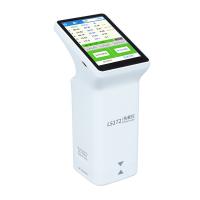
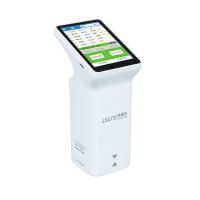
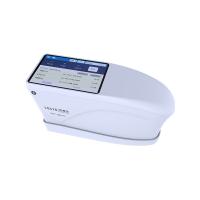
In recent years, with the rapid development of the domestic paint market, the Colorimeter has gradually become a key tool in the production of coatings. Through the accurate detection and management of color, Colorimeters play an important role in improving product quality and reducing production errors. The introduction of advanced Colorimeter equipment from international brands such as Hunter Lab, Minolta and BYK-Gardner has brought standardized testing technology and significant economic benefits to the domestic coating industry. For example, Shanghai Zhenhua Paint Factory first introduced Colorimeters for product quality control in the late 80s of the 20th century, and has continued to update its equipment since then to maintain the competitiveness of the industry.
The basics of color
Three major features
Color is a visual phenomenon formed by the human eye after light is absorbed and reflected by the surface of an object.
Hue - used to distinguish color types, such as red, yellow, green, etc.;
Value, which indicates the brightness of the color, from light to dark;
Chroma - A measure of the purity and saturation of a color, the stronger the monochromacy, the higher the chromacity.
These properties of color are crucial in the production of coatings, as they affect the appearance of the product and its adaptability to the environment.
The human eye observes the influencing factors of color
The influence of light sources
The formation of color is highly dependent on the conditions of the light source. The same paint sample may display different colors under natural light, fluorescent light, or incandescent light. Coatings companies often utilize standard light source light boxes or Colorimeters to ensure uniform and comparable measurement results. Especially when it comes to color matching at night, the role of standard light source light boxes is particularly important.
Environment and the Theory of Opposing Colors
The color of the surrounding environment can interfere with the perception of color by the human eye. For example, when looking at a white object after observing a pattern of red, yellow, and black, the eye will temporarily perceive green and blue. This is the role of the opposing color theory, which illustrates the significant influence of ambient light and observation conditions on color perception.
The human factor
The sensitivity of the human eye to color varies from person to person. The judgment of the same observer in different states of mind will also be different, so relying on the human eye to observe is easy to cause errors. The introduction of Colorimeters effectively reduces this subjective bias.
The technical principle of the Colorimeter
Geometry and measurement
The structure of the Colorimeter determines its applicable scenario
Directional Colorimeter (0°/45° or 45°/0°) – The light is at a fixed angle to the sample, designed to mimic the way the human eye sees, making it suitable for quality control.
Integrating Sphere Colorimeter - Irradiates the sample with diffuse light, ignoring the effect of surface properties and gloss on color, and is commonly used for pigment dye detection and computer color matching.
A quantitative representation of the color
Colorimeters use different chromaticity spaces to digitize colors, such as CIE L\*a\*b\* and Hunter L, a, b. Although the two are based on the same principle, the calculation formulas are different and the measurement results are not interchangeable. In practice, operators need to make a strict distinction between the two methods to avoid measurement errors due to misuse.
The choice of light source
Colorimeters typically use a D65 light source (simulated daylight) for outdoor paint inspection, or an A light source (tungsten lamp) for indoor paint inspection. The choice of light source should be adjusted according to the use scenario of the coating and customer needs, and ensure the consistency of test conditions.
Application in actual production
Build a color database
By measuring pigment and sample data with a Colorimeter, coating companies can establish a standard color database. This data is used in production for formulation guidance and quality verification to ensure color consistency from batch to batch.
Toning and color matching
The Colorimeter is combined with a computerized color matching system to quickly generate a color scheme and adjust the color. By accurately measuring the L, a, and b values, it is possible to control the ΔE (color difference value) within a reasonable range, e.g. within 1 for ordinary paints and 0.5 for demanding paints.
The effect of surface characteristics and gloss
The gloss and flatness of the paint surface can significantly affect color perception. The higher the gloss, the flatter the surface and the stronger the reflected light. For example, when measuring high-gloss and matte coatings, the sensitivity of the Colorimeter to ΔE showed a significant difference. Therefore, it is necessary to select the appropriate instrument type in production and optimize the measurement conditions according to the actual application.
Measurement of special pigments
Metallic pigments (e.g., aluminum, copper) and pearlescent pigments are difficult to measure with a common Colorimeter due to their unique optical properties. The three-view Spectrophotometer can more accurately capture the color performance of these pigments by simulating different angles of observation, and is widely used in the field of high-end coatings.
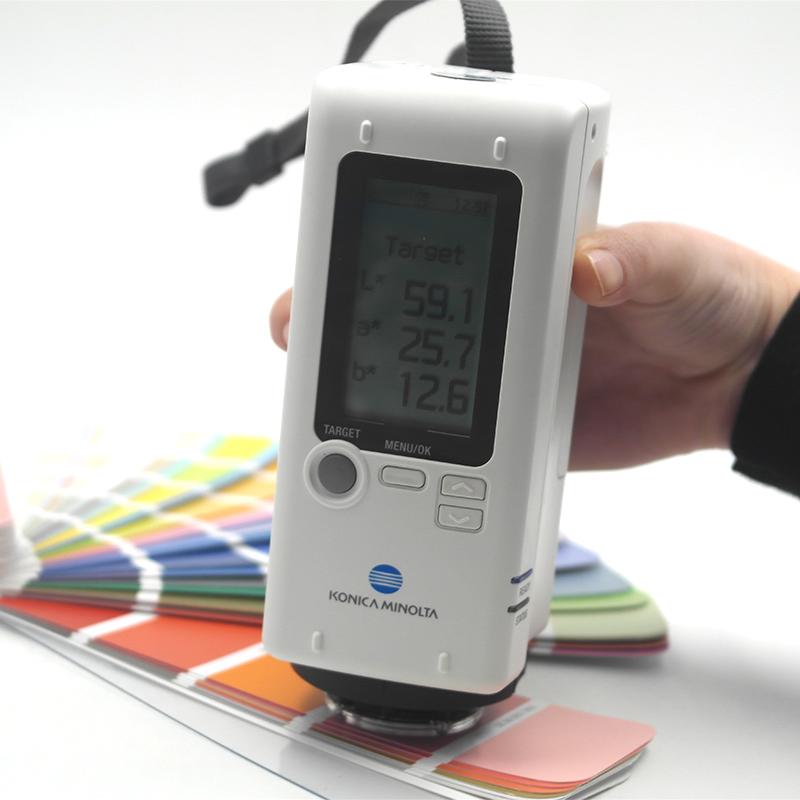
Use of portable Colorimeters
The portable Colorimeter is highly portable and suitable for production line inspection and customer communication scenarios. However, compared to stationary instruments, their long-term stability and measurement accuracy are relatively low, and regular calibration is required to ensure the reliability of measurement results.
Prospects for the future
With the development of Internet technology, Colorimeter is developing in the direction of intelligence and networking. By building an online color management system, coatings companies can realize remote measurement and data sharing, accelerating communication and collaboration between factories and customers. This method not only saves time and costs, but also significantly improves the efficiency and market competitiveness of coating production.
epilogue
The wide range of Colorimeters has led to more accurate color management and quality control in the coatings industry. In the future, with the continuous progress of technology and the intelligent development of equipment, the Colorimeter will show its potential in more fields and inject new impetus into the innovation and development of the coating industry.