Paint film adhesion refers to the degree of firmness of the paint film and the surface of the coated object through physical and chemical forces. It is one of the important indicators to measure the performance of the paint film, which is directly related to the quality and service life of the coating. Good adhesion is the basis for the paint film to play a protective and decorative role, and insufficient adhesion may cause the coating to peel off and lose its proper function. Therefore, the determination of paint film adhesion is of great significance for the research and development, production and application of coatings.
Adhesion mechanism of paint film
The adhesion mechanism of paint film mainly includes two ways: mechanical adhesion and chemical adhesion. The mechanical adhesion depends on the properties of the coated sheet and the mechanical strength of the resulting varnish. When the paint liquid is applied to a substrate with an uneven surface, the paint can penetrate into the pores and cracks of the substrate and form a "nail"-like structure after curing, thereby enhancing adhesion. For example, the mechanical adhesion effect is noticeable on wood, sandblasted or mechanically sanded metal surfaces. Chemical adhesion refers to the mutual attraction of paint film molecules and sheet molecules at the interface between the paint film and the plate, which depends on the physical and chemical properties between the paint film and the plate. It is generally believed that the adhesion of the paint film depends on the interaction between the polar groups of the polymer (e.g., -OH, -COOH) in the film-forming substance and the polar groups on the surface of the coated object. For example, the hydroxyl group in the paint film can hydrogen bond with the hydroxyl group on the metal surface, thereby enhancing adhesion. However, any factors that reduce this polar bonding, such as contamination and moisture on the surface of the coated object, or large shrinkage stress on the coating film itself, as well as the amount of polar groups consumed by the polymer cross-linking with each other during the curing process, will result in a decrease in the adhesion of the paint film.
Paint film adhesion test standard
At present, CHINA's current effective paint film adhesion test standards mainly include the following three
GB/T 1720-1979 (2020)
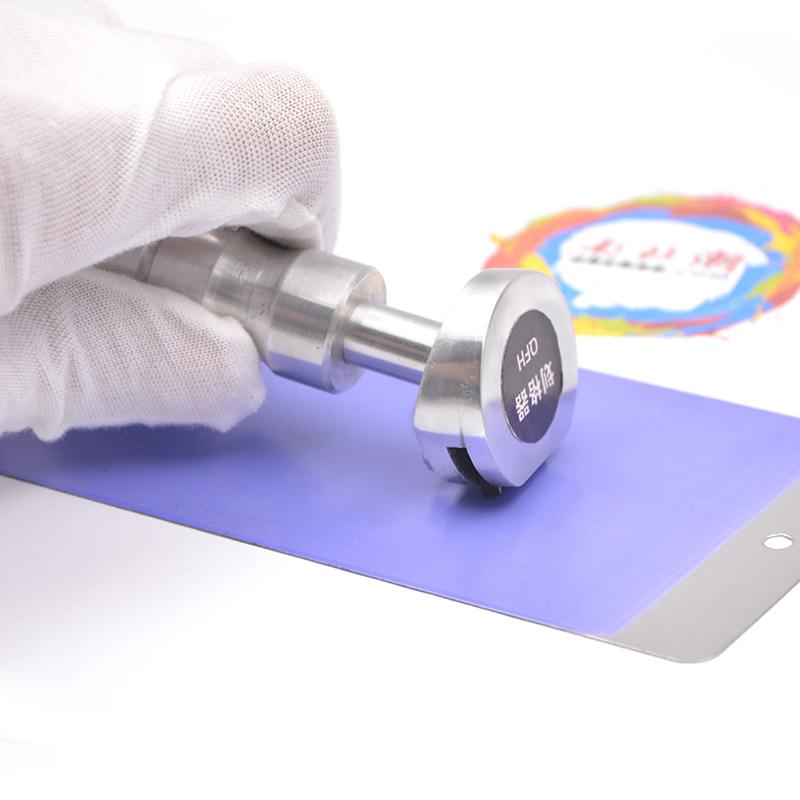
This standard uses the circular method to determine the adhesion of the paint film. The test principle is to fix the sample on a platform that can be moved back and forth, and while the platform moves, the stylus used as a circle movement can cut through the paint film and draw the lines of overlapping rolling lines. By observing the position of the paint film failure in the circular rolling line pattern, the level of adhesion can be judged. The advantages of this method are that it is easy to operate and the evaluation method is intuitive, so it is widely used. However, it is an indirect measurement method, and the measured adhesion includes not only the adhesion itself, but also the resistance of the paint film to deformation and destruction. Therefore, although this method is quick and simple, the accuracy of its test results is relatively low, and it is suitable for the adhesion determination of a variety of individual coatings, and has a wide range of applications.
GB/T 9286-1998
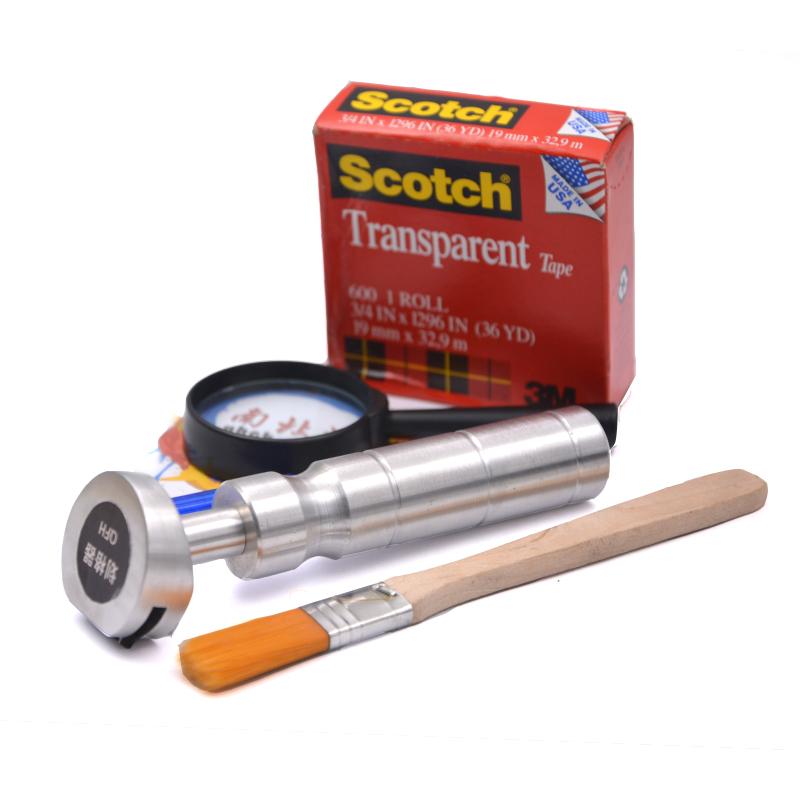
This standard uses the scratch method to determine the adhesion of the paint film. The test principle is that according to the thickness of the sample substrate and the paint film, the paint film is cut by grid cutters with different spacing, so that it can just penetrate to the substrate. The level of adhesion is then determined by looking at the area where the paint film comes off the substrate in the scratch area. This method is relatively simple to operate, suitable for use in the field, and the results are intuitive and can be used in a wide range of applications. However, since this method is only a qualitative evaluation and does not provide accurate adhesion values, it is not suitable for situations where accurate data is required. In addition, although this method can be used for the determination of multi-coat, it is generally used to determine the adhesion of a single coat because it is not easy to determine whether it is interlayer adhesion or the adhesion between the coating and the substrate. Its scope of application is mainly for paint films with a thickness of less than 250 μm.
GB/T 5210-2006
This standard uses the pull-up method to determine the adhesion of the paint film. The test principle is to apply a vertical and uniform tensile force on the cemented surface of the specimen at a specified speed to determine the force required for adhesion failure between coatings or between coatings and substrates, expressed in MPa. The advantage of this method is that it can directly measure the adhesion and accurately represent the adhesion of the paint film with data, so it is suitable for applications that require accurate data. However, this method is a complex testing process that requires waiting for the adhesive to fully cure before it can be tested, so it is not as quick and easy as the circle and grid methods. It has a wide range of applications and is suitable for the adhesion determination of thicker coatings (e.g. putty), both for single and multiple coatings, especially when determining interlaminar adhesion.
Comparison of the three methods
| Standard number | Test environmental conditions | Main instruments | Main material | substrate | Pay attention to the main points | Scope of application | merit | shortcoming |
| GB/T 1720-1979 | Temperature(23±2)°C,Relative humidity(50±5)% | Adhesion Tester | stylus | Tinplate | The stylus must be sharp and replaced in a timely manner; The standard swing radius meets the requirements | A variety of single coatings | It is quick and easy to operate and can be used in a wide range of applications | Indirect measurement of the resistance of the paint film to deformation and destruction |
| GB/T 9286-1998 | - | Scratcher | adhesive tape | soft substrates (wood, plastic); Hard substrate (steel plate, tinplate) | Select the scribing spacing according to the thickness of the paint film; The tape is applied, peeled off at an angle and time according to the standard | Paint film with a thickness of less than 250 μm | The operation is simple and the results are intuitive | Cannot provide accurate data and is not suitable for thicker coatings or multi-coat systems |
| GB/T 5210-2006 | - | Tensile testing machine | Test columns, adhesives | Steel plate, asbestos cement board | Choosing the right adhesive; The paint film and spilled adhesive around the test column should be removed | Thicker coatings (e.g. putty) | Direct measurement method to indicate adhesion with data | The testing process is complex and requires waiting for the adhesive to cure |
summary
The methods for measuring paint film adhesion have their own advantages and disadvantages, and the results of the three methods are independent of each other, and there is no conversion relationship. In practical applications, the appropriate test method should be selected according to the type of coating, the nature of the substrate and the test requirements. For occasions that require quick and easy testing, you can choose the circle method or the grid method; For situations where precise data is required, the pull-off rule is more applicable.
