In this paper, the control and detection methods of ink gloss, as well as the control and detection technology of ink fixation speed, are discussed in depth. Ink gloss is one of the key indicators of print quality, which is affected by factors such as ink film leveling, reflectivity, surface flatness and substrate gloss.

Control of ink gloss
Ink gloss refers to the gloss of ink printing on the substrate after forming an ink film.
Leveling of ink film - Inks with good leveling can form a smooth, uniform ink film, which improves gloss.
The ability of the ink film to reflect light – the flatter the surface of the ink film, the stronger the ability to reflect light and the higher the gloss.
Flatness of the ink film surface – the smoother the ink film surface, the higher the gloss.
Glossiness of the substrate – The gloss of the substrate itself also affects the glossiness of the ink.
Ways to improve the gloss of inks
Increase the ink film thickness——By controlling the printing pressure and ink volume, more ink is left on the surface of the substrate to form a thicker ink film.
Optimize ink formulations
Choose a resin with low permeability and good leveling.
Use pigments and fillers with fine particle sizes.
Add an appropriate amount of leveling agent to improve the leveling performance of the ink.
Choose the right gloss ink- When curing UV inks, almost all solvents (active monomers) are involved in film formation, so the gloss is higher.
Detection of ink gloss
The gloss of the ink is usually detected by using a photoelectric gloss meter, which evaluates the gloss of the ink by measuring the ratio of the reflected light measurement of the specimen to the standard surface.
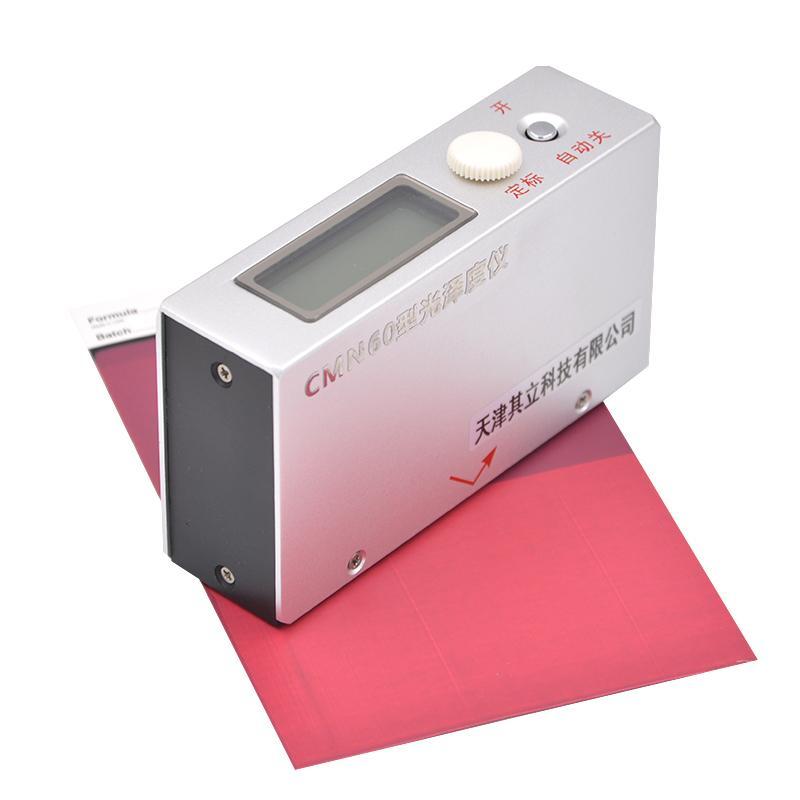
Determination of Gloss of Offset and Lead Printing Inks (QB578-83)
Test principle: Using the DFH-80 photoelectric gloss meter, the ratio of the reflected light metric between the specimen and the standard surface is measured under the illumination of a specific light source.
Inspection steps
1. Make ink samples: Make printing samples by printing suitability meter or small hand-cranked proofing machine.
2. Preheat the instrument: Turn on the power and preheat for 10 minutes.
3. Zeroing and calibration: Place the measuring head on the standard plate and adjust the instrument to point the pointer to the standard value.
4. Measure the printing sample: select three points to measure on the printing sample, and take the average value as the gloss of the ink.
Precautions
Use the same standard paper to avoid data bias.
The sample should be dried for 24 hours before measurement.
The position of the measuring head bulb cannot be changed at will, and the replacement bulb needs to be operated according to the manual.
Gloss test of gravure plastic ink (GB/T13217.2-91)
Test principle: Use a photoelectric gloss meter to measure the ratio of the reflected light to the standard surface.
Instruments & Materials
Low-density polyethylene film, black liner paper, scrubbing solvent (ethanol or gasoline).
KGZ-1 mirror gloss meter (60° angle), glass rod, wire rod, etc.
Inspection steps
1. Make a printing sample: Scrape the ink on the low-density polyethylene film and measure it after 2 hours.
2. Measure gloss: Place the gloss meter probe on the sample and read the data.
3. Calculate the average value: select the upper, middle and lower three points on the printing sample to measure, and take the average value as the gloss.
Control and detection of ink fixation speed
Ink fixation speed refers to the initial drying time of ink on the substrate, which directly affects printing efficiency and quality. Here's how to control and detect ink set-up speed:
Control of ink fixation speed
Influencing factors
UV ink - related to the activity of the premer (monomer), the performance of the photoinitiator and the UV light intensity.
Offset inks – related to resin softening point, solvent release, dryness of vegetable oil, desiccant type and dosage, substrate permeability.
Solvent-based gravure inks – related to the volatility of the solvent and the solvent release of the resin.
Control methods
Choose a rosin-modified phenolic resin with a high softening point.
Use dry vegetable oils (e.g., tung oil, flax oil).
Increase the amount of ink oil with high boiling point.
Add the appropriate amount of desiccant.
Ink Fixation Speed Detection (QB570-83)
Test principle: The fixation speed is evaluated by measuring the initial drying time of the ink on the paper (the degree to which the second color can be overprinted).
Tools & Materials
Printability meter, ink mixing knife, glue, paper cutter, coated paper, etc.
Test Method
1. Make printing samples: Use a printability meter or a hand-cranked proofing machine to make ink printing samples.
2. Measure Drying Time: Record the time it takes for the ink to reach the degree of dryness of the second overprintable color.
summary
Ink gloss and speed of hold are two key quality indicators in the printing industry. The ink gloss is affected by factors such as ink film leveling, reflectivity, surface flatness and substrate gloss, which can be improved by increasing the ink film thickness, optimizing the ink formulation (such as selecting low permeability resin, fine particle size pigment, adding leveling agent) and UV ink. According to the GB/T 13217.2-2024 standard, a photoelectric gloss meter is used to measure the ratio of reflected light of the printed sample under stable environmental conditions, and a multi-point average value is taken to ensure accuracy. The ink fixation speed is related to the photoinitiator performance of UV ink, the amount of desiccant used in offset printing inks and the volatility of solvent-based inks, which can be controlled by selecting high softening point resins, using dry vegetable oils, increasing the amount of high boiling point ink oils and adding desiccant. When measuring the fixation speed, the initial drying time of the ink is measured by means of a printability meter in accordance with the QB570-83 standard. In actual production, strict control of these two indicators is essential to improve the quality and production efficiency of printed matter, and it is necessary to pay attention to factors such as instrument calibration, printing sample preparation and environmental conditions to ensure the accuracy and reliability of test results.
