In modern industry, the thickness of coatings and coatings is a key indicator of surface performance, which is directly related to the wear resistance, corrosion resistance and service life of products. Therefore, the non-destructive testing technology of coating thickness is particularly important. Magnetic method and eddy current method are two commonly used non-destructive thickness measurement techniques, which are widely used in machinery manufacturing, aerospace, automotive, electronics and other fields. In this article, we will compare the characteristics and applications of these two thickness measurement technologies, and analyze their advantages and limitations with practical cases.
Magnetic Thickness Gauge
How it works
Magnetic Thickness Gauges are based on the principle of magnetic induction. When the probe is in contact with the overlay, the probe's head forms a closed magnetic circuit with the magnetic metal substrate. Due to the presence of a non-magnetic overlay, the magnetic resistance of the magnetic circuit changes, resulting in a change in magnetic flux. The thicker the covering, the smaller the magnetic flux and the smaller the induced EMF. By measuring the change in the induced electromotive force, the thickness of the overburden can be calculated.
peculiarity
merit
No damage to the substrate or coating is required, making it suitable for rapid on-site inspection.
The instrument is lightweight, simple to operate, and suitable for large-area detection.
Suitable for non-magnetic coatings (e.g. zinc, copper, plastics, paints, etc.) on magnetic metal substrates (e.g. iron, steel).
Modern magnetic Thickness Gauges measure with an accuracy of up to 1% and a resolution of up to 0.1 microns.
shortcoming
It is only suitable for non-magnetic coatings on magnetic metal substrates, and it is not possible to measure coatings on non-magnetic metal substrates.
The roughness and contamination of the substrate surface can affect the measurement accuracy.
apply
Magnetic Thickness Gauge is widely used in machinery manufacturing, automobile manufacturing, steel structure anti-corrosion and other fields, used to measure the thickness of galvanized layer, copper plated layer, paint layer, etc.

Eddy-current Thickness Gauges
How it works
Eddy-current Thickness Gauges use high-frequency alternating currents to generate a high-frequency alternating magnetic field in the transducer coil. When the probe is close to the conductive substrate, eddy currents are generated in the substrate that react on the probe coil, causing a change in coil impedance. By measuring the change in coil impedance, the thickness of the overlay can be calculated.
peculiarity
merit
The probe does not require direct contact with the substrate, which avoids mechanical wear and is suitable for hard-to-reach surfaces.
High measurement accuracy, suitable for the measurement of thin coatings, with a resolution of up to 0.1 microns.
It is suitable for non-conductive coatings (e.g. oxide films, ceramic coatings, paints, etc.) on non-magnetic metal substrates (e.g. aluminum, copper, zinc).
Substrate thickness and coating thickness can be measured simultaneously.
shortcoming
It is only suitable for conductive substrates and cannot measure coatings on non-conductive substrates.
The shape and size of the probe can affect the accuracy of the measurement.
The equipment cost of eddy-current Thickness Gauges is typically higher than that of magnetic Thickness Gauges.
apply
Eddy current Thickness Gauges are widely used in the thickness measurement of anodized films on aluminum alloy surfaces, insulating coatings on aluminum surfaces, and protective coatings on copper surfaces.
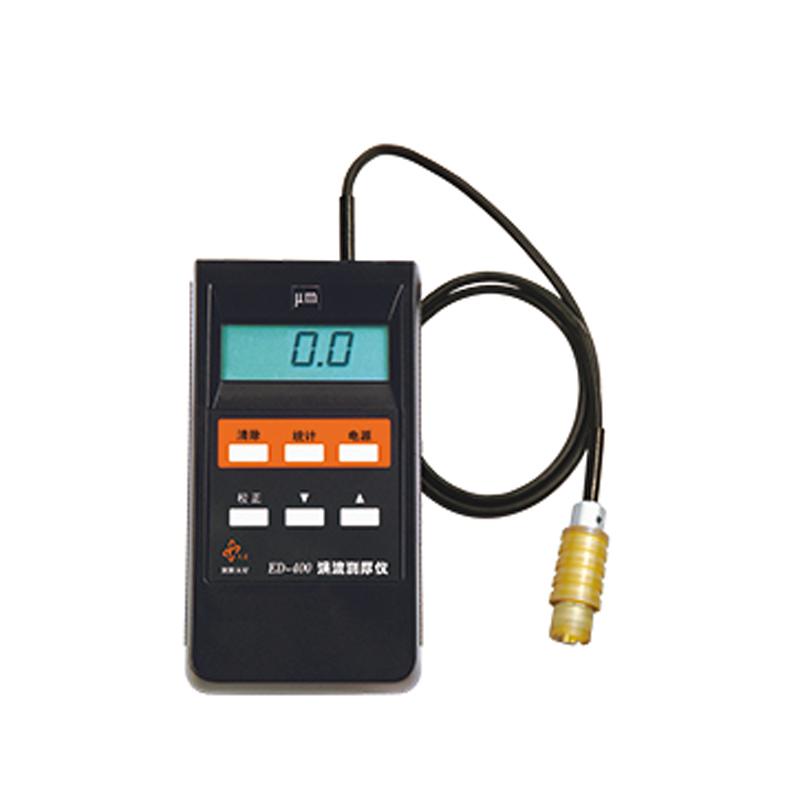
Compare & Choose
Both magnetic and eddy current Thickness Gauges have their own advantages and disadvantages, and the choice should be based on the specific needs and measurement object
Magnetic Thickness Gauge
Measurement of non-magnetic coatings on magnetic metal substrates, such as galvanized layers and paint layers on steel surfaces.
It is easy to operate, low cost, and suitable for large-area rapid detection.
Eddy-current Thickness Gauges
Measurement of non-conductive coatings on non-magnetic metal substrates, such as anodized films on aluminum alloys, insulating coatings on copper surfaces.
High-precision, non-contact measurement, suitable for high-precision inspection and hard-to-reach surfaces.
epilogue
With the rapid development of CHINA's manufacturing and high-tech industries, the importance of surface engineering technology has become increasingly prominent. As an important means of non-destructive testing, magnetic and eddy current thickness measurement technology has been widely used in electronics, machinery, aerospace and other fields. Although CHINA has made remarkable progress in this field, there is still a certain gap with the international advanced level. In the future, it is necessary to further strengthen theoretical research, equipment development and application practice to promote the continuous development of surface engineering performance monitoring and measurement technology.
