As an efficient, environmentally friendly and safe form of pesticide preparation, pesticide suspension has been widely used in agriculture, forestry and public health because of its good dispersion and stability. However, the viscosity of a pesticide suspension has an important impact on its properties. High viscosity may lead to clogging of the nozzle and affect the spraying effect; If the viscosity is too low, it may lead to insufficient dispersion of the liquid and reduce the efficacy of the drug. Therefore, accurate measurement of the viscosity of pesticide suspensions is essential to optimize formulations, improve product quality, and ensure effective application. The NDJ-5S digital display Rotational Viscometer has become a reliable choice for measuring the viscosity of pesticide suspensions due to its high precision, high sensitivity and easy operation.
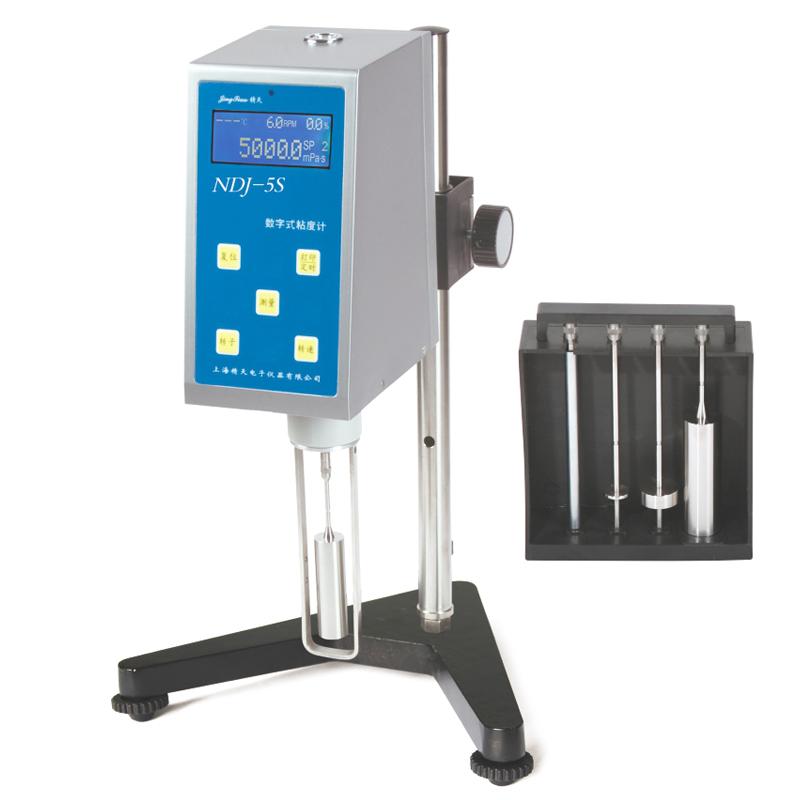
Core features:
NDJ-5S Digital Display Rotational Viscometer is a new generation of digital display Rotational Viscometer, which adopts advanced mechanical design and microcomputer control technology, and the data acquisition is stable and reliable. The display uses a high-resolution 3.5-inch IPS color screen, which can visually display information such as viscosity, rotational speed, temperature, percentage torque, rotor number, and the maximum measurable viscosity at the current rotational speed. The instrument is highly sensitive and reliable, and is capable of measuring both the absolute viscosity of Newtonian liquids and the apparent relative viscosity of non-Newtonian liquids. It has a measuring range of 1100,000 mPa·s and is equipped with a size 14 rotor with a speed selection of 6/12/30/60 rpm. The measurement accuracy of the instrument is ±2%, the reproducibility is ±1%, and the display resolution can reach 0.01 mPa·s. In addition, the NDJ-5S also has a variety of functions such as routine measurement, curve measurement, recording, viscosity conversion, printing, etc., and the data can be exported through USB or RS232 interface for subsequent analysis and processing.
Pesticide suspensionviscosityimportance
Pesticide suspensionThe viscosity directly affects its fluidity and spraying performance during the application process. By accurately measuring viscosity, the formulation of the suspension can be optimized, ensuring its stability and application effectiveness under different environmental conditions. For example, viscosity control is one of the key factors in the development of highly concentrated oil suspensions. By adding a highly effective dispersant, the viscosity of the suspension can be significantly reduced, while its stability and flowability can be improved. In addition, viscosity measurement can help assess the stability of suspensions during storage and prevent delamination, flocculation and agglomeration.
NDJ-5S ViscometerApplication Benefits
The NDJ-5S viscometer has significant advantages in the viscosity measurement of pesticide suspensions. First, its high accuracy and sensitivity provide reliable viscosity data to help researchers and production staff optimize formulations. Secondly, the instrument is easy to operate, even for non-specialists. For example, in practical applications, researchers can use the NDJ-5S viscometer to measure the viscosity of different formulations of pesticide suspensions, and combine the use of dispersants to optimize the formulation and significantly improve the stability and application effect of the product.
In addition, the NDJ-5S viscometer has a variety of functions to meet different measurement needs. For example, the instrument is equipped with a temperature probe that can measure the temperature of liquids in real time, ensuring consistent measurement conditions. The data can be exported via USB or RS232 interface for subsequent analysis and processing. These features make the NDJ-5S viscometer suitable not only for laboratory research, but also for quality control in the production process.
Procedure
Prepare the sample – Stir the pesticide suspension well to ensure that the sample is free of bubbles and impurities.
Mounting the rotor – Select the appropriate rotor based on the viscosity range of the sample and mount it to the instrument.
Set the parameters – set the speed (6/12/30/60 rpm) as needed and turn the instrument on.
Measure viscosity – pour the sample into a measuring vessel and make sure the sample level is above the rotor. Start the instrument and record the viscosity value.
Data logging and analysis – Once the measurement is complete, the data can be exported to a PC or printer via USB or RS232 interface for further analysis.
NDJ-5S digital display Rotational Viscometer has become a reliable tool for measuring the viscosity of pesticide suspensions due to its high precision, high repeatability, easy operation and versatility. By accurately measuring viscosity, the formulation of pesticide suspensions can be optimized, improving their flow and stability, thus ensuring the effectiveness and safety of pesticides during application. With the continuous improvement of the pesticide industry's requirements for product quality and environmental protection, the application prospect of NDJ-5S viscometer will be broader.
