Epoxy resin is a very important polymer material, which is widely used in coatings, glues, and electronic packaging. Its viscosity directly determines the processability and the quality of the final product. The RVDV-1H high-temperature Rotational Viscometer, with its ultra-wide measuring range and high-precision control, has become a "sharp tool" for measuring the viscosity of epoxy resin.
Types and viscosity characteristics of epoxy resins
There are many types of epoxy resins, and the viscosity of different types of epoxy resins at room temperature varies greatly. For example, bisphenol A epoxy resin has a very high viscosity, generally at 10,000-15,000 mPa·s (25 °C); The viscosity of bisphenol F epoxy resin is much lower, about 2,000-5,000 mPa·s (25°C). Phenolic epoxy resins have a higher viscosity of 20,000-50,000 mPa·s (25 °C), while alicyclic epoxy resins have a much lower viscosity of 500-2,000 mPa·s (25 °C). Looking at waterborne epoxy resins and UV-curable epoxy resins, the viscosities are even lower, at 100-1,000 mPa·s and 500-2,000 mPa·s at 25°C, respectively. These different viscosity properties determine their performance in different application scenarios.
Features & Benefits of RVDV-1H Viscometer:
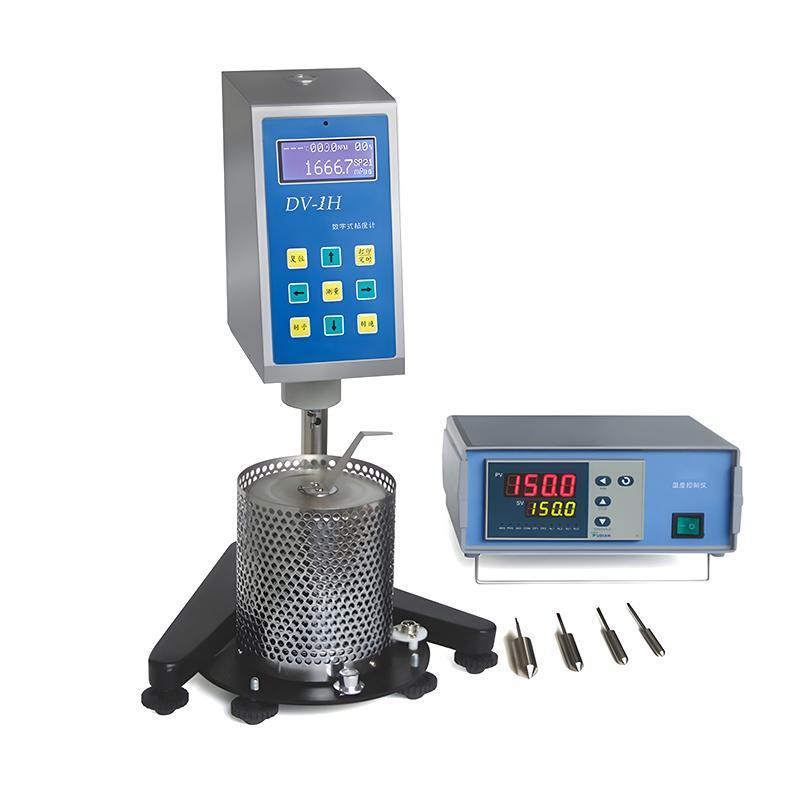
The RVDV-1H viscometer is designed for high temperature measurements, especially for epoxy resins that change from solid to liquid at high temperatures. It has a particularly wide range of measuring ranges, from 100 to 10 million mPa·s, and can easily handle both low- and high-viscosity epoxy resins. The measurement accuracy is also very high, reaching ±1%, and the repeatability is only ±0.5%, and the data reliability is not to be said. In addition, it has a continuously variable speed function with a speed range from 0.1 to 99.9 rpm, which enables continuous measurement from low shear rate to high shear rate to meet various test needs.
In terms of temperature control, the RVDV-1H is also very powerful. The temperature control range is from room temperature +10°C to 250°C, and the temperature control accuracy is up to ±0.1°C, which can accurately simulate the temperature environment of epoxy resin in processing and use. The instrument is also equipped with data acquisition and analysis software that can monitor the viscosity-temperature profile from start to finish, providing researchers with strong support for the analysis of the rheological properties of epoxy resins, helping to optimize formulations and improve processes.
Actual measurement steps
Using the RVDV-1H viscometer to measure the viscosity of epoxy resin is actually quite simple. First, heat the epoxy sample to a liquid state, noting that there are no bubbles and impurities. Then, depending on the viscosity of the sample, a suitable rotor is selected to be mounted on the instrument. Next, set the speed and temperature to turn on the heating and stirring functions. Once the temperature of the sample has stabilized, the measurement can be started and the viscosity value will be displayed directly. If required, viscosity-temperature profiles can also be plotted by software. Finally, analyze the data to see how the viscosity of the epoxy resin changes at different temperatures and evaluate its rheological properties.
summary
Overall, the RVDV-1H high-temperature Rotational Viscometer is fully capable of meeting the viscosity measurement needs of a wide range of epoxy resins due to its ultra-wide measuring range, high accuracy and high repeatability. By precisely controlling the temperature and shear rate, it can provide reliable data support for the formulation optimization and process improvement of epoxy resins, and is definitely an indispensable "good helper" in scientific research and production.
