The determination of the surface tension coefficient of liquids is an important basic experiment in university physics experiments, and the traditional methods mostly use the pull-off method or capillary method. However, the Jorlet's scale used in the traditional method needs to dynamically adjust the scale scale to coincide with the fixed reference line during the measurement process, which is complicated to operate and easy to cause the water film to rupture prematurely, resulting in a large experimental error. In this paper, on the basis of the pull-off method, the experimental scheme is redesigned, and an electronic balance is used instead of the Jorchy scale for measurement, and good experimental results are obtained.
Protocol design
In the past, when measuring the surface tension coefficient of liquids using the pull-off method, a Jorchy scale was usually used to measure the force. However, the upper end of the spring and the lower end of the beaker need to be adjusted at the same time during the operation of the Jorchy scale, so that the scale mark of the mirror ruler coincides with the fixed reference line on the column in the dynamic, which is not only complicated to operate, but also easy to cause the water film to rupture in advance, thereby increasing the experimental error.
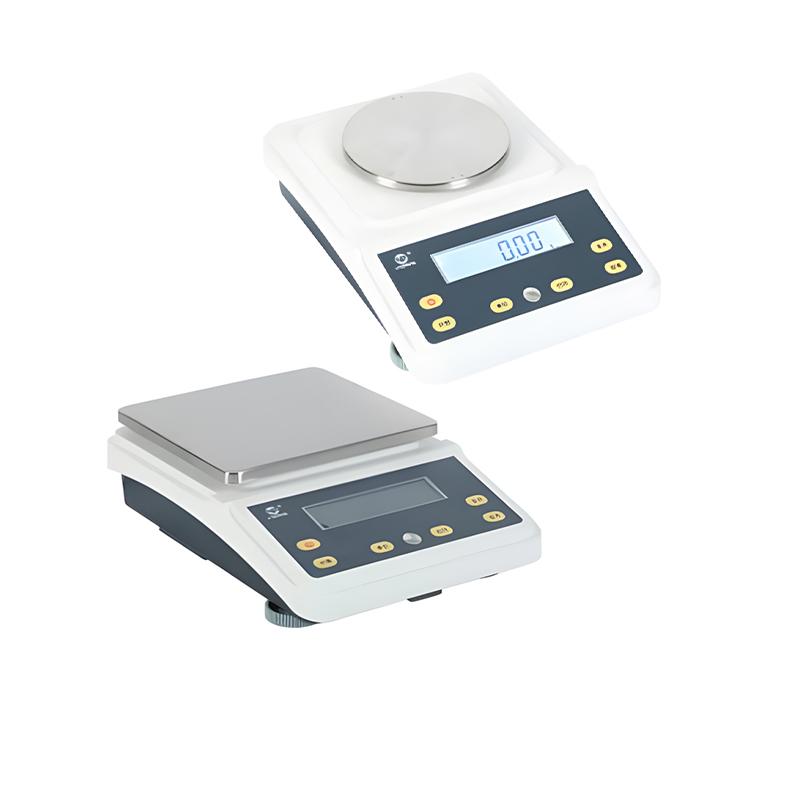
In order to overcome this difficulty, an electronic balance is used to measure the force. Electronic Balances with a minimum division of 0.1 g are used in experiments, but due to their low accuracy, direct measurement of the surface tension of a single piece of metal when pulled up can lead to large experimental errors. Therefore, the use of a metal sheet group consisting of ten metal sheets instead of a single metal sheet in the experiment is equivalent to an electronic balance that improves the accuracy of measuring the surface tension of a single metal sheet by a factor of ten, thus meeting the measurement requirements.
Experimental instruments and materials
The instruments and materials used in the experiment include: J-FYZ Jorrys scale, JJ3000 electronic balance (0.1g), blade set, mercury precision thermometer (050°C, 0.1°C), vernier caliper, spiral micrometer, beaker (250mL), drinking purified water (250mL), alcohol lamp, matches, fine wire, etc.
In this experiment, the Jorchy scale is only used to adjust the turning knob to lift the blade set through a thin wire and slowly pull up the water film. Electronic Balances are used to measure the surface tension when the water film is pulled up. The blade set consists of the common double-edged blades used on mechanical shavers, with the individual blades held in parallel by screws and nuts. A thermometer is used to measure the temperature of water, and a vernier caliper and spiral micrometer are used to measure the length and thickness of the blade.
Experimental principle
Liquid surface tension is generated due to the interaction force between molecules in the surface layer of the liquid, which causes the surface area of the liquid to shrink. The surface tension coefficient α represents the amount of surface tension acting along the surface of a liquid over a unit length, and its value is related to the properties, purity and temperature of the liquid.
Experimental Methods
Pull-out method
Place a beaker with purified water on the balance and adjust the height of the blade set so that it just touches the water. After the power is turned on for a self-test, the reading is adjusted to zero, and the measurement can be carried out. When the water film is pulled up, the electronic balance's reading is the surface tension. When measuring again, press the tare key (TARE) on the balance to reset the reading to zero.
Downward pressure method
Adjust the blade set to the appropriate height (without touching the water surface), use the elastic elongation of the thin wire, press the blade set down with your hand until it is in contact with the water surface, slowly and steadily lift your finger to pull up the water film, and take the reading of the electronic balance at this time.
Experimental results and analysis
In the experiment, the surface tension coefficient of water was calculated to be 0.06986 N/m by taking the average value of multiple measurements. According to the data of the surface tension coefficient of water at different temperatures provided in the literature, the surface tension coefficient of water at room temperature of 19.8°C is calculated by using the unary full-interval unequal interpolation program. Compared with the experimental results, the relative error is 4.0%.
The magnitude of the experimental error depends mainly on the measurement of the surface tension coefficient. The key is to adjust the height of the blade set so that the higher the water film is pulled up, the better. In addition, it is necessary to operate slowly during the experiment to avoid premature rupture of the water film.
conclusion
In this paper, an electronic balance is used instead of Jorley's scale to measure the surface tension coefficient of water, which is simple to operate and has a small experimental error. This method effectively overcomes the problem of premature rupture of the water film caused by dynamic adjustment of the scale mark in the traditional method, improves the experimental accuracy and reduces the difficulty of operation. This method can be replicated in laboratories with electronic balances or as part of a comprehensive design experiment.
