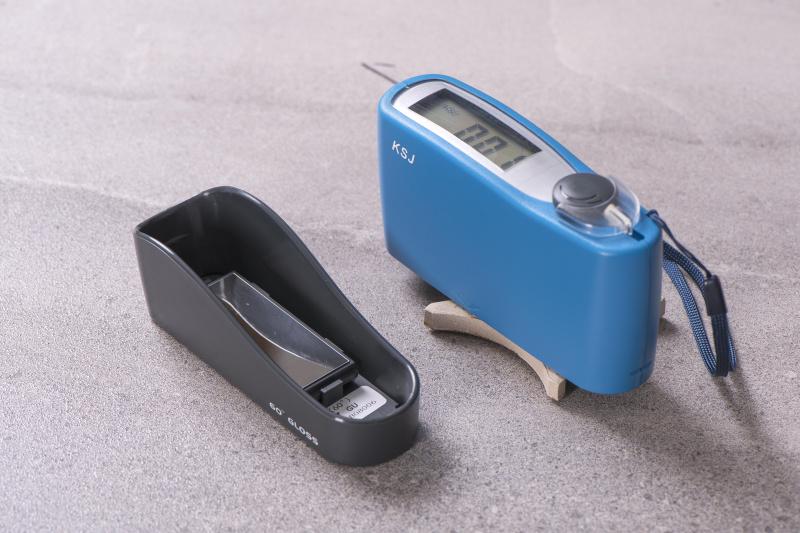
Glossmeters operate based on the reflective properties of light. The internal light source emits a calibrated beam of light at a specific angle towards the measured object, and the reflected light is converged by the lens to the photocell, converted into an electrical signal, and then processed by the circuit to display the gloss value. The original reference standard is often highly polished quartz glass or black glass, with no more than 2 interference fringes per centimeter. If such standard glass cannot be obtained, the gloss meter needs to be calibrated, and the measurement accuracy is ensured through professional processes and standard parts, laying a solid foundation for accurately obtaining the gloss data on the surface of the object.
Applications in the screen printing industry
In the field of screen printing, gloss meters are used in a wide range of applications. On the one hand, it can accurately measure the gloss of printed products according to user-defined standards. Different users have various requirements for the gloss effect of printed matter, and the gloss meter helps printing enterprises to optimize the process parameters such as ink blending, printing pressure, and drying time through accurate measurement, so that the gloss of the product meets the expectations of users. On the other hand, according to the established standard, the gloss meter can select multiple uniform distribution points on the printed sample to measure and take the average value to test the consistency and stability of the gloss of the product. In this way, the gloss abnormality caused by ink quality, printing process, equipment status and other factors can be detected in time, and strong data support is provided for quality improvement. In addition, in the simulated aging test, the gloss of the printed sample is measured with a gloss meter before and after the test, and the gloss loss data is obtained, which intuitively reflects the gloss retention ability of the product in long-term use, helps enterprises evaluate the durability of the product, and optimizes the product formula and production process.
Operational points
Calibration is crucial before using a gloss meter. Some instruments have the function of automatic calibration at start-up, but in order to ensure accuracy and flexibility, the operator often manually calibrates with the adjustment plate, and places the measurement window on the white and black standard boards in turn to measure and calibrate to eliminate the systematic error of the instrument. When measuring, it is necessary to ensure that the instrument is stable, and the measuring port is closely attached to the surface of the object to be measured, so as to avoid interference factors such as flickering of surrounding light and rapid temperature changes. The measurement angle needs to be reasonably selected according to the gloss characteristics of the surface of the object, and the common angles are 20°, 45°, 60°, 75°, 85°, etc., and different angles are suitable for objects with different gloss degrees. For objects with unknown gloss, it is generally measured from a 60° angle, and then a more suitable angle is selected according to the measurement results to obtain accurate measurement data.
Fields of application
Gloss meters have important applications in a wide range of industries. In the packaging industry, by measuring the gloss of packaging materials such as paper, plastic film, and metal foil, the appearance attractiveness of products is improved to meet the packaging design needs of different products. In the paint and paint industry, it is used to detect the gloss of coatings under different construction processes, and help enterprises optimize the formula and construction process to meet the gloss requirements of coatings in different indoor and outdoor scenarios. In the electronics industry, gloss meters ensure uniform gloss on the surface of electronic product housings, improve product quality, and monitor quality consistency between production batches. In the automotive industry, in the production line and maintenance, the gloss meter is used to detect the gloss of the body paint surface and ensure the appearance quality of the car. Ceramics and glass industry, it helps to judge whether the product firing process is up to standard, and enhance the artistic value and practicability of ceramic tableware, glass crafts, etc.
summary
As a professional instrument for measuring the gloss of the surface of objects, the gloss meter plays an irreplaceable role in the production, quality control, product research and development of various industries with its accurate measurement ability. It not only provides a key basis for product quality control, helps enterprises improve product quality, but also helps enterprises to understand product performance, promote product innovation and upgrading, and plays an extremely important role in meeting consumers' demand for high-quality products and enhancing product market competitiveness.
