Coating viscosity is a key physical parameter that has a crucial impact on the production, storage, application and final film formation performance of coatings. Accurate determination of coating viscosity helps to control coating quality, optimize application processes, and ensure consistent coating performance. Because of its wide measurement range and high accuracy, Rotational Viscometer can adapt to the measurement of Newtonian fluids and non-Newtonian fluids (such as most coatings are pseudoplastic fluids), and is widely used in the coating industry in the quality control of anti-corrosion coatings, absolute viscosity measurement and viscosity determination of two-component coating base agent (component A). In this article, we will detail the method of determining the viscosity of a coating using a Rotational Viscometer.
Measuring principle
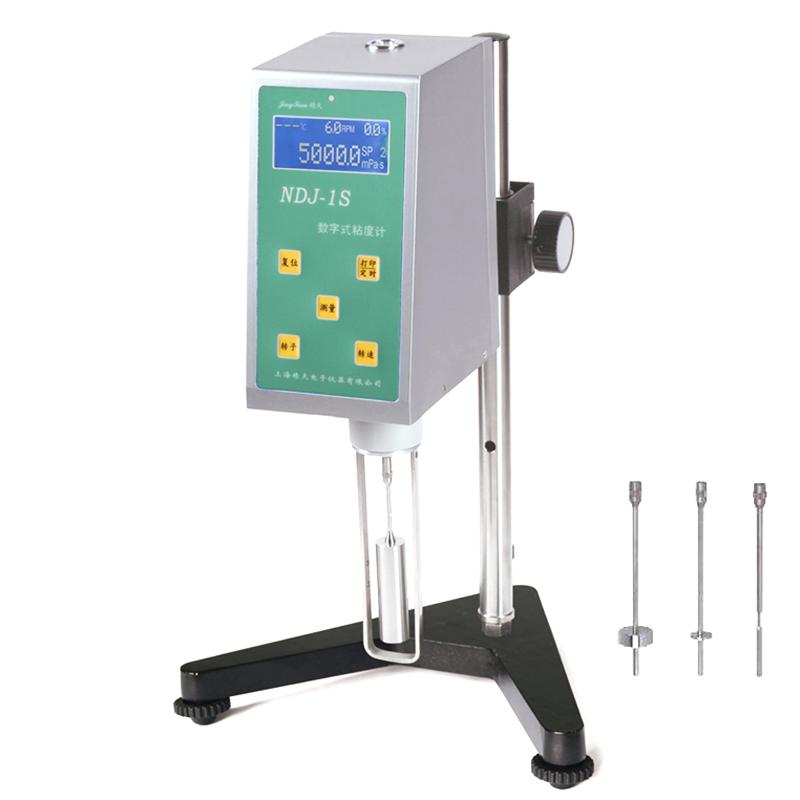
The working principle of a Rotational Viscometer is based on the flow characteristics of a fluid under force. When the rotor of a Rotational Viscometer is immersed in the paint to be measured and rotates at a specific rate, the viscous force of the paint creates resistance to the rotor, which causes the rotor to lag. The instrument converts the viscous resistance of the rotor into measurable physical quantities by linking it with the torsional stress of the elastic element, and finally calculates the viscosity value of the coating. The core of its measurement principle is that, under certain conditions, the torque of the rotor is proportional to the viscosity of the coating, and the viscosity of the coating is obtained by measuring the torque.
Instruments and materials
In the experiment of measuring the viscosity of coatings by Rotational Viscometer, the domestic NDJ-1 Rotational Viscometer is widely used. It has a measuring range of 10 to 100,000 mPa・s and is equipped with four rotor sizes, ranging from the largest of No. 1 to the smallest of No. 4. At the same time, there are 4 kinds of rotor speeds, which are 6r/min, 12r/min, 30r/min, and 60r/min. In practice, for high-viscosity paint samples, in order to ensure the accuracy of the measurement results, small rotors and slower rotation speeds should be selected; For low-viscosity specimens, large rotors and fast speeds are required. In addition, it is necessary to use a beaker with a diameter of not less than 70mm or a special lacquer cup to hold the sample, measure the temperature with a thermometer with a range of 0-50 °C and an index of 0.1 °C, and a stopwatch with an index value of 0.1 seconds
Assay method
When using a Rotational Viscometer to determine the viscosity of the coating, it is necessary to first select the rotor of the corresponding specifications according to the estimated coating viscosity range, and carefully screw it into the instrument connecting shaft, and be sure to protect the instrument connector during installation, keep the rotor nut and the instrument threaded connector smooth and clean, and avoid impurities from interfering with the rotor rotation. Then, pour the test sample into a suitable container, slowly lower the instrument to immerse the rotor into the shaft mark, the operation should be stable to prevent bubbles or lateral impact on the rotor, and then put in the thermometer, the sample and the instrument are placed in a constant temperature chamber, so that the temperature is stable at (23±0.2) °C. Subsequently, press the pointer control lever, close the power switch and start the motor, turn the variable speed knob to adjust to the appropriate speed, release the pointer control lever to make the rotor rotate stably, turn on the stopwatch timing, select the rotation time of 60s or 120s according to the characteristics of the coating, and read the dial reading after the pointer is stable. Finally, according to the formula η=Kα (where η is the absolute viscosity, K is the rotor corresponding coefficient, and α is the pointer reading), the actual viscosity value is calculated, and the result is expressed in Pa・s or mPa・s, and the Rotational Viscometer model, rotor specification, rotation speed, test temperature and measurement time should be indicated together when recording, so as to facilitate subsequent analysis and comparison.
Reference standards
This measurement method is mainly carried out with reference to the American ASTM D2196 standard "Rheology of Non-Newtonian Materials by Rotational Viscometer (Brookfield)". This standard has detailed and standardized requirements for the instrument requirements, operating procedures, data processing and result reporting of non-Newtonian materials (e.g., coatings) for Rotational Viscometers, ensuring the comparability and accuracy of measurement results between different laboratories and operators. When it comes to the actual determination of paint viscosity with a Rotational Viscometer, it is important to follow this standard in strict compliance with this standard, which is an important guarantee for reliable measurement results.
All in all, a Rotational Viscometer is a key tool for determining the viscosity of coatings. The principle is based on the proportional relationship between the viscosity force and viscosity of the rotor in the coating. Taking the commonly used domestic NDJ-1 type as an example, it has a specific measurement range, rotor specification and rotation speed, which needs to be adapted according to the viscosity of the paint, with a special container, thermometer and stopwatch. The measurement steps are strictly standardized, and the results are presented in Pa・s or mPa・s, and key information is recorded. This method is based on the American ASTM D2196 standard, which ensures the reliability of the measurement results and is of great significance to the coatings industry.
