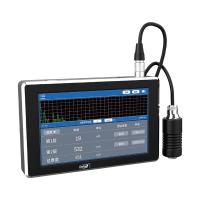
Coating Thickness Gauges are widely used in many fields, and can non-destructively measure the thickness of non-magnetic coatings (such as paint, rubber, etc.) on magnetic metal substrates (such as steel, iron, etc.) and non-conductive cladding layers on non-magnetic metal substrates (such as copper, aluminum, etc.). Measurement accuracy is critical, and there are many factors that make it the right way to get reliable data.
Magnetic Thickness Gauge
It is suitable for measuring the thickness of non-magnetic coatings on magnetically conductive materials such as steel, iron, silver, and nickel. The thickness of the cladding is determined by the proportional relationship between the suction force and distance between the permanent magnet (probe) and the magnetically conductive steel, or according to the magnitude of the magnetic flux and magnetoresistance that flows into the ferromagnetic matrix from the probe through the non-ferromagnetic cladding, and the measurement accuracy is quite high. For example, when applying paint to the surface of steel, this method can be used to accurately determine the thickness of the paint coating. When a permanent magnet comes into contact with a non-magnetic paint coating on the surface of steel, the suction between the two varies depending on the thickness of the coating, and the coating thickness can be calculated by measuring this suction change. Or according to the magnetic flux emitted by the measuring hair through the paint coating into the steel matrix, due to the different coating thicknesses resulting in changes in magnetic flux and magnetic resistance, the instrument captures these changes, and then obtains the coating thickness.
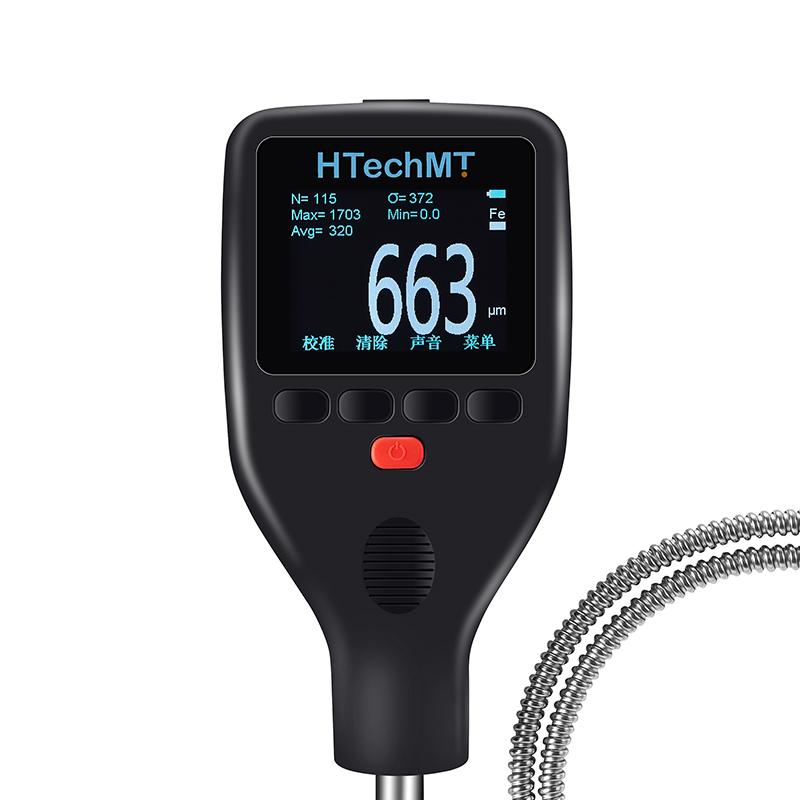
Eddy current Thickness Gauge
It is used for the thickness measurement of non-conductive layers on conductive metals. The electromagnetic field generated by the probe coil causes the approaching conductors to form eddy currents, which are reflected in the reflected impedance and thus reflect the thickness of the non-conductive cladding. However, compared with the magnetic thickness measurement method, its accuracy is slightly lower, and it is often used to measure the thickness of the paint layer on the surface of aluminum alloy doors and windows. When the probe is close to the paint layer on the surface of the aluminum alloy door and window, the high-frequency electromagnetic field generated by the probe coil will produce eddy currents in the aluminum alloy matrix, and the size of the eddy current is affected by the thickness of the paint layer, which then changes the reflection impedance, and the instrument calculates the paint thickness according to the change of the reflection impedance.
Other Thickness Gauges
The ultrasonic thickness measurement method can measure the thickness of multi-layer coatings, the principle is to use ultrasonic waves between the coating and the substrate propagation and reflection characteristics, by measuring the sound wave round-trip time and propagation speed to calculate the thickness, but due to high cost, poor accuracy, few domestic applications, only a few foreign enterprises use; The electrolytic thickness measurement method needs to destroy the coating, and the thickness is estimated by the power consumption of the chemical reaction of the coating in the electrolyte, etc., which is complicated and has low accuracy, and the actual use is limited. Radiometric thickness is based on the change in intensity before and after the radiation penetration, which is expensive and only used in specific scenarios with special requirements and sufficient budgets.
Coating Thickness Gauge measurements are subject to a variety of factors. In terms of matrix characteristics, the magnetic thickness measurement method is affected by the change of the magnetic properties of the magnetic matrix, and the magnetic properties and surface roughness of the standard sheet should be similar to those of the specimen during measurement, such as the steel workpiece after heat treatment. The eddy current Thickness Gauge method is affected by the conductivity of the base metal, and needs to be calibrated with a standard with similar electrical properties to the specimen. There is a maximum critical value for the thickness of the substrate, beyond which calibration is required. In terms of edge and curvature, the edge data of the specimen is unreliable, and the smaller the radius of curvature, the more bent or easily deformable the specimen measurement results are not credible. In the external environment, the strong magnetic field interferes with the magnetic induction measurement, and the surface attachment of the specimen affects the accuracy, and the probe pressure and orientation are also crucial, and should be placed smoothly and vertically to ensure accurate measurement.
Instrument selection and calibration
According to the material structure of the workpiece, the coating Thickness Gauge is correctly selected, and the magnetic coating Thickness Gauge is used for magnetic materials, such as the thickness of the paint coating for automobile body (steel); Conductive body selection eddy current coating Thickness Gauge, like automotive aluminum alloy wheel coating measurement. Before measuring, calibrate the zero point on the uncoated workpiece or standard piece according to the instructions, take out the battery to prevent leakage and corrosion of the circuit if the instrument is not used for a long time, and replace the high-quality battery in time when the low voltage prompts during use, pay attention to the installation of the positive and negative poles according to the identification, avoid reverse installation, and ensure the measurement accuracy.
Measurement operation points
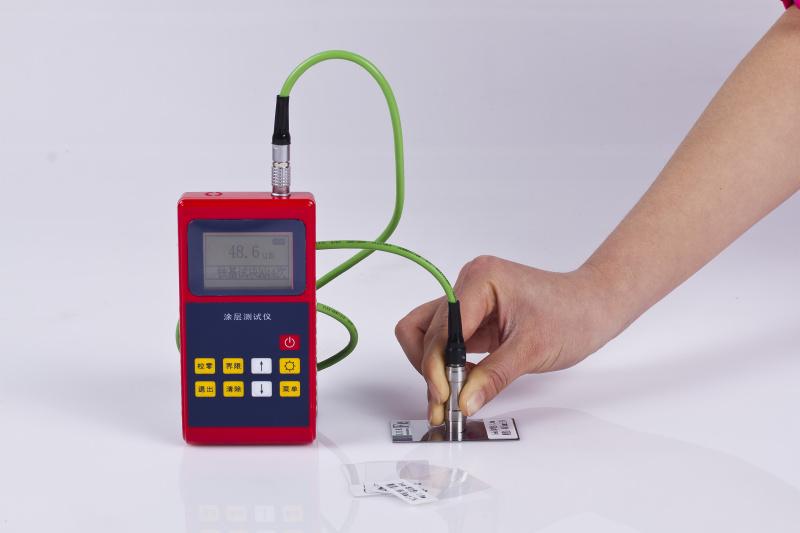
When using the coating Thickness Gauge to measure, the operation needs to be standardized: to press the probe vertically on the surface of the measured object and keep it stable, do not drag, like measuring a large area of flat coating, the probe should be placed slowly and vertically, read the value after the data is stable, and then move to the next point to repeat the operation, because dragging will interfere with the electromagnetic induction and make the data fluctuate, which cannot reflect the real coating thickness; In view of the fact that the measurement is affected by a variety of factors, the measurement data will fluctuate each time, generally three to five times in each measurement area, and the data with large errors should be eliminated, such as when measuring the uniform coating of the workpiece, if there is such as the first 30 microns, the second 32 microns, the third 28 microns, the fourth 40 microns (obvious deviation), 40 microns should be eliminated, and the remaining average value should be taken as the coating thickness value of the measurement point; For example, to measure the thickness of the paint coating of wooden components of ancient buildings, the surface needs to be gently cleaned with a soft brush to ensure that the probe is in stable contact with the surface of the specimen, so as to obtain accurate measurement data.
Instrument maintenance
The coating Thickness Gauge needs to be maintained regularly after use, and the instrument shell and probe should be wiped with a clean and soft cloth in time, and the small gaps of the probe should be lightly brushed with a small brush to remove the dust, oil and other impurities accumulated due to use, and prevent interference with the electromagnetic induction function of the probe, such as after use in dusty environments such as construction sites. At the same time, it is necessary to avoid the instrument being subjected to violent vibration and impact, do not use it in high temperature (such as boiler room), high humidity (such as seaside) or strong magnetic field (such as substation) environment, and use a special instrument box and shock absorption protection when transporting.