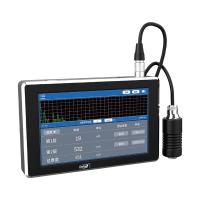
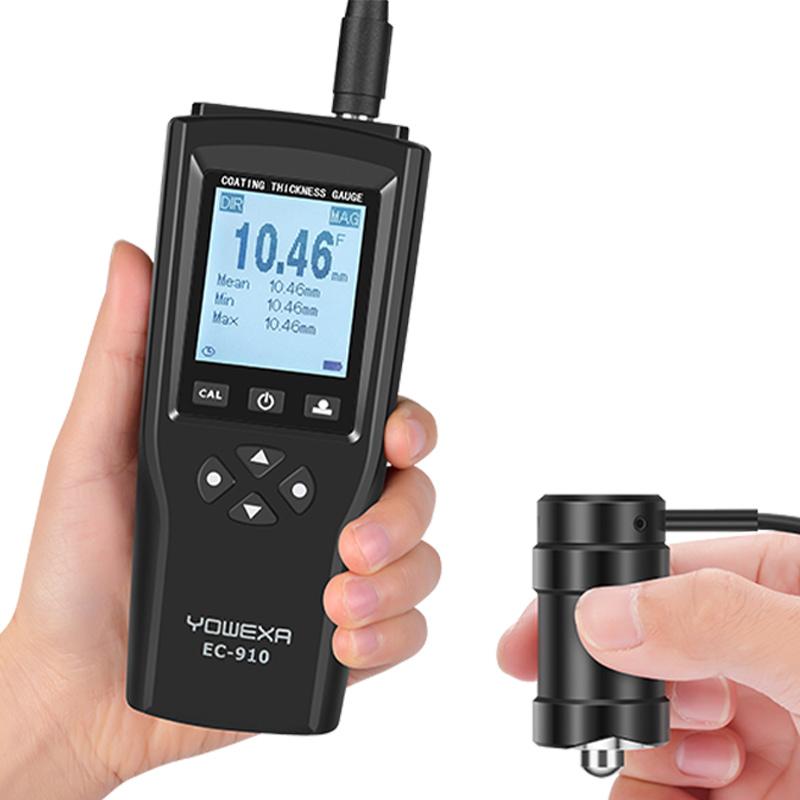
The coating Thickness Gauge is used to measure the thickness of the non-magnetic coating on the magnetic metal matrix and the non-conductive cladding on the non-magnetic metal matrix, which is widely used in metal manufacturing, chemical industry, aerospace and other fields, and is an important tool to ensure product quality testing.
How it works
Electromagnetic induction
Common measuring principles. When the probe comes into contact with the test piece, a magnetic loop is formed, and as the distance between the probe and the ferromagnetic material changes, the reluctance and inductance also change, so that the coating thickness is measured. Among them, the magnetic thickness measurement method is suitable for the non-magnetic permeability layer on the magnetic permeable material, and the accuracy is high; Eddy current thickness gauging is used for non-conductive layers on conductive metals with slightly lower accuracy.
Other methods
Ultrasonic thickness measurement is suitable for multi-layer or special situations, but the price is high and the accuracy is limited; The electrolytic thickness measurement method is a destructive test, which is complex to operate and not high in accuracy. Radiometric thickness gauging relies on radioactive sources, is expensive, and is only used in special environments. The most widely used in CHINA are magnetic and eddy current Thickness Gauges, which have the advantages of small and portable, easy operation and high accuracy.
Common faults and troubleshooting
The indication value is unstable - the Thickness Gauge needs to be selected according to the workpiece material; Thoroughly remove dust, grease and other attachments on the surface of the test specimen before measurement; The system should be zeroed with a clean and smooth substrate, and if the calibration is abnormal, it should be returned to the factory for maintenance.
Large measurement error - ensure that the probe is placed vertically during measurement to avoid dragging and staying for a long time; At the same time, it is necessary to avoid the influencing factors such as substrate magnetization, too small thickness, too small curvature and electromagnetic field interference.
No display on the screen – check the battery level first, if the battery level is normal, then check whether the probe and cable are loose or damaged, and rule out battery leakage and corrosion of the internal components of the instrument.
Human Factor - The user must read the manual carefully, master the standard operation method, and prevent measurement errors caused by probe deviation.
Instrument failure - It is recommended that the instrument be used and stored by a special person to avoid vibration, drop and magnetic field interference. If the instrument fails, it should be returned to the factory for maintenance in time, and should not be disassembled without authorization.
Precautions for use
When using a coating Thickness Gauge, there are many ways to ensure measurement accuracy. Before measuring, it is necessary to select a standard piece similar to the metal magnetism and surface roughness of the specimen for calibration, and at the same time check the surrounding environment, away from large motors and other strong magnetic field equipment to avoid interference. During the measurement, it is necessary to standardize the operation of the probe, keep it perpendicular to the surface of the sample, and avoid tilting, dragging or placing it for a long time; Clarify the critical thickness of the base metal to ensure that the thickness of the matrix meets the standard; Avoid special positions such as inner corners and edges, and choose flat areas for measurement; For special shape specimens such as arcs, special probes adapted to curvature should be used; The measuring pressure needs to be kept constant, which can be achieved with the help of the fixed device supporting the instrument; If an ultrasonic Thickness Gauge is used, remove any build-up on the probe surface in advance to ensure that the probe is in direct contact with the specimen.
summary
Coating Thickness Gauge occupies an important position in industrial production quality inspection, and its working principle is based on electromagnetic induction, ultrasonic, electrolysis, radiation and other technologies, among which magnetic and eddy current Thickness Gauge are the most commonly used. In the actual use process, the instrument may have unstable values, large measurement errors, no display on the screen and other faults, which may not only originate from the instrument itself, but also may be related to the characteristics of the measured workpiece or improper human operation. By understanding the causes of faults and mastering the corresponding elimination methods, the normal operation of the instrument can be effectively guaranteed. At the same time, strictly follow the precautions for use, and achieve standardized operation in all aspects from standard film selection, probe operation to measurement environment control, etc., so as to give full play to the performance of the coating Thickness Gauge, obtain accurate and reliable measurement results, and provide strong support for product quality control.