In the inspection of coatings and coating films, the thickness of the coating film is an extremely critical control index. During the coating application phase, uneven film thickness or failure to meet the specified standards can have a significant impact on the performance of the coating. Therefore, the determination of the wet film thickness is particularly important and must be carried out immediately after the preparation of the paint film to prevent the paint film from shrinking due to volatilization of volatile solvents, which will affect the measurement accuracy. At present, there are three commonly used wet film thickness measurement tools: wheel gauge, comb gauge and wet film gauge.
Wheel gauge
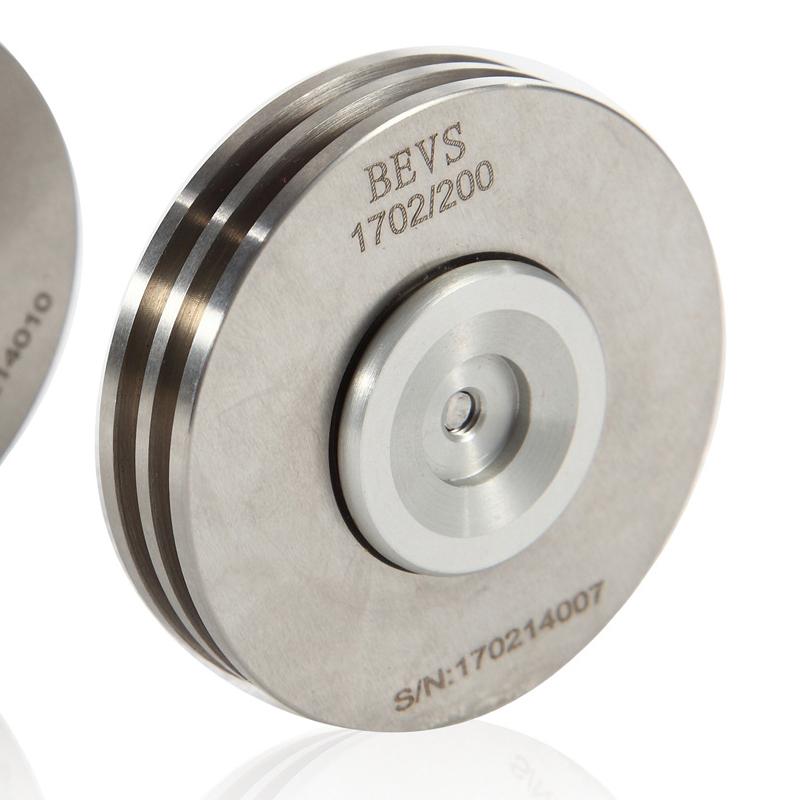
Wheel gauges are tools used to measure wet film thickness and are suitable for laboratory panels or freshly painted surfaces. It consists of three equally spaced coaxial wheels, with the middle wheel smaller than the outer wheel and eccentric, forming a height difference. When measuring, put the wheel gauge vertically on the surface of the paint film, so that the maximum scale of the two outer wheels is in contact with the substrate, keep it stable and not shaking, roll along the surface 180°, find the position where the middle wheel rim and the wet film surface are in contact first, and read the thickness of the wet film corresponding to the outer wheel scale, and roll from the maximum gap to reduce the squeezing of the wet film and make the measurement more accurate. In order to ensure the representativeness of the results, at least two more readings should be taken at different parts, expressed in μm, and the measurements should be carried out with reference to the national standard GB/T 13452.2.
Comb gauge
A comb gauge is a wet film thickness measurement tool suitable for on-site painting operations and is made of sheet metal or plastic with a comb structure around the perimeter. The external teeth at both ends are at the same level to form a baseline, and the gap between the middle inner teeth and the baseline increases sequentially, and each gap corresponds to a different reading, which is used to represent the coating thickness value.
When measuring, the comb gauge needs to be pressed vertically and firmly on the surface of the tested coating film, and when part of the comb teeth are wet, remove them, check the tooth opening, find out the shortest tooth in contact with the wet film surface, and take the value between the last tooth touching the wet film and the scale shown by the first untouched wet film tooth as the wet film thickness, such as the last wet tooth scale is 120 μm, the first unwet tooth scale is 130 μm, and the wet film thickness is 120 - 130 μm. In order to ensure the accuracy of the results, at least two more readings should be taken at different sites, and the results are expressed in μm, and the measurements are performed according to the national standard GB/T 13452.2.

Wet film meter
The wet film meter can measure wet films up to 360 μm thick, which consists of a convex lens L with a radius of curvature of 250 mm, two metal round tubes T1 and T2, the lens L is mounted in T1 and slides within T2, and the spring S makes the convex lens not contact the wet film at first, and presses it in under pressure. When measuring, first apply the paint on a hard plate with a large enough area (ensure that the measurement place is at least 25mm away from the edge of the board), fix the test plate, put the wet film meter on the painted surface, press down the inner tube to make the convex lens contact the substrate, the paint is extruded to form a circular paint mark, remove the wet film meter and use a steel ruler to measure the diameter of the paint mark from two approximately right-angle directions (accurate to 0.5mm) to take the average value. Due to the effect of surface tension, the measured value differs from the actual thickness, and coefficient correction needs to be introduced in order to accurately measure the wet film thickness in coating application and quality control.
To sum up, wheel gauges, comb gauges and wet film gauges have their own characteristics and application scenarios. Wheel gauges are suitable for precise measurements in the laboratory and on newly painted surfaces; The comb gauge is convenient for rapid rough determination on site; The Pfund wet film meter is a little more complicated to operate, but it can measure thicker wet films. In the coating construction and quality inspection, it is necessary to reasonably select the corresponding tools and standardize the operation according to the actual needs, measurement scenarios and accuracy requirements, so as to accurately control the thickness of the wet film, lay a solid foundation for the subsequent coating performance standards, and ensure the quality and effect of the coating project.
