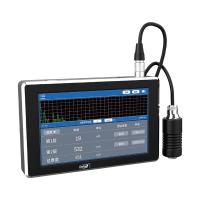
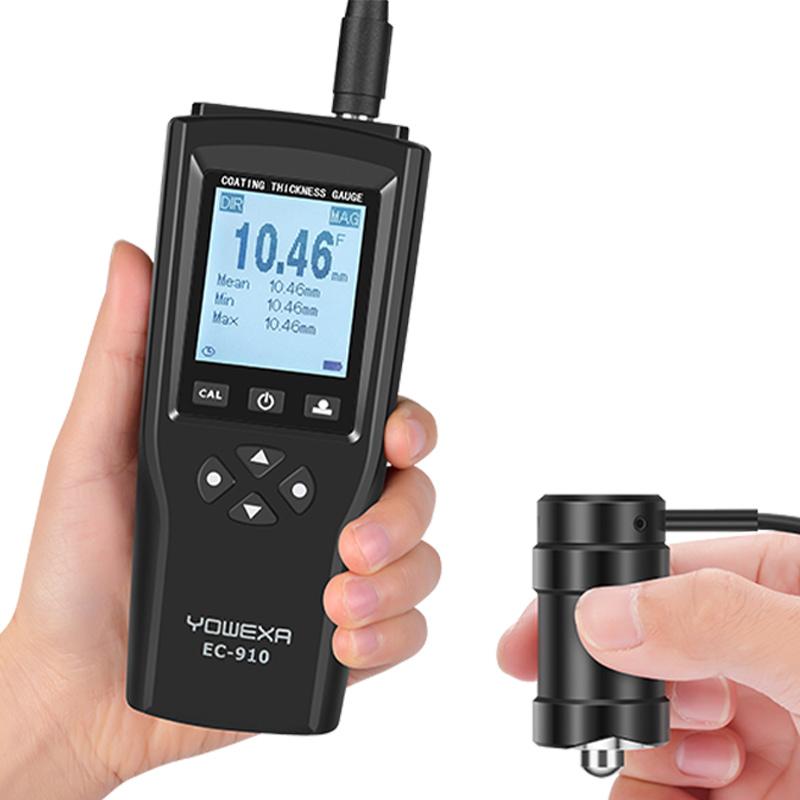
Coating Thickness Gauges play an integral role in a wide range of industries as a critical inspection device. It is capable of non-destructively measuring the thickness of non-magnetic coatings (e.g. aluminum, chromium, copper, enamel, rubber, paint, etc.) on magnetic metal substrates (e.g. steel, iron, alloys, hard magnetic steel, etc.) and the thickness of non-conductive cladding (e.g. enamel, rubber, paint, plastic, etc.) on non-magnetic metal matrices (e.g. copper, aluminum, zinc, tin, etc.). Because of its small measurement error, high reliability, good stability, easy operation and other characteristics, it has become an important testing instrument to control and ensure product quality, and is widely used in manufacturing, metal processing industry, chemical industry, commodity inspection and other testing fields.
Measuring principle
The measuring principle of the coating Thickness Gauge is mainly divided into the principle of magnetic induction and the principle of eddy current. Based on the principle of magnetic induction, the thickness of the coating is measured by the magnetic flux of the probe through the non-ferromagnetic cladding into the ferromagnetic matrix, or the corresponding magnetoresistive size, when the soft-core probe with the coil contacts the sample, the instrument outputs a signal, and with the introduction of new circuit technology, the measurement is more accurate, as long as the difference between the permeability of the cladding and the substrate is large enough, it can be measured, like a mechanical magnetic coating Thickness Gauge, relying on the magnetic attraction between the permanent magnet and the magnetic substrate to overcome the spring elastic force to produce displacement, and then indicate the coating thickness; The eddy current principle Thickness Gauge is suitable for the measurement of non-conductive cladding on all conductors, such as aerospace vehicles, vehicles and other surface coatings, and its measurement level is comparable to that of magnetic induction Thickness Gauges, which can achieve high resolution, small allowable error and wide range.
Product Features:
Dual-use functionality
Some of the most advanced coating Thickness Gauges are dual-purpose. For example, its F-type probe can directly measure the thickness of non-magnetic conductive overlays (such as paint, plastic, enamel, copper, aluminum, zinc, chromium, etc.) on the surface of magnetically permeable materials (such as iron and nickel), and can be applied to the thickness measurement of electroplating, paint layer, enamel layer, aluminum tile, copper tile, babbitt tile, phosphate layer, paper, and can also be used for thickness measurement of hull paint and adhesion of underwater structural parts; The NF probe measures the thickness of the insulating overlay on non-magnetic metal substrates, such as paint, plastic, and rubber coatings on materials such as aluminum, copper, zinc, and non-magnetic stainless steel, as well as the anodizing thickness of aluminum or aluminum alloy materials.
High resolution and wide measuring range
Modern coating Thickness Gauges have a wide measurement range and high resolution, which can meet the accuracy requirements of coating thickness measurement in different scenarios. Whether it's a thinner coating or a thicker cladding, it can be accurately measured. For example, some products have a measuring range of up to 3000 μm and a resolution of 0.1 μm.
Convenient calibration and operation
It has a variety of calibration modes, such as zero point correction, single point correction, five-point correction, etc., and supports a variety of measurement modes, such as basic mode, quality control mode, continuous mode, statistical mode, etc., which can adapt to more test scenarios. It is easy to operate, and some products can also automatically memorize calibration values for subsequent use.
Other features:
Spring-loaded bushing probes with wear-resistant hard metal probes can measure on hard or rough surfaces with constant compression and stable sampling values. The instrument is usually an all-in-one structure, small in size, light in weight, and easy to carry and operate. Digital backlit display, no parallax, easy to read data in different environments. Multiple sets of data can also be stored, and the statistical function of the instrument can be realized by measuring the average, maximum and minimum values. Some instruments use optional software and cables to communicate with a PC computer for data acquisition, processing, analysis, and printing, and even have an automatic shutdown function to save power.
Application scenarios
Coating Thickness Gauges play a key role in all areas of industry. In the manufacturing industry, it is used to control the thickness of auto parts coating, electronic product shell coating treatment and other links to ensure that the product is protective, beautiful and durable; The metal processing industry uses it to detect the coating thickness after hot-dip galvanizing, hard chromium and other processes to ensure the accuracy of the processing technology and the product quality standards; The chemical industry relies on it to monitor the coating of chemical equipment, detect losses in time, provide data support for equipment maintenance, and ensure safe and stable production; In the field of commodity inspection, it is used to inspect the coating of import and export products to ensure that it meets the requirements of standards and contracts, and to maintain market order and consumer rights.
To sum up, coating Thickness Gauges play a key role in the quality control of various industries with the principles of magnetic induction and eddy current, as well as the characteristics of high resolution and wide range. It not only ensures the quality of manufacturing products, optimizes the metal processing process, maintains the safety of chemical equipment, but also builds a solid quality defense line for commodity inspection, is an indispensable and important tool for modern industrial production and quality inspection, and with the development of technology, its functions and application scope will continue to expand and upgrade.