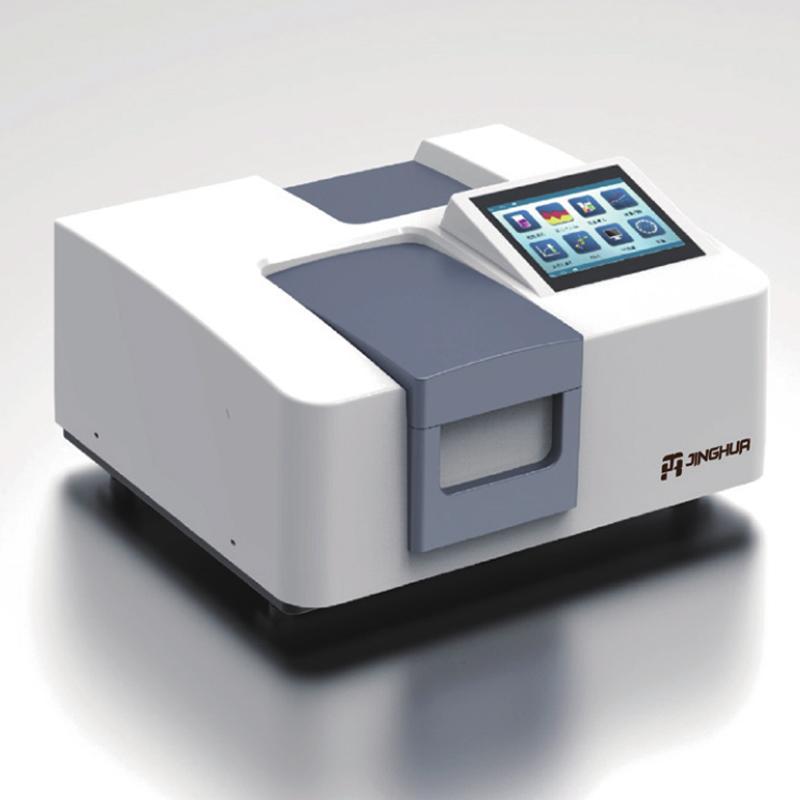
Spectrophotometer is an analytical instrument based on the selective absorption characteristics of substances to electromagnetic radiation, with precise structure and clear division of labor of each component, which jointly completes the qualitative and quantitative analysis of substances.
light source
As the "light source" of the Spectrophotometer , it is responsible for providing mixed light energy for analytical needs. In different spectral regions, the selection of light sources has its own emphasis: hydrogen arc lamps and deuterium lamps are commonly used in the ultraviolet light region, among which deuterium lamps are mostly used in the range of 190~360nm due to their stronger UV emission intensity; from visible light to infrared light (360~2500nm), tungsten lamps or tungsten halide lamps are the main ones; The far infrared band (2~50μm) relies on energy strip lamps and silicon carbon rods, which meet the emission requirements of far infrared light with their own physical characteristics.
Monochromer
It is the core of the instrument, and its function is to decompose the continuous spectrum of the light source into monochromatic light, which is mainly composed of slit and dispersive elements. Common monochromator systems include horizontal self-collimation systems, vertical self-collimation systems, and Zenie-Turner systems. The horizontal type is suitable for infrared Spectrophotometer s, the vertical type has slightly better resolution, and the Zeni-Turner system has less stray light but larger volume, and different systems have their own advantages and disadvantages according to the needs of application scenarios.
Sample room
It is a key area for the substance to be tested and consists of a specimen cell and a sliding seat structure. The material of the sample cell changes with the spectral region, such as quartz, glass, infrared artificial crystal, etc. The gas cell has different light path lengths to adapt to different concentration detection, and the liquid cell adopts cuvettes or special cells of different materials and structures according to the needs of UV-visible or infrared analysis.
Detection system
It is responsible for converting optical signals into recognizable electrical signals and processing them, including receivers, amplifiers, and display Recorders. Receivers are divided into two categories: photoelectric and thermoelectric, photoelectric receivers such as photocells and photomultiplier tubes are suitable for the ultraviolet-visible region, and thermoelectric receivers such as thermocouples are mostly used in the infrared region; amplifiers amplify weak electrical signals and suppress interference; The display Recorder presents the results in the form of table headers, digital displays, etc.
In general, the four major components of the Spectrophotometer - the light source provides energy, the monochromator accurately splits the light, the specimen chamber carries the sample, and the detection system converts and records the signal, which is closely coordinated, and plays an irreplaceable role in scientific research, production, environmental protection and other fields with the capture of the spectral characteristics of materials, and provides efficient and accurate technical support for material analysis.
