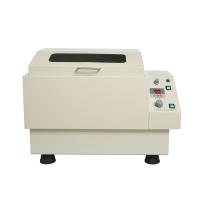
1. The core definition of oscillator and shaker
Oscillators and shakers are devices that are driven by motors or mechanics to periodically oscillate or shake the platform carrying the sample according to a set frequency, amplitude and motion mode. Its core function is to achieve uniform mixing of samples, simulate the reaction environment, or provide suitable growth conditions for biological samples (such as cells and bacteria) through regular motion.
From the structural point of view, the equipment is mainly composed of a drive system (providing power), a control system (adjusting parameters), a sample carrying platform (fixed container) and a stable body (reducing vibration interference). The application scenarios cover biological laboratories (cell culture, microbial fermentation), chemical experiments (reaction acceleration), environmental monitoring (sample preparation), and food industry (mixing and extraction), making it an indispensable basic tool in scientific research and industry.
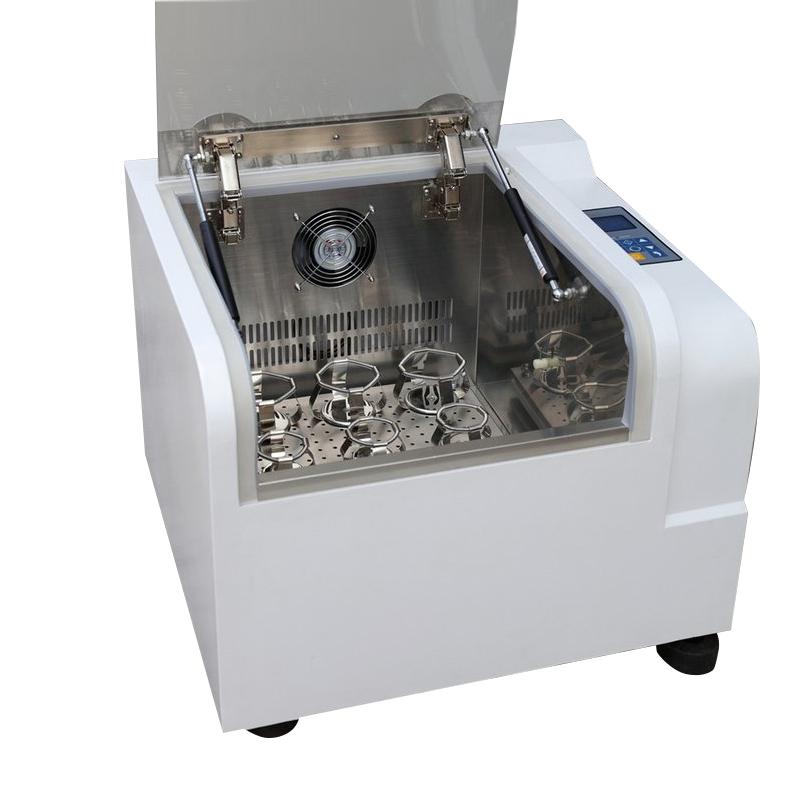
2. Type subdivision of oscillators and shakers
According to the differences in motion mode, control logic and application scenarios, oscillators and shakers can be divided into various types, each of which is designed for specific needs.
(1) Classification according to the mode of movement
1. Reciprocating type: The platform moves periodically in a straight line (front and back/left and right), suitable for gentle mixing (such as solution immersion, basic liquid mixing), and has low requirements for container tightness.
2. Rotary type: The platform rotates around the central axis to achieve strong mixing (such as centrifuge tubes, microplate reagent homogenization) through centrifugal force and liquid inertia, which is commonly used in chemical reaction acceleration scenarios.
3. Orbital type: The platform moves in a small circular orbit (typical amplitude 3-5mm), with gentle motion and uniform mixing, which is especially suitable for shear sensitive experiments such as enzyme-linked immunosorbent assay (ELISA).
4. Three-dimensional: combined with multi-directional compound motion (such as horizontal + vertical oscillation), suitable for complex needs (protein crystallization, special cell culture), but complex structure and high cost.
(2) Classification according to control methods
• Mechanical: Relies on a mechanical knob to adjust the speed, without accurate numerical display, suitable for basic experiments (such as conventional liquid stirring).
• Digital: Accurately control speed, time, temperature and other parameters through a microprocessor (accuracy up to ±1rpm), support program storage and repeated operation, suitable for high-precision scientific research scenarios.
(3) Classification according to application scenarios
• Constant temperature type: integrated heating system (temperature control range from room temperature to 80°C) to maintain stable sample temperature (e.g., microbial culture needs to be kept at 37°C).
• Cryogenic version: equipped with a refrigeration module (down to 4°C) for cryogenic reactions or sample preservation (e.g. enzyme activity protection).
• Micro-type: Designed for microplates (suitable for 96/384-well plates) for high-throughput screening (e.g., PCR reaction mixing).
3. The core testing principle of oscillator and shaker
Its function is based on the precise regulation of the motion state of the sample, and promotes physical/chemical/biological reactions through mechanical action.
1. Accelerated mixing and reaction
Regular vibration accelerates dissolution or chemical reactions (e.g., efficient binding of substrates to enzymes) by breaking liquid stratification and increasing the contact area of components. For example, in enzymatic reactions, appropriate shaking can increase the reaction rate by 30%-50%.
2. Cell culture optimization
In suspension cell culture, gentle shaking (such as 50-200rpm) maintains uniform distribution of cells to avoid nutrient deficiencies or metabolic waste accumulation caused by precipitation. The thermostatic oscillator further provides a stable temperature environment (e.g., mammalian cells need 37°C±0.5°C) to promote cell proliferation.
3. Sample uniformity control
In high-throughput experiments (e.g., microplate detection), the orbital/rotary motion ensures that the reagents are mixed evenly in each well, reducing well-to-well errors (standard deviation <5%) and improving the reliability of experimental data.
4. Collaborative regulation of the environment
Devices with integrated temperature control systems, such as thermostatic oscillators, can precisely control temperature uniformity (±1°C) to meet special environmental requirements such as PCR denaturation (95°C) and protein crystallization (4°C).
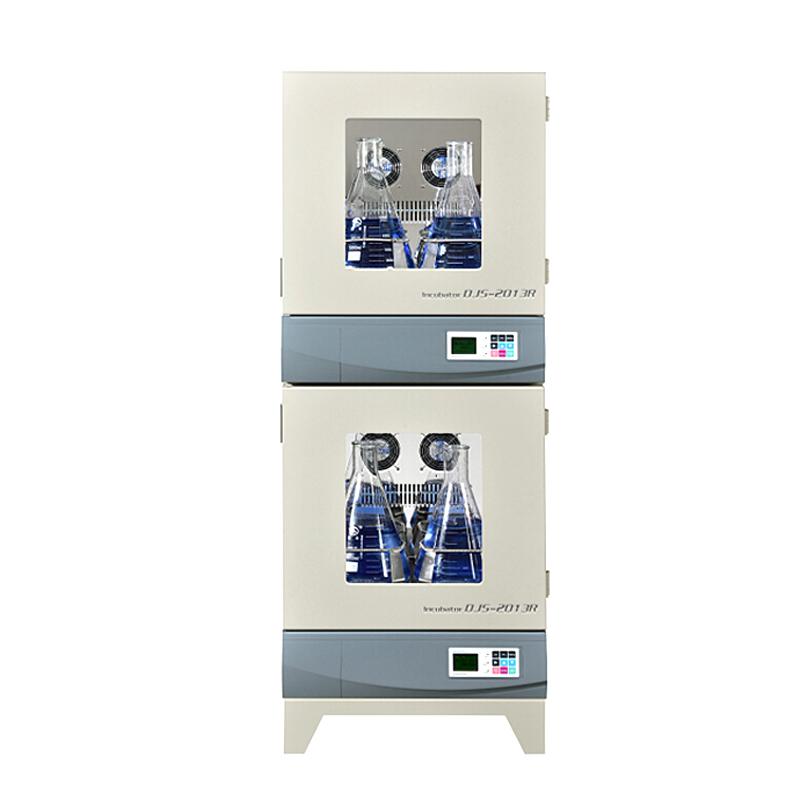
4. Key elements of scientific selection
The selection of adapted equipment should take into account the following factors:
1. Sports mode matching
• Conventional liquid mixing: reciprocating/orbital (gentle and efficient).
• Microplate/Centrifuge Tube Processing: Orbital/Rotary (splash-proof design).
• Complex mixing requirements: 3D oscillators (multi-directional synergy).
2. Rotation speed and amplitude parameters
• Low speed (10-300rpm): cell culture, gentle mixing.
• High speed (>1000rpm): fast dissolution, violent reaction.
3. Capacity and platform adaptability
Depending on the sample volume (e.g., tube/flask size) and the number of containers, the industrial-grade equipment needs to support multi-module expansion (carrying tens of kilograms of material).
4. Temperature control needs
The constant temperature test needs to confirm the temperature control range of the equipment (such as room temperature to 80°C) and uniformity (±1°C); For low-temperature experiments, compressor refrigeration or semiconductor refrigeration models should be selected.
5. Intelligent function
The digital device supports program presets (storing ≥ 10 sets of parameters), remote control and data logging, making it suitable for repetitive experiments and automated processes.
6. Stability and additional features
• Amplitude affects mixing efficiency (fine operation for small amplitudes, fast mixing for large amplitudes).
• Equipment stability (anti-vibration design) ensures long-term operation reliability.
• Low noise (<50dB) and low energy consumption design for laboratory environments.
epilogue
As core equipment in the laboratory and industrial fields, oscillators and shakers provide precise solutions for different scenarios due to their diverse types and functions. By understanding the motion patterns, test principles, and selection points, users can efficiently match equipment and experimental requirements, thereby improving experimental accuracy and optimizing production efficiency. Whether it's basic liquid mixing or complex cell culture, choosing the right shaker/shaker is critical to the success of your experiment.