One
Core type: the difference between the volume method and the coulomb method
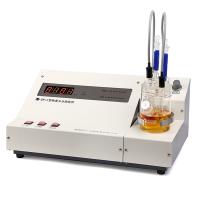
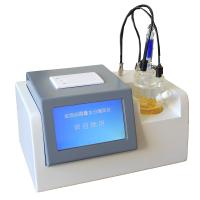
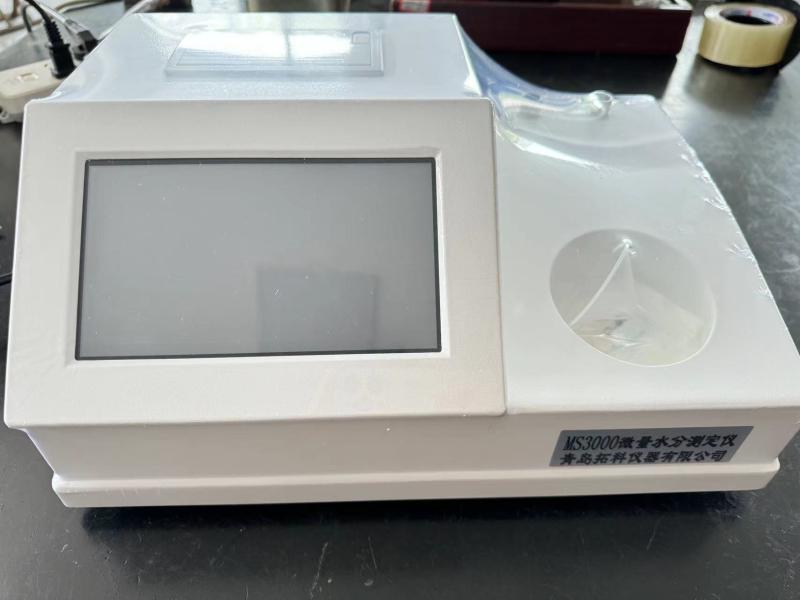
The technical basis of the Karl Fischer Moisture Meter is the Karl Fischer titration method, which achieves moisture determination by a chemical reaction in which quantitative water is consumed when iodine oxidizes sulfur dioxide. According to the different reagent consumption methods and detection principles, instruments are mainly divided into two categories: volumetric method and coulomb method.
Volumetric method Karl Fischer Moisture Meter
The volume method accurately measures the volume of Karl Fischer reagent consumed by the burette, combined with the titration of the reagent (the moisture content corresponding to the volume per volume) to calculate the sample moisture. This method is suitable for samples with high moisture content (usually > 100 ppm), intuitive operation, judgment of the end point by potential or color change, relatively simple instrument structure, low cost, suitable for the rapid detection of medium moisture samples in conventional laboratories, such as ordinary chemical raw materials, intermediates with non-high precision requirements, etc.
Coulomb Farkarfischer Moisture Meter
The Coulomb rule is based on the principle of iodine production by electrolysis, which dynamically generates iodine element (I₂) through electrolysis of iodine ions (I⁻), and directly calculates the moisture content according to Faraday's law of electrolysis (the amount of electricity consumed by electrolysis is directly proportional to the amount of iodine produced). It does not need to pre-prepare reagents, but generates iodine in real time through electrolysis, with higher sensitivity, and can detect trace moisture (< 100 ppm, or even as low as ppm), especially suitable for scenarios with strict moisture requirements, such as lithium battery electrolytes, high-purity chemicals, electronic-grade gases, etc.
The core difference between the two is that the volume method relies on external reagent titration and is suitable for conventional ranges; The coulomb method uses electrolysis of self-generated iodine, which has a lower detection limit and is more suitable for ultra-trace moisture analysis.
2. Wide range of applications of Karl Fischer Moisture Meters
From multiple industries to scientific research, Karl Fischer moisture analyzers cover almost all moisture-sensitive scenarios.
In some industries, the moisture content of a product is directly related to stability and effectiveness. If the active ingredients of raw materials are too high water content, they may decompose and fail, and the moisture of tablets or capsules will accelerate the growth of microorganisms. Relevant standards have strict regulations on moisture determination, and Karl Fischer Moisture Meters have become the core quality control equipment of the industry by accurately detecting the moisture of raw materials, intermediates and finished products.
In the food industry, moisture is a key factor affecting taste, texture and shelf life. Excessive moisture in baked goods is prone to mildew, improper moisture control of dairy products will shorten the shelf life, and excessive moisture in snack foods (such as potato chips and nuts) will lead to oxidation of fat. The Karl Fischer Moisture Meter can detect liquid (beverage), solid (powder, confectionery) and special forms (sauce) food, helping relevant enterprises optimize their production processes and enhance product competitiveness.
The chemical industry is more sensitive to moisture. Trace amounts of moisture in lithium battery electrolytes can lead to short circuits or performance degradation of batteries, high moisture content of lubricating oil will accelerate oxidation and deterioration, and water residues in organic solvents (such as methanol and acetone) will affect reaction efficiency. Karl Fischer moisture analyzers cover moisture detection from high levels (common solvents) to trace amounts (electronic grade chemicals) to support quality control in the petrochemical, fine chemical, and new energy industries.
In addition, the instrument is also widely used in scenarios such as environmental monitoring (such as trace water analysis in water quality), agriculture (seed moisture content determination), and scientific research institutions (moisture control in the research and development of new materials), making it a "rigid tool" for cross-industry moisture detection.
3. Four key elements of scientific selection
Choosing the right Karl Fischer Moisture Meter requires a combination of sample characteristics, testing needs, budget, and ease of operation.
Sample type and moisture range
First, the sample type and moisture range need to be defined. If the liquid sample has a high moisture content (>0.05% and no strong acid/oxidation), the volume method can be selected; If it is trace moisture (<0.5%) or contains interfering components (such as sulfide), the coulomb method is required. In solid samples, the Karl Fischer method can be used directly for organic solvents (such as chemical powders); For those that are difficult to dissolve or require rapid detection (e.g. plastic particles), they can be combined with a heating furnace or a halogen heater (not Karl Fischer principle, but suitable for rapid solid testing). Due to the very low moisture content (ppm class) of the gas sample, the coulomb method must be selected and equipped with a gas injection system.
Detection accuracy and range
Secondly, detection accuracy and range are the core indicators. Conventional testing (moisture > 0.1%) has low accuracy requirements, and the capacity method can meet it. In high-precision scenarios (e.g., some raw materials need to be controlled at < 0.1%, electronic materials < 10 ppm), the Coulomb method must be chosen to ensure an error of ≤ 0.1 μg.
Automation capabilities
Furthermore, automation capabilities can significantly improve efficiency. The multi-station autosampler is suitable for batch testing, and the touch screen interface and preset method library can lower the operating threshold. For high-frequency use scenarios, the instrument also needs to have a reagent management system (such as automatic dosing and draining) to avoid manual contact with corrosive reagents.
Security and maintenance costs
Finally, safety and maintenance costs cannot be ignored. Karl Fischer reagents are corrosive, so instruments with automatic reagent management are preferred; Long-term use requires attention to electrode life and electrolyte consumption, and durability designs (such as glass titration cells with better corrosion resistance) can reduce maintenance frequency.
epilogue
The selection of Karl Fischer Moisture Meters needs to be accurately matched according to the actual application scenario. Whether it is the high-precision needs of some industries, large-scale testing in the chemical field, or rapid analysis in the food industry, only by comprehensively considering the sample type, moisture range, accuracy requirements and ease of operation can the appropriate instrument be selected to provide reliable guarantee for product quality and production efficiency.