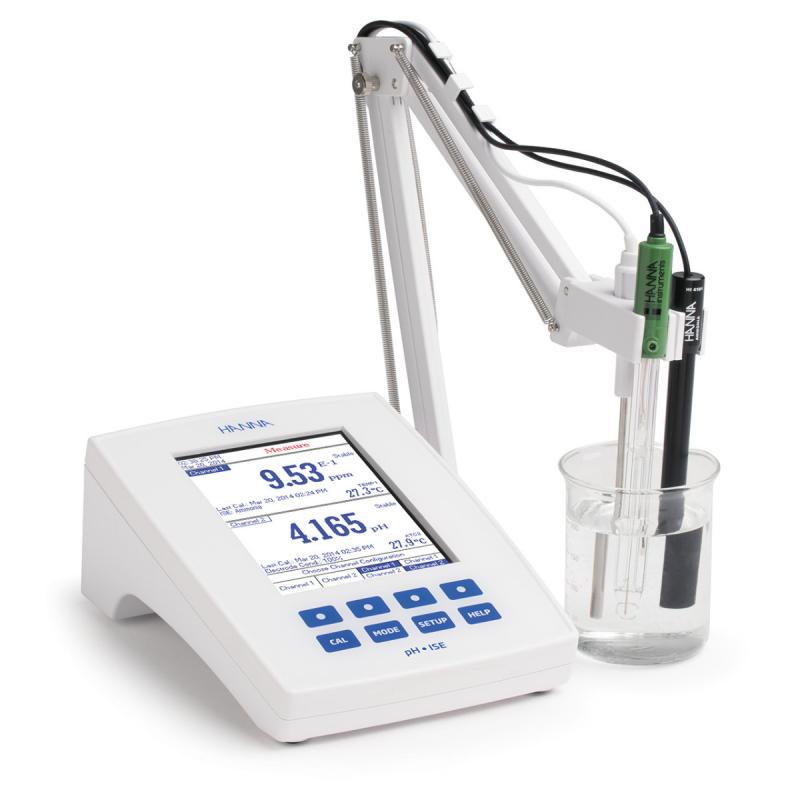
Acidity meter, also known as pH meter, is designed according to the practical definition of pH and the principle of potentiometric method, used to accurately measure the pH value of various aqueous solutions, and is widely used in laboratory analysis and industrial monitoring. Its core structure is "pH-potential transmitter" and "potential-acidity conversion indicator": the former uses the saturated mercury reference electrode and the glass indicator electrode as the core to convert the acidity change of the solution into a potential signal; The latter processes the signal through an internal module that displays the pH level directly.
The glass electrode is highly selective for hydrogen ions, not interfered with by oxidants, surfactants, etc., and can measure colored, turbid or colloidal solutions, and can also be used for neutralization potential titration, and has fast balance, simple operation and non-contamination test solution. However, it has limitations: glass bulbs are easily damaged, the conventional measurement range pH is 1-9, and fluorine-containing solutions cannot be measured, because the resistance is extremely high (10^6~10^9Ω), it needs to be measured with high input impedance equipment.
How it works
The acidity meter works on the basis of the Nernst equation, and the key components are the indicator electrode (commonly used glass electrode) and the reference electrode (commonly saturated mercury electrode). The two electrodes are inserted into the solution to form the galvanic battery, indicating that the electrode potential changes with the hydrogen ion activity, and the reference electrode potential is stable, and the potential difference between the two is related to the hydrogen ion activity.
After the potential difference is transmitted to the meter, the circuit converts it to pH according to the Nernst equation (at 25°C, the potential difference changes by 59.16mV and the pH changes by 1). Some acidity meters have a temperature compensation function that corrects the effect of temperature on the measurement, ensuring accurate readings at non-standard temperatures, and the final result is displayed on the dashboard or screen.
Types and characteristics
Acidity meters commonly used in laboratories can be divided into two categories according to the type of amplifier
(1) Directly coupled with DC amplification acidity meter
The core of the meter is a direct-coupled DC amplifier, the signal is directly input to the amplification stage, which is transmitted after impedance transformation, and the front and rear stages are directly coupled through resistance. The advantages are simple circuit, easy maintenance, high sensitivity, and can detect small fluctuations in pH. The disadvantage is that the input impedance is limited by the tube, which is easily affected by temperature and voltage and has zero point drift, which needs to be compensated by constant temperature design, zero point correction and other measures. Representative models include pHS-25, pHS-29A, etc., which are suitable for conventional precision testing scenarios.
(2) Modulated DC amplification acidity meter
In order to solve the direct coupling defect, the "modulation-AC amplification-demodulation" process works: the DC signal is first converted into an AC signal of a specific frequency, amplified by the pre-stage and intermediate stage, and then demodulated to a DC signal to promote the display, and at the same time corrects the error with the help of the feedback network (including temperature compensation and positioning compensation).
Its advantages are high input impedance (up to more than 10^12Ω), small zero drift, and more stable performance, which is the mainstream of modern mid-to-high-end acidity meters. The quality of modulated devices (mechanical vibrators, field-effect transistors, etc.) determines the performance and needs to meet the requirements of high modulation coefficient, low noise, and long life. Representative models include pHS-2 (accuracy 0.02pH), pHS-3 (with temperature compensation), and pHS-3C (digital display), which are suitable for high-precision scenarios such as inspection and environmental monitoring.
Fields of application
Chemical industry - monitor the pH of reactor solution to ensure antibiotic purity and dye color and light stability; Detect the pH of chemical wastewater to determine whether neutralization is needed to avoid polluting the environment.
Environmental protection - regularly monitor surface water pH (normal 6.5~8.5) to identify acid rain and industrial wastewater pollution; Control the pH of the aeration tank and sedimentation tank of the sewage treatment plant to improve the purification efficiency.
Food industry - control the end point of yogurt fermentation (pH 4.0~4.5) and judge the freshness of fruits and vegetables (such as apples with pH exceeding 5.5 and spoilage); Optimize beverage pH to balance taste with preservative effects.
Agriculture – measuring soil pH and guiding improvement (acidic soil with lime, alkaline soil with ferrous sulfate); Crops are selected according to pH (acidic soil tea tree, alkaline soil cotton) to improve yield and quality.
summary
Acidity meter is a key instrument for measuring the pH value of aqueous solutions, relying on the practical definition of pH and the Nernst equation, through two core components to realize the function, and the characteristics of the glass electrode determine its scope and limitations. According to the type of amplifier, it is divided into two categories, and the modulation type has become the mainstream due to its better performance. It plays an important role in the fields of chemical industry, environmental protection, food, agriculture, etc., and is not only the core tool of quality control, but also a reliable support for scientific research and production, which is of great significance to ensuring the accuracy and efficiency of various industries.
