1. High Temperature Test Chamber: professional equipment for accurately simulating high temperature environments
The high-Temperature Test Chamber is specially used to test the adaptability of machinery, instruments, electrical and electronic products, etc. in high-temperature environments, which is very different from ordinary drying ovens. Ordinary drying ovens are only used for drying and baking, while the temperature error, change rate, temperature difference between inside and outside the workshop of the high-Temperature Test Chamber must meet national standards, so ordinary drying oven cannot replace it for high-temperature testing.
structure
The high-Temperature Test Chamber adopts a fully symmetrical air duct circulation, and the axial flow fan on the back of the box rotates in reverse, sucking in the air from the studio and blowing it to the air ducts on all sides, and then flowing back to the studio to form uniform convection. The electric heater is evenly installed in each air duct to ensure stable temperature. The electrical control part is a modular design, consisting of TA-092 regulator, ZK-50 thyristor voltage regulator, etc., which can be hung on the side of the main unit and can be controlled from a distance by changing the leads. In terms of safety, there are three sets of protection devices for setting value over-temperature alarm, extreme high temperature alarm, and fuse power off and shutdown to avoid safety problems.
use
The equipment should be placed in a dry room, equipped with a special power switch and grounded, and the electrical performance should be checked before starting to prevent leakage. During the test, the line cannot be changed casually, and the fault should be checked against the manual. In daily maintenance, do not use it as an ordinary drying oven, and cannot bake volatile and corrosive items; Leave enough space for the placement of the test product, otherwise it will affect the test effect; It is also necessary to clean the motor fan regularly, replace the worn bearings in time, add special lubricating oil, keep the surrounding area clean and free of flammable materials, and do not let people stay near the safety door when running at high temperatures.
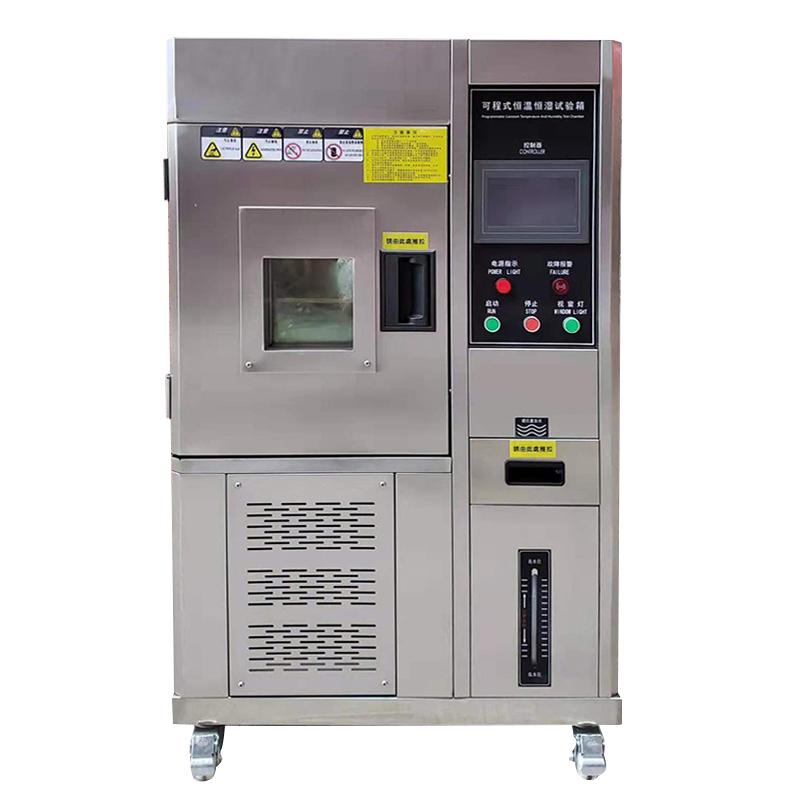
2. Low Temperature Test Chamber: in-depth application of overlapping refrigeration technology
The low-Temperature Test Chamber mainly evaluates the performance stability of products and materials at low temperatures, taking DW-808 as an example, it is divided into three parts: upper working room, lower refrigeration unit, and back air conditioning room. The evaporator, heater and axial flow blower device in the air-conditioning room are separated from the working room by a double-layer partition to avoid direct radiation of the specimen by hot and cold elements. The observation window of the box door is convenient to see the test situation, and the side test hole can be used for specimen leads.
structure
At its core is a stacked refrigeration system, which works together on the hot and low temperature sides. F-13 refrigerant is used on the cryogenic side, which is compressed by the compressor, pre-cooled by the precooler, de-oiled by the oil separator, liquefied by the condensate evaporator, and then depressurized by the expansion valve and then entered the evaporator to absorb heat, so that the studio can cool down, and finally the cycle is completed through the heat exchanger reflow. F-22 refrigerant is used on the high-temperature side, which mainly cools the gas discharged from the low-temperature side and provides ultra-low condensation temperature to the low-temperature side through similar circulation. For safety, check valves, expansion vessels, and capillaries are also added to the low-temperature side, which can buffer when the shutdown pressure changes drastically, and automatically replenish refrigerant during operation.
use
The equipment should be verified according to the GB5170.2-85 standard, and a special power supply and grounding device must be installed before use. During operation, the target temperature is set first, and the chiller and fan are started after switching to the temperature measurement mode. When leading the line from the test hole, it is necessary to use a sponge to seal the gap to prevent temperature loss, and turn off the observation window when the lighting is exhausted. During maintenance, you cannot put anything within 120 mm of the chiller filter, otherwise it will affect the condensation effect; If the condensing fan does not start or the compressor delays for 2-3 seconds, it must be stopped immediately for inspection; Do not turn on and off the chiller frequently in a short period of time, and do not touch the pipeline valve to prevent refrigerant leakage.
3. High-low Temperature Test Chamber: dual simulation of temperature drastic change and gradation
The name of the high-low Temperature Test Chamber varies due to different standards, and our country's GB2423.22-81 standard uniformly calls it a temperature change Test Chamber, including mutation type and gradual type, and foreign countries often call the mutation type cold and hot shock Test Chamber. This type of equipment is widely used in automotive electronics, aerospace and other fields, and the global market sales have reached 13.82 billion US dollars, and the main manufacturers are LABTECH, BINDER, etc.
Classification and use
High-low temperature mutation Test Chamber: There are double chambers, or dual generators with single chambers, which are used to test the adaptability of products in sudden temperature changes, and must comply with IEC-68-2-14 test Na and similar standards in our country.
High-low temperature gradient Test Chamber: can automatically cycle and adjust the temperature according to the specified rate, mainly test the performance of the product when the temperature changes slowly, in line with IEC-68-2-14 test Nb and other standards, the temperature rise and fall rate is 1°C±0.2°C/min, 3°C±0.6°C/min, 5°C±1°C/min.
Structural principles
Air medium mutation structure - there are balance type (older, specimen lifting and moving), vertical moving type (compact structure, specimen alternating up and down), horizontal moving type (specimen immovable, high-low temperature chamber moving, convenient for power-on testing), cylinder rotary type (workshop rotary docking generator, small footprint, large volume, advanced design). There is also a damper control type, which relies on a cylinder to drive the damper to switch between hot and cold air, and Satake Chemical Company of Japan has such mature products.
Liquid medium mutation equipment - using water, silicone oil, etc. as the medium, set up high-low temperature double liquid tank, through the mechanical device to drive the specimen to be immersed alternately, strong thermal stress, suitable for testing glass and metal sealing components, temperature range - 65°C to 200°C.
Solid medium mutant equipment - using fluidized solid particles as heat transfer medium, divided into mechanical refrigeration and liquid helium refrigeration, low temperature can reach -65°C, high temperature 200°C, no medium loss than liquid tank type, easy to clean, suitable for solid circuit testing, in line with MIL-STD-883B standard.
Gradual structure - single-chamber design, shaped like a low-Temperature Test Chamber, with strong refrigeration capacity and temperature program control, can quickly start the refrigeration mode after the end of the high temperature stage.
Technology development and maintenance
Now the high-low Temperature Test Chamber is developing in the direction of refrigerant flow servo control, and companies such as Taiqi Technology use PID+Fuzzy control to adjust the electronic expansion valve, which is more energy-saving than traditional manual valves and can achieve carbon reduction goals. The equipment should be verified according to the GB5170.4-85 standard, the common BJYSL-GDW-225 type, the working chamber size is 500×600×750mm, the temperature range is - 70°C to 150°C, and the humidity fluctuation is ±2.5% RH.
Pay attention to use and maintenance: heat up the water vapor in the drying box after the test, and regularly clean the calcification of the humidified water tray; Do not open the box during the high temperature and high humidity test, and do not repeatedly switch the refrigeration unit within three minutes; Regularly check safety devices such as circuit protectors, which is consistent with the idea of "paying attention to data and finding hidden dangers" in equipment troubleshooting, which can reduce minor faults. At the same time, equipment production should comply with GB 26572-2025 standards to control the content of harmful substances such as lead and mercury.
summary
High-temperature, low-temperature and high-Temperature Test Chambers are key equipment to ensure the stable operation of products in different temperature environments, each of which plays a role in different temperature needs: high-Temperature Test Chambers focus on high-temperature environment assessment, low-Temperature Test Chambers focus on low-temperature performance evaluation, and high-low Temperature Test Chambers take into account the testing of sudden temperature changes and gradual scenarios. They have their own technical priorities in structural design, and their use and maintenance need to follow standard specifications, not only to ensure the accuracy of test data, but also to avoid equipment failure and safety risks. With the development of technology, this type of equipment continues to upgrade in the direction of more energy saving and more accurate, and continues to provide strong support for product quality control and performance optimization in various industries.
