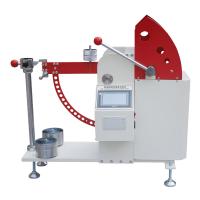
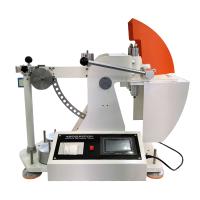
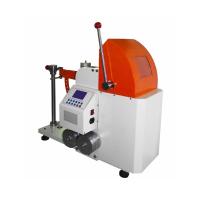
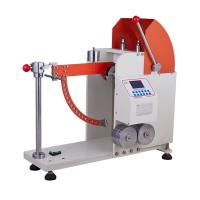
The puncture strength tester is a special instrument used to detect the ability of materials to resist the puncture and failure of sharp objects, and quantifies the material puncture strength index by simulating the process of sharp objects impacting the puncture material, providing data support for the evaluation of material resistance resistance.
Instrument type
1. Benchtop precision type: dedicated to the laboratory, accurate puncture speed and force control, complete data acquisition system, support multiple sets of test comparison and analysis, and adapt to high-precision testing requirements.
2. Portable on-site type: small and easy to carry, easy and fast operation, can quickly complete the puncture test, suitable for production site or outdoor material quality sampling.
3. Servo control type: Driven by servo motor, the puncture force and speed can be accurately adjusted, and the custom test mode is supported, which is suitable for multi-working conditions of complex materials.
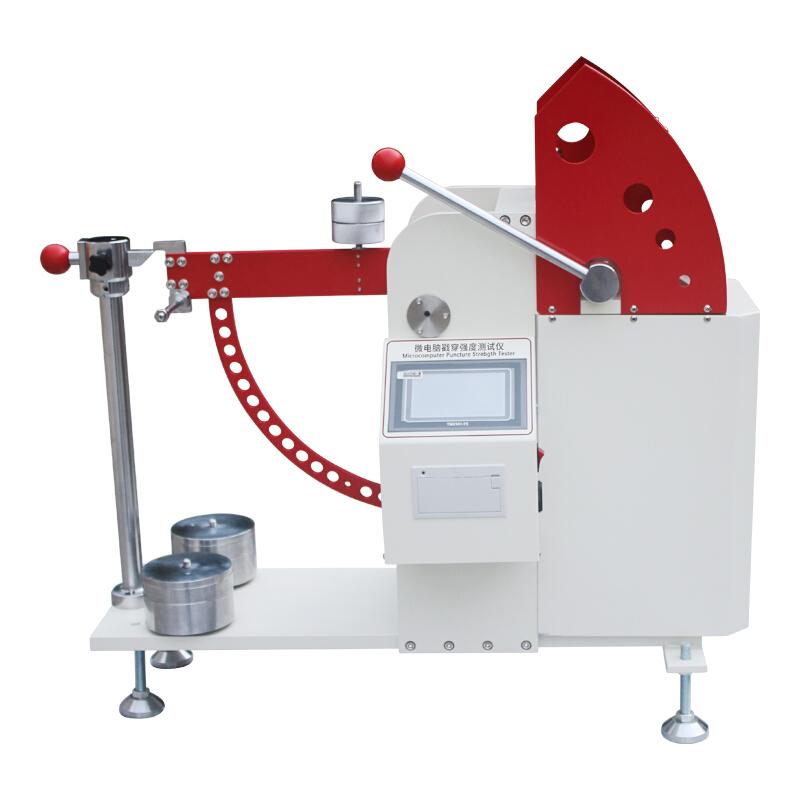
Test principle
Prepare material specimens of specified sizes according to industry standards, and fix the specimens on the instrument fixture to ensure that the grip is firm and not loose. After starting the instrument, the puncture mechanism drives the needle to impact the puncture specimen with preset parameters, and the sensor collects the force value change and puncture depth data during the puncture process in real time until the specimen is completely punctured. After the test, the system automatically calculates and outputs key indicators such as the material's puncture strength and maximum puncture force.
Fields of application
1. Packaging industry: Test the puncture resistance of packaging materials such as corrugated boxes, plastic packaging films, and composite packaging bags to ensure that the packaging is not easily damaged during transportation and handling.
2. Paper industry: Evaluate the puncture strength of paper products such as paper, cardboard, and honeycomb core to determine their durability in printing and packaging applications.
3. Building materials industry: suitable for puncture resistance testing of waterproof membranes, insulation boards, decorative boards and other materials to verify the protective performance during the use of materials.
4. Plastic and rubber industry: Test the puncture resistance of polymer materials such as plastic films and rubber sheets to provide a basis for material formulation optimization and product quality control.
Common faults and solutions
1. Abnormal display of puncture force value: check the calibration status of the puncture sensor and recalibrate it with standard weights; Clean the sensor connection lines to rule out poor contact or signal interference.
2. Unstable needle puncture: Replace worn or deformed puncture needles, adjust the needle mounting position, and ensure that the needle is vertically aligned with the specimen.
3. Loose specimen clamping: Replace the clamp suitable for the specimen size and adjust the clamping pressure to avoid specimen slippage or deformation during testing.
4. Instrument operation lag: overhaul the transmission mechanism, add special lubricating oil; Clean the dust and impurities inside the fuselage, check the motor running status, and troubleshoot.
Selection method
Priority is given to matching material characteristics, and instruments corresponding to the puncture force range and needle type are selected according to the thickness and hardness of the material. refer to industry testing standards (such as GB/T 2679.7 in the packaging industry) to ensure that the instrument meets the standard testing requirements; Pay attention to core parameters, select equipment with high force accuracy, wide adjustable puncture speed and stable data collection; Combined with the usage scenarios, the laboratory precision test selects the benchtop precision type, the on-site sampling selection selects the portable type, and the complex material test selects the servo control type.
summary
The puncture strength tester is divided into three categories: benchtop precision, portable on-site, and servo control, which quantifies the puncture resistance of materials through standardized puncture tests, and is widely used in packaging, papermaking, building materials and other industries. During use, it is necessary to solve common faults such as abnormal force values and unstable needles, and combine the material characteristics, standard requirements, core parameters and usage scenarios to ensure accurate and reliable test results.