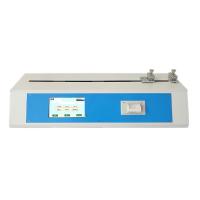
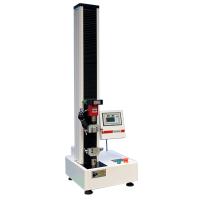
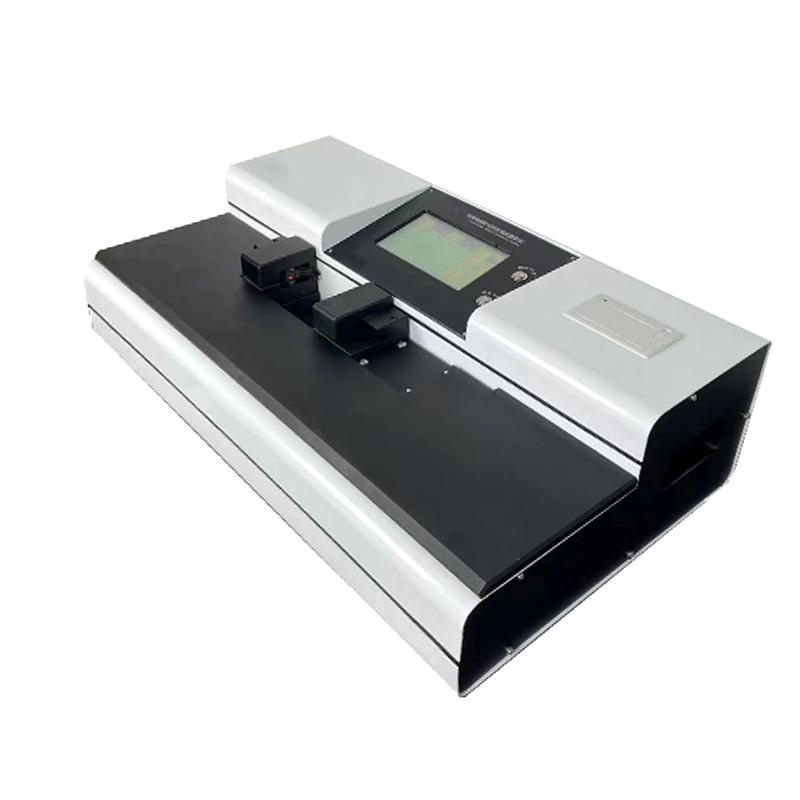
The tensile strength tester is a special equipment based on the principle of material mechanics to detect the mechanical properties of materials under axial tensile force. By applying uniform tensile force to fracture or setting the amount of deformation, key indicators such as tensile strength and elongation at break can be measured, providing data support for material quality assessment, R&D optimization, and is an important tool for industrial production and scientific research.
Main types
Electronic universal type: servo motor drive, high precision, easy operation, suitable for the testing of plastics, films, textiles and other medium and low strength materials, is a common model in laboratories and small and medium-sized enterprises.
Hydraulic type: The hydraulic system provides large load, strong stability, suitable for testing high-strength materials such as metals and building materials, and is widely used in heavy-duty industrial quality inspection.
Test principle
After preparing the specimen according to the standard, it is fixed with a clamping device; The drive system applies axial tension at a uniform speed, and the sensor collects the tension and elongation data synchronously. The data system calculates tensile strength, elongation at break and other indicators and generates a report.
Fields of application
Plastics and rubber industry - raw material inspection and formula research and development;
Packaging materials industry - tensile and tear strength testing of film and paper;
Textile and leather industry - tensile strength and elasticity testing of yarns and fabrics;
metal and building materials industry - tensile performance testing of steel and steel bars;
Scientific research field - research on mechanical properties of new materials.
Common faults and solutions
Data bias (sensor drift)
The reason is that it is not calibrated, temperature change or power supply fluctuation, and it is necessary to calibrate regularly, control the temperature (15-25°C), and check the power supply grounding;
Clamping and slipping
Due to mismatch, insufficient strength or wear of the fixture, it is necessary to replace the special fixture, adjust the pressure or repair the clamping surface;
Abnormal tensile curve
Most of them are driven faults or specimen eccentricity, and the transmission parts need to be overhauled and the specimen reinstalled;
Data transmission error
Due to loose connections, software compatibility, or port problems, you need to replug the connection, upgrade the software, or replace the port.
How to choose
Select the type according to the strength of the material - choose the electronic universal type for medium and low strength, and choose the hydraulic type for high strength;
Determine the accuracy according to the scene - choose high-precision models for scientific research, and choose ordinary precision models for regular quality inspection;
Consider the operational needs - choose the automated model for batch testing, and choose the portable one for the field test;
Confirm compatibility with industry standards, take into account equipment cost-effectiveness and after-sales service.
summary
As the core equipment of material mechanics testing, the tensile strength tester covers the testing needs of materials of different strength through electronic universal and hydraulic models, and its scientific tensile testing principle can accurately obtain the key mechanical indicators of materials, widely serving the quality inspection and research and development of multiple industries. In daily use, it is necessary to solve common faults such as sensor drift and clamping slippage, and the selection of materials can give full play to its supporting role in material quality control and technological innovation.