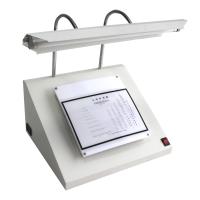
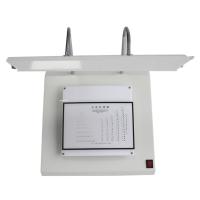
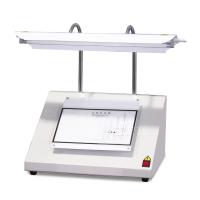
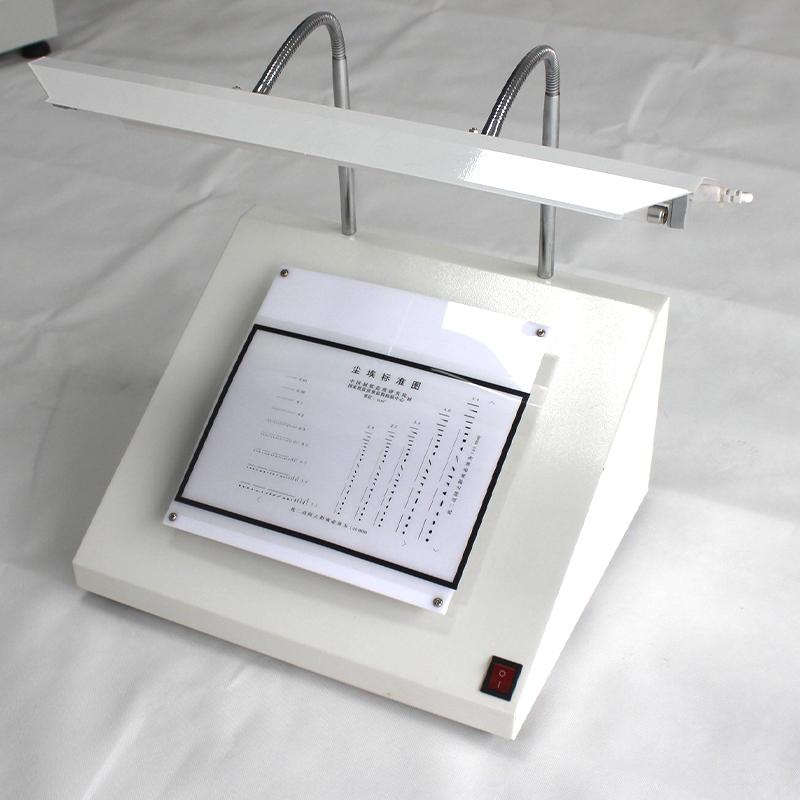
The dust meter is a precision instrument based on optical detection technology that quantitatively analyzes the surface and internal defects of sheet materials such as paper, pulp, cardboard, and film, as well as dust, black spots, impurities, and fiber bundles. Quantify defects (units/㎡ or mm²/㎡) through standardized processes, provide data support for material cleanliness assessment and production quality control, and adapt to domestic and foreign standards such as GB/T 1541 and ISO 5350.
type
Dust meters are mainly divided into three categories: manual type has a simple structure and low cost, and is suitable for routine sampling inspection of small enterprises through manual comparison with standard sample counting, but has low efficiency and strong subjectivity; The automatic type is equipped with CCD/CMOS imaging system and analysis software, which automatically counts dust parameters, with high accuracy (resolution ≥ 0.01mm), objective data, suitable for high-precision laboratory or batch testing, high price and regular calibration; The online type is installed in the production line, real-time image acquisition and linkage alarm/rejection to achieve continuous quality control, but the installation and commissioning are complex, the site environment requirements are high, and the cost is the highest
Test principle
The core is based on optical contrast and digital processing: the light source uniformly irradiates the specimen, and there is a difference in the reflection/transmission characteristics of dust and material matrix to light, and the sensor captures the optical signal and converts it into an electrical signal.
Fields of application
Paper industry - raw material quality inspection, production process monitoring, finished product factory inspection (covering cultural paper, packaging paper, special paper, etc.).
Packaging/printing industry - Cleanliness testing of food packaging materials and printing paper to ensure product safety and printing quality.
Film/flake industry – impurities and pinhole detection of plastic films, aluminum foils, tobacco flakes, etc.
Scientific research / quality inspection institutions - material property research, standard verification and quality arbitration.
Common faults and solutions
Image blur: Clean the lens and stage, check the brightness of the light source, and recalibrate the focal length.
Inaccurate counting: Adjust the detection threshold, replace the qualified standard sample, level the specimen and calibrate the optical parameters.
Data cannot be exported: Check the interface connection, update the driver/software, clear the cache, or reinstall the software.
Linear false alarm: clean the probe dust, fix the probe position, and use shielded wires to reduce signal interference.
How to choose
Laboratory high-precision testing is automatic, small enterprises are routinely sampling manual, and production line real-time monitoring is online.
Focus on detection range, resolution, repeatability, and data export capabilities.
Preferentially choose models that meet national standards/international standards such as GB/T 1541.
Balance precision needs with budget, and choose a manufacturer with perfect after-sales service.
summary
The dust meter is the core equipment for the cleanliness detection of flake materials, and the manual, automatic and online types are adapted to the needs of different scenarios, and its detection principle based on optical contrast ensures the objectivity of the data. In use, failures can be reduced through regular cleaning and calibration, and the selection of models can focus on the adaptability of scenarios, parameters and standards, which can maximize the quality control value of the instrument. As a key tool for production process optimization and product quality assurance, dust meters play an irreplaceable role in papermaking, packaging, printing and other industries, directly affecting the product competitiveness and industry reputation of enterprises.