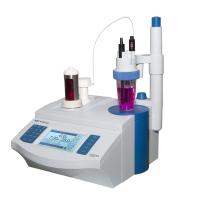
Potentiometric titrator is a capacitance analysis instrument that determines the titration endpoint based on electrode potential changes, compared with the traditional indicator titration method, it can avoid the error of the human eye judgment of the endpoint, has higher detection accuracy and repeatability, and is widely used in various physical and chemical analysis scenarios.

The types of potentiometric titrators can be divided into two core dimensions, classified according to the type of titration reaction, including acid-base potential titrator, redox potential titrator, precipitation potential titrator, and complex potential titrator, which are suitable for the detection needs of chemical reactions. According to the classification of control and operation mode, it can be divided into manual potentiometric titrator and automatic potentiometric titrator, of which the automatic potentiometric titrator is subdivided into equivalence point titrator, potentiostatic titrator, dynamic titrator, etc., and the automatic model can realize the automatic completion of the whole process of titration, end point judgment and data calculation, greatly improving the detection efficiency.
Fields of application
The application scope of potentiometric titrators covers a wide range of industries. In the chemical industry, it is used to determine the acid-base concentration, purity and impurity content of chemical raw materials; In the food industry, it can detect the acidity, salt, sugar and preservative content of food; In the environmental protection industry, it is used to monitor pollutants such as heavy metal ions, cyanide, and sulfide in water quality. In the metallurgical industry, it is possible to analyze the content of metal elements in ores and metal materials.
Common faults and solutions
Slow electrode response: mostly due to surface contamination or passivation of the electrode, the electrode can be rinsed with distilled water, and then soaked in the corresponding solution for activation.
Potential value drift: There is a high probability that the liquid filling in the reference electrode is insufficient, contaminated or blocked at the liquid junction, and the internal filling fluid needs to be replenished or replaced in time to clean the liquid junction part.
The titration end point is not obvious: generally the titration speed is too fast or the electrode is aging, which can reduce the titration speed, and if the electrode is old, a new electrode needs to be replaced.
The instrument cannot be titrated normally: mainly the titration pipeline is blocked or the solenoid valve is faulty, and the pipeline needs to be dredged, and the solenoid valve needs to be repaired or replaced.
Potentiometric titrator selection
First of all, it is necessary to clarify the type of titration reaction, and select the corresponding model according to the testing items, such as acid-base potentiometer for food acidity measurement, and complex potential titrator for heavy metal measurement. Secondly, the degree of automation should be considered, and manual or semi-automatic models can be selected for small-batch and multi-variety testing in the laboratory, and fully automatic models should be preferred for industrial batch testing or high-precision requirements. Thirdly, it is necessary to pay attention to accuracy indicators, and give priority to products equipped with high-precision metering pumps and high-sensitivity electrodes to meet the needs of trace or trace analysis. Then consider scalability to see if the instrument supports multi-electrode switching and multiple titration modes, and whether it can adapt to the expansion of future testing projects. Finally, pay attention to ease of use, choose a model with a user-friendly interface and data storage and export functions to facilitate experimental recording and data management.
summary
The potentiometric titrator is a kind of physical and chemical detection instrument that relies on the change of electrode potential to achieve accurate titration analysis, which has a wide range of types, can adapt to different chemical reactions and operational needs, and its core advantage is that it can avoid the error of manual judgment of the end point and improve the accuracy and repeatability of the test results. With its wide adaptability, the instrument plays a key role in many fields such as chemical, food, and environmental protection, and mastering its common fault handling methods and scientific selection skills can further ensure the efficiency and stability of testing work and meet the needs of analysis and testing in different scenarios.