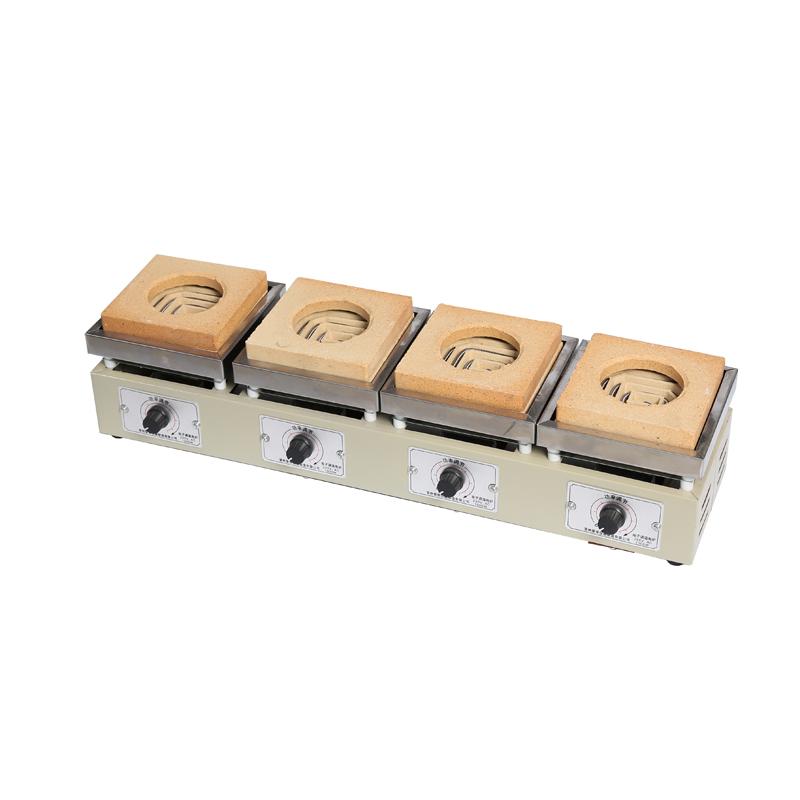
The universal electric furnace is a commonly used general-purpose heating equipment in laboratories and small production scenarios, with resistance wire as the core heating element, through the current thermal effect to achieve heat output, with simple structure, convenient operation, adjustable heating temperature and other characteristics, can heat, dry, melt, evaporate and other operations on a variety of samples such as liquids and solids.
type
According to the structural form, it can be divided into open universal electric furnace and closed universal electric furnace, which has good heat dissipation and closed can effectively prevent debris from falling into the heating body; According to the number of heating links, there are single, double, quadruple, six-link and other specifications, which can meet the needs of heating multiple samples at the same time. According to the temperature control method, including ordinary universal electric furnace and digital temperature control universal electric furnace, the ordinary type needs to manually adjust the voltage and temperature control, and the digital display temperature control type can accurately set and maintain the target temperature.
Test principle
The core working principle of the universal electric furnace is Joule's law, when the current passes through the electric heating wire with a certain resistance value, it will convert electrical energy into heat energy and radiate outward. By adjusting the voltage of the external voltage regulator, the current through the heating wire can be changed, and then the heat generation of the heating wire can be controlled to realize the adjustment of the heating temperature. The digital display temperature control universal electric furnace is additionally equipped with a temperature sensor and temperature control system, which can monitor the heating temperature in real time and automatically adjust the power to keep the temperature within the set range.
Fields of application
Universal electric furnaces are widely used in chemical laboratories for experimental operations such as heating and dissolving samples, evaporation and concentration, and burning decomposition. In biological laboratories, it can be used for heating, melting, and insulating culture media; In the industrial field, it is suitable for preheating and drying small workpieces and heat treatment of small batches of samples; In addition, it can also be applied to teaching experiments to help students intuitively understand the principle of electric current thermal effect.
Common faults and solutions
No heating after power-on - mostly the resistance wire is burned, the power line is broken or the plug is not in good contact, you can replace the resistive wire with a new one, check whether the power cord is broken, and replug and unplug the plug to ensure good contact.
Temperature regulation failure - the ordinary type may be a voltage regulator failure, and the digital display temperature control type is likely to be the temperature sensor is damaged or the thermostat fails, and the regulator, sensor, and thermostat need to be overhauled or replaced.
The shell is overheated or smells - usually poor heat dissipation or overloaded heating power, and the debris on the surface of the electric furnace should be cleaned in time to ensure smooth heat dissipation and avoid long-term high-power heating.
Uneven redness of the resistance wire - the reason is that the resistance wire is loose or locally oxidized, the fixing screw of the resistance wire can be tightened, and the resistance wire needs to be replaced when the oxidation is severe.
How to choose
Choose single or multi-link models according to the number of samples heated in a single time. For experimental scenarios that require precise temperature control, the digital display temperature control type is preferred.
When the sample volume is large or needs to be heated up quickly, choose a model with higher power; Conventional small sample heating, with the option of small and medium-power products to save energy consumption.
Priority should be given to purchasing universal electric furnaces with insulated and thermal insulation shells and overload protection devices to reduce potential safety hazards during use.
Open model can be selected for laboratory routine operation; For places with a lot of environmental debris, it is recommended to use a closed universal electric furnace to protect the heating elements.
summary
The universal electric furnace is a general-purpose heating equipment with Joule's law as the core principle and relying on resistance wire to generate heat, and its type can be flexibly divided according to the structure, number of links, and temperature control methods, which can adapt to different heating needs such as single sample or multiple samples, ordinary temperature control or precise temperature control. The equipment is easy to operate and cost-effective, and is widely used in laboratory sample processing, industrial small-batch processing, teaching experiments and other scenarios, mastering its common troubleshooting methods and scientific selection skills, which can not only extend the service life of the equipment, but also ensure the efficiency and safety of heating operations, and meet the basic heating needs of many fields.
