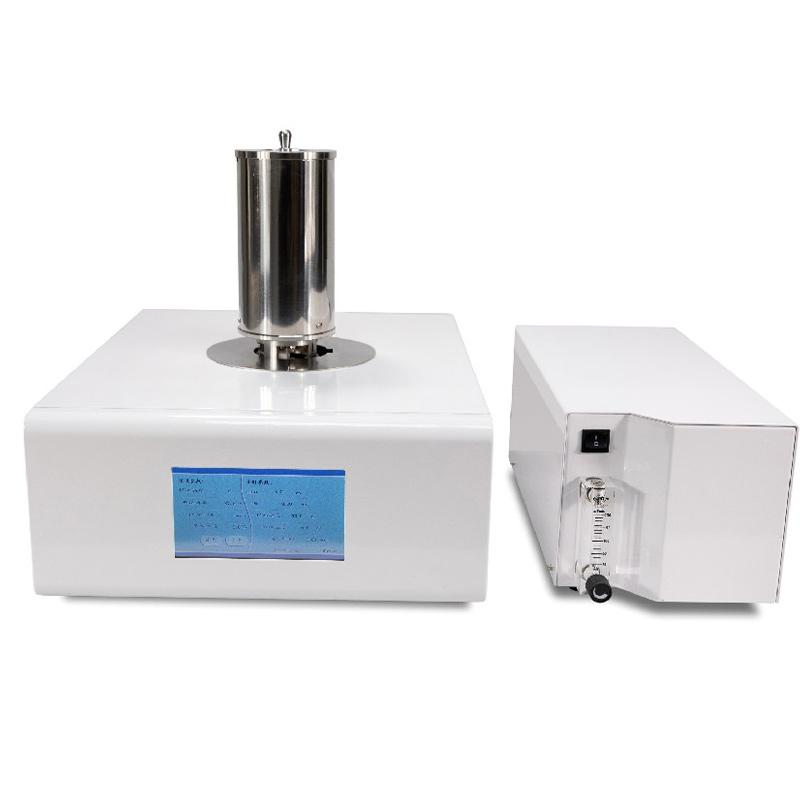
Thermogravimetric Analyzer (TGA) is a thermal analysis instrument based on thermogravimetric analysis, which can continuously measure the change of substance mass with temperature or time under the temperature controlled by the program, so as to analyze the thermal stability, component content, thermal decomposition process and other characteristics of the substance.
type
Divided by heating method
Dynamic thermogravimetric analyzer - Detects changes in quality during the dynamic process of program warming, cooling, or constant temperature, and is a common type used in laboratories for thermal behavior analysis of most materials.
Static thermogravimetric analyzer - mass testing at a fixed temperature, mostly used to study the long-term stability of substances at specific temperatures, such as high-temperature aging testing of polymer materials.
Divided by measurement accuracy
Conventional thermogravimetric analyzer - mass resolution at the level of 0.1mg, which can meet the needs of daily routine analysis.
Micro/Ultramicro thermogravimetric analyzer - mass resolution up to 0.01mg and higher, suitable for accurate analysis of microgram-level biological samples, nanomaterials and other trace samples.
By combined technology
Single thermogravimetric analyzer - only has basic thermogravimetric analysis functions, simple structure, easy operation, suitable for basic mass change research.
Combined thermogravimetric analyzer - can be combined with infrared spectrometer, gas chromatography-mass spectrometry and other equipment to detect the composition of gas products produced by thermal decomposition while analyzing mass changes, and realize the simultaneous analysis of "mass change + product qualitative".
Test principle
At its core, thermogravimetric analyzers use high-precision balances to monitor the quality of samples placed in the furnace in real time in a programmed temperature-controlled environment. During the experiment, the sample to be tested is placed in a special crucible and placed in the heating furnace, and the same empty crucible is placed on the other side of the balance as a reference. The temperature control system heats up, cools down or constant the temperature at a preset rate, and controls the atmosphere in the furnace at the same time. When the sample undergoes physical or chemical changes such as thermal decomposition, oxidation, and dehydration, there will be an increase or decrease in mass, and the high-precision balance converts the mass change into an electrical signal, and finally outputs the mass-temperature or mass-time thermogravimetric curve (TG curve), and the microquotient thermogravimetric curve (DTG curve) can also be derived from the curve, which is used to analyze the mass change rate.
Fields of application
Materials science - analyze the thermal decomposition temperature, thermal stability and composition content of polymer materials such as plastics and rubber; The sintering process and weightless behavior of inorganic materials such as ceramics and metal oxides, as well as the component compatibility of composite materials, were studied.
Chemistry and chemical engineering - detect the purity and thermal decomposition products of organic synthesis products and judge the stability of the synthesis process; The thermal stability, active component loading, and mass changes during catalytic reactions were analyzed.
Environment and food - analyze the organic matter content and thermal stability of heavy metals in soil and sludge, and study the incineration treatment characteristics of solid waste; The content of moisture, fat and dietary fiber in food is determined to judge the shelf life and processing stability of food.
Common faults and solutions
1. Severe baseline drift
It is mostly caused by uncalibrated balances, unstable atmosphere in the furnace, or contamination of the sample crucible. Balances can be recalibrated and sensors checked, high-purity carrier gases can be replaced and air path seals can be ensured, and the sample crucible can be cleaned or replaced with a new one.
2. No change in sample quality (actual change)
It could be a heating system failure that caused the temperature to not reach the preset value, the sample volume was too low or not placed in the center of the crucible, or it could be the wrong atmosphere selection. It is necessary to check the heating furnace wire and thermostat and calibrate the temperature sensor, increase the sample volume appropriately and ensure accurate placement, and replace the appropriate atmosphere according to the experimental needs.
3. Poor data reproducibility
It is usually caused by inconsistent sample volume at a time, unstable temperature rise rate, or poor heat dissipation of the instrument. Accurately weigh the sample to ensure that the error of each dose is within the allowable range; Check the temperature control program to ensure that the heating rate is stable; Clean the heat sink of the instrument and keep the laboratory ambient temperature stable.
4. Balance overload alarm
The reason is that the sample volume exceeds the maximum balance range, or the sample heats up to produce a large number of bubbles and splashes. the sample volume needs to be reduced and controlled within 1/3 of the balance range; Choose the appropriate ramp-up rate, or use a covered crucible to prevent sample splashing.
How to choose
conventional milligram-level samples choose conventional thermogravimetric analyzers, which are cost-effective; For microgram-level micro and ultra-micro samples, a micro/ultra-micro thermogravimetric analyzer should be selected, focusing on balance resolution.
For low-temperature and medium temperature experiments at room temperature ~1000°C, choose the standard model of ceramic heating furnace, which is less costly; For high-temperature experiments of 1000°C~2000°C, it is necessary to choose a model equipped with a graphite heating furnace, which is suitable for the analysis of inorganic and metal materials.
Only need to analyze the quality change, choose a single thermogravimetric analyzer, low operation and maintenance cost; If you need to analyze the thermal decomposition products simultaneously, you can choose TGA-IR, TGA-GC-MS and other combined equipment, taking into account the equipment footprint and budget.
Instruments with a balance resolution ≤ 0.1 mg and a heating rate error of ≤± 1°C/min were preferred. According to the experimental needs, choose a model that supports multiple atmospheres such as inertness, oxidation, and reducing and has a controllable flow rate.
Give priority to brands with good reputation and mature technology to ensure instrument stability; Pay attention to the manufacturer's installation and commissioning, operation training, accessories supply and fault repair and other after-sales service to ensure long-term use.
summary
Thermogravimetric analyzer is a professional thermal analysis instrument that relies on program temperature control and high-precision balance to detect the relationship between substance mass and temperature/time change. With its ability to accurately analyze the thermal behavior of substances, this instrument plays a key role in various fields such as materials science, chemistry and chemical engineering, and environmental food. In actual use, it is necessary to pay attention to troubleshooting common faults such as baseline drift and poor data repeatability, and when selecting, it is necessary to combine core factors such as sample volume, experimental temperature, and combination needs, and consider instrument performance and after-sales service to choose the most suitable equipment.
