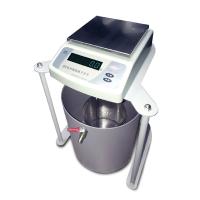
Hydrostatic balances are special analytical balances designed based on Archimedes' principle, which are mainly used for the density determination of solid substances, and can also complete routine mass weighing work. It has added a special density measurement component on the basis of ordinary balances, including hooks, beaker holders, overflow cups and other accessories, which can accurately measure the mass of the object in the air and the apparent mass submerged in a specific liquid, and calculate the volume of the liquid discharged by the object through the numerical difference between the two, and then convert the density of the substance. The instrument has the characteristics of high measurement accuracy and convenient operation, and is a key equipment for density testing in scientific research, quality inspection, teaching and other fields.
Product type
1. Mechanical hydrostatic balance
With the principle of lever balance as the core working mechanism, it relies on weight counterweights to achieve weighing operation, and is equipped with manually adjustable hooks and bracket components. The advantages of this type of balance are stable structure and relatively low purchase cost, but the disadvantage is that the operation process is cumbersome and the reading error is relatively large, which is more suitable for teaching demonstrations or conventional inspection scenarios that do not require high measurement accuracy.
2. Electrostatic hydrostatic balance
It adopts an electromagnetic force balance sensor to support digital display of measurement readings, and some high-end models also have a built-in density calculation program, which can directly output sample density results. Its advantages are high weighing accuracy, which can reach 0.1mg level, simple operation and high detection efficiency, which is the mainstream selection model in the laboratory; the disadvantage is that the price of the equipment is higher than that of the mechanical model, and it is more sensitive to the temperature, humidity and vibration of the use environment, and needs to be operated in a stable environment.
3. Portable hydrostatic balance
It is compact and lightweight, and is equipped with a rechargeable battery that can be used for outdoor work without a fixed power supply. This type of balance is suitable for on-site rapid density testing, such as ore density determination in geological exploration, on-site sampling inspection in the building materials industry, etc., although the accuracy is slightly lower than that of laboratory-grade electronic hydrostatic balances, but it can fully meet the testing needs of outdoor sites.
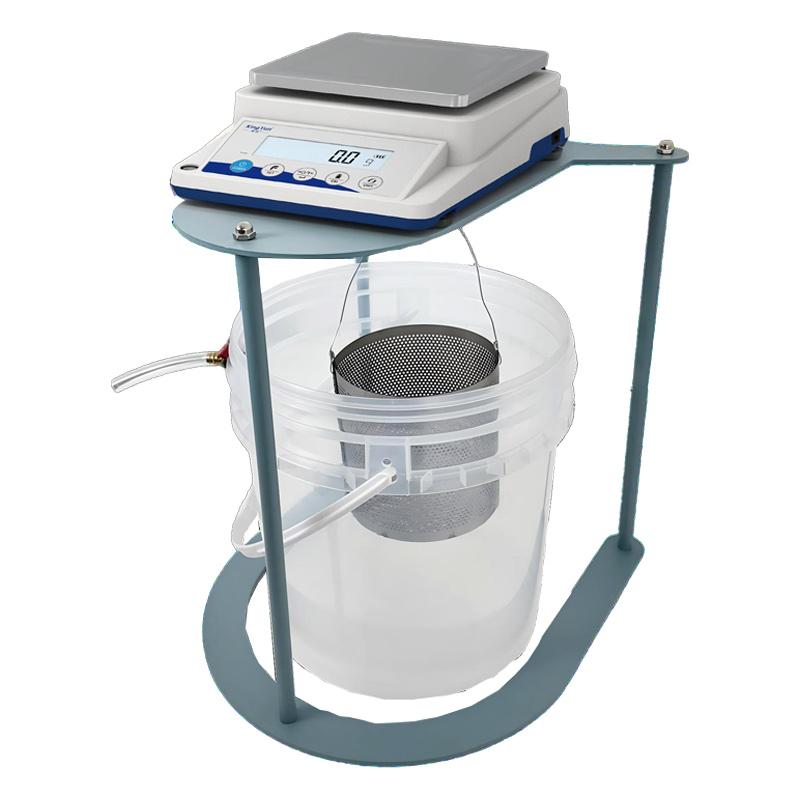
Test principle
The core test principle of hydrostatic balances is Archimedes' law, that is, objects immersed in liquid will be subject to upward buoyancy, and the amount of buoyancy is equal to the gravity of the object expelling the liquid. During the specific test, the mass of the solid sample to be measured in the air is first weighed, and then the sample is hung through a special hook so that it is completely immersed in the liquid of known density, and the apparent mass of the sample is weighed at this time to ensure that the sample does not touch the inner wall and bottom of the container. The buoyancy of the sample is calculated by the mass difference of the two weighs, and this buoyancy is equal to the gravity of the sample expelling the liquid, so that the volume of the sample expelling the liquid can be further derived, and finally combined with the mass of the sample in the air to convert the actual density of the sample. Some electrostatic balances can automatically complete the above calculation steps and directly present the results.
Fields of application
Research and teaching
It is often used for the verification and demonstration of Archimedes' principle in physics experiments, and also provides data support for research in materials science, geology and other disciplines, such as determining the density parameters of various samples such as ores, alloys, and polymer materials, and helping to promote related scientific research projects.
Quality inspection and industrial fields
In the building materials industry, the density of cement, sand, ceramics and other materials can be detected to determine whether the porosity and strength of the product meet industry standards. In the jewelry industry, by measuring the density of jade and precious metals, it assists in the identification of authenticity; In the plastic and rubber industry, it is used to detect the density of plastic particles and rubber products, and to control the rationality and performance stability of product formulations.
Chemical field
It can measure the density of chemical raw materials and particles, provide accurate data support for production process optimization and product quality control, and ensure the production quality of chemical products.
Common faults and solutions
Unstable weighing values after sample immersion – this may be due to bubbles on the surface of the sample, shaking of the liquid, or contact with the walls of the container. When solving, you can use a fine needle to pick out the bubbles on the surface of the sample, or you can vacuum degassing the sample, and then measure after the liquid is completely resting, and adjust the hook position to ensure that the sample is not in contact with the inner wall and bottom of the container.
Large drift of the balance value - mostly caused by excessive fluctuations in ambient temperature and humidity, the balance is not placed horizontally, or the sensor is contaminated. It is necessary to control the temperature and humidity of the laboratory, keep the balance away from air conditioners, heat sources and other equipment, adjust the level foot at the bottom of the balance, keep the level bubbles centered, and clean the sensor with anhydrous ethanol, and dry it before putting it into use.
Density cannot be calculated accurately – most likely the parameter is set incorrectly in the built-in program, such as the liquid density value entered incorrectly, or the hook weight is not calibrated. At this point, the actual density value of the submerged liquid should be re-entered, and the hook calibration procedure should be performed to deduct the buoyancy effect of the hook in the liquid.
Unbalanced levers of the mechanical balance – this may be due to rusted weights leading to inaccurate weights or jamming of the balance beam. The solution is to replace qualified weights and calibrate them regularly, check the balance beam for foreign objects jamming, and readjust the lever balance after cleaning.
How to choose
1. Clarify precision requirements
If it is used for high-precision analysis work in the laboratory, such as the density detection of precious metals, an electronic hydrostatic balance should be chosen, giving priority to models with an index value of no more than 0.1mg, and the maximum weighing should be selected according to the weight of the daily test sample. If it is only used for teaching demonstrations or conventional low-precision testing, it is enough to choose a mechanical hydrostatic balance, which can effectively control the cost.
2. Match sample characteristics
For measuring large-volume samples, such as building materials, ores, etc., choose models equipped with extended hooks and large-volume overflow cups; When measuring water-soluble samples, it is necessary to use a dedicated anti-corrosion liquid tank and a suitable immersion liquid, while preferring balances with anti-corrosion components.
3. Consider the usage scenario
If used in a fixed place in the laboratory, choose a desktop electronic model, which has comprehensive functions and usually supports data export, which is convenient for subsequent data collation and analysis; If outdoor on-site testing is required, portable hydrostatic balances should be chosen, which have charging endurance and strong anti-interference ability, and can adapt to complex outdoor environments.
4. Focus on additional features
Give preference to electronic balances with built-in density calculation programs to reduce errors caused by manual calculations. If you need data traceability, choose a model with RS232 or USB interfaces that support connecting computers and printers.
summary
The hydrostatic balance is a special instrument focusing on density detection, and its three types of mechanical, electronic and portable are adapted to different precision requirements and usage scenarios, and the core working logic relies on Archimedes' law, which plays an irreplaceable role in scientific research and teaching, quality inspection industry, chemical industry and other fields. In the actual use process, common faults such as unstable index and value drift after sample immersion can be solved through standardized operation and environmental control. When selecting the model, it is necessary to focus on the three core elements of measurement accuracy, sample characteristics, and usage scenarios, and pay attention to the additional functions of the instrument in order to select the most suitable equipment to ensure the accuracy and efficiency of density testing work.