The mixer is a general laboratory instrument that quickly achieves a homogeneous state of liquid, solid powder or solid-liquid mixing system through mechanical vibration, rotation or oscillation. It has the characteristics of small size, easy operation and high mixing efficiency, which can replace manual hand shaking and mixing, avoid errors and pollution caused by manual operation, and is widely used in sample preparation in biology, chemistry and other fields.
Product type
1. Vortex mixer
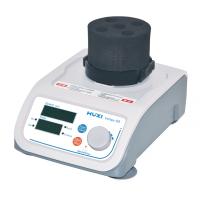
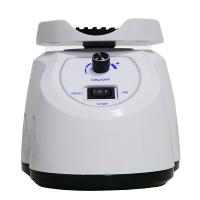
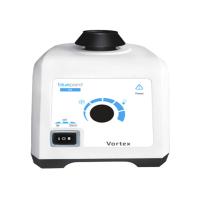
It is suitable for rapid mixing of small containers such as test tubes and centrifuge tubes, and is characterized by adjustable rotation speed and fast mixing speed, suitable for the processing of small samples.
2. Oscillating mixer
It is divided into three types: horizontal oscillation, vertical oscillation and reciprocating oscillation, which can be mixed by reciprocating or circular movement of the tray, and is suitable for a variety of containers such as beakers, conical flasks, and microplates, and is often used for batch sample processing such as medium preparation and solution dilution.
3. Magnetic mixer
It uses the magnetic stirrer in the container to drive the rotation of the magnetic stirrer in the container to achieve sample mixing, which can be combined with heating function, suitable for mixing liquids with low viscosity, and has the advantages of low noise and gentle mixing, and is mostly used for stirring biochemical reaction systems.
4. Flip the mixer
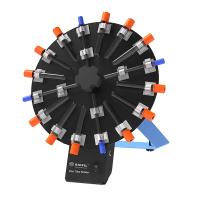
The 360° rotation of the container is driven by the flipping bracket to fully mix the samples, which is suitable for mixing large-capacity containers or easy-to-precipitate samples, avoiding uneven local mixing, and is commonly used in sample processing in food, environmental testing and other fields.
Test principle
The core of the mixer is to drive the movement of the sample container through mechanical power, or to drive the operation of the stirring element with the help of magnetic field, break the intermolecular force of the sample system, so that different components diffuse and penetrate each other, and finally achieve a homogeneous state.

Fields of application
Chemical and chemical fields
It is used in reagent mixing, solution dilution, and stirring of reaction systems to help chemical experiments and the ratio of chemical raw materials, and improve the accuracy of experimental results.
Food Testing Field
Mix food samples such as beverages, sauces, and grain extracts to ensure the uniformity of sample preparation and facilitate subsequent component analysis and quality testing.
Environmental monitoring field
It is used for mixing water quality samples and soil leachate to ensure that all components of the detection sample are uniform and avoid detection errors caused by sedimentation or stratification.
Common faults and solutions
No response after powering on – it may be a power supply that is not connected or a blown fuse. The solution is to check whether the power plug is tightly plugged in, whether the power switch is on, if the fuse is blown, replace the fuse of the same specification and then try to turn it on.
Poor mixing – this may be due to a low speed setting, a loose eccentric shaft, or the agitator absorbing impurities. The solution is to increase the rotation speed appropriately, tighten the eccentric shaft screws, and clean the impurities on the surface of the magnetic stirrer before use.
Excessive noise during operation – mostly uneven work surfaces, loose components or worn motor bearings. The solution is to adjust the table to a horizontal state, tighten the loose screws, and replace the motor bearings with new ones if the bearings are severely worn.
The heated magnetic mixer does not heat - there is a high probability that the heating tube is damaged or the thermostat is faulty. The solution is to contact the manufacturer to overhaul the heating tube, calibrate or replace the thermostat, and avoid disassembling it yourself.
How to choose
Process a small number of test tube samples to select vortex mixer; Batch processing beakers and microplates are selected as oscillating mixers; low-viscosity liquid mixing and homing magnetic mixing instrument; Large capacity or easy-to-precipitate samples can be flipped and mixed.
For conventional sample mixing, choose a model with a speed of 0-3000rpm, and for high-viscosity samples, you need to choose a mixer with high speed and high torque to ensure sufficient mixing.
If you need to control the temperature, choose a magnetic mixer with heating function; If you need to operate at a time, give priority to models equipped with timing functions to improve the automation of experimental operations.
The laboratory desktop uses a table model, and a small mini model can be selected when space is limited. For mobile use or on-site testing, a cordless portable mixer is an option.
summary
The mixer is a key equipment for laboratory sample preparation, and different types of models are adapted to different samples and experimental needs, and its working principle revolves around mechanical power or magnetic field force to achieve uniform mixing of samples. In practical applications, it is necessary to reasonably select the type according to the characteristics of the sample, the specifications of the container and the functional requirements, and at the same time do a good job of daily troubleshooting and maintenance, in order to ensure the stable operation of the instrument and improve the efficiency of the experiment and the accuracy of the results.