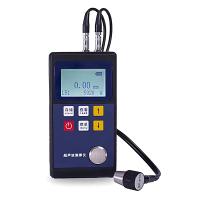
1. Overview
Deguang intelligent ultrasonic Thickness Gauge, using microprocessor technology, utilizationThe ultrasonic measurement principle can measure the thickness and sound velocity of metals and other materialsMeasure.Before using the instrument, please read this user manual thoroughly in order to understand the functions of the instrument.Master how to use the instrument.
Second, technical parameters
(1) Model 1: DC-1000C
Display: 128×64 LCD dot matrix LCD display (with backlight)
Number of digits: 4 digits
Measuring range: 0.7mm~400.0mm (measuring flat steel)
Indication accuracy: ±0.1mm (measurement greater than 100mm),±0.01mm (measured less than 100mm)
Sound velocity range: 1000~9999m/s
Measurement cycle: 4 times/second
Auto power off: 2 minutes
Power supply: two No. 7 (AAA) batteries, which can work continuously for no less than 48 hours.
Environment: Temperature: -20°C~60°C
Storage temperature: -20°C~50°C
Dimensions: 116mm(L)×64mm(W)×27mm(H)
Weight: 220g (including battery)
Optional accessories: Probes: D5008, D5113, D7006, D7004, D2012
(2) Model 2: DC2000C
Display: 128X64 LCD dot matrix LCD display (with LED backlight)
Number of digits: 4 digits
Measuring range: 0.65mm~400.0mm
Indication accuracy: ±0.01mm or ±0.1mm
Measurement accuracy: low accuracy: 0.65mm ~ 99.9mm ±0.1mm
100.0mm ~ 400.0mm ≤0.3%Hmm
High accuracy: 0.8mm ~ 9.99mm ±0.04mm
10.00mm ~ 99.99mm ±(0.1%+0.04)mm
100.0mm ~ 400.0mm ≤0.3%Hmm
Note: H is the measured thickness value
Sound velocity range: 1000~9999m/s
Measurement cycle: 2 measurements/sec for normal measurements
High-speed measurement of 10 times/second
Auto power off: 1 minute, 3 minutes, 5 minutes optional
Power supply: two No. 7 (AAA) batteries, which can work continuously for no less than 48 hours.
Operating environment: operating temperature: -20°C~50°C
Storage temperature: -20°C~50°C
Dimensions: 116mm(L)×64mm(W)×27mm(H)
Weight: 220g (including battery)
(3) Model 3: DC-2010C
Display: 128X64 LCD dot matrix LCD display (with LED backlight)
Number of digits: 4 digits
Measuring range: 0.65mm~400.0mm
Indication accuracy: ±0.01mm or ±0.1mm
Measurement accuracy: low accuracy: 0.65mm ~ 99.9mm ±0.1mm
100.0mm ~ 400.0mm ≤0.3%Hmm
High accuracy: 0.8mm ~ 9.99mm ±0.04mm
10.00mm ~ 99.99mm ±(0.1%+0.04)mm
100.0mm ~ 400.0mm ≤0.3%Hmm
Note: H is the measured thickness value
Sound velocity range: 1000~9999m/s
Measurement cycle: 2 measurements/sec for normal measurements
High-speed measurement of 10 times/second
Data storage: 3000 groups
Data output: USB
Auto power off: 1 minute, 3 minutes, 5 minutes optional
Power supply: two No. 7 (AAA) batteries, which can work continuously for no less than 48 hours.
Operating environment: operating temperature: -20°C~50°C
Storage temperature: -20°C~50°C
Dimensions: 116mm(L)×64mm(W)×27mm(H)
Weight: 220g (including battery)
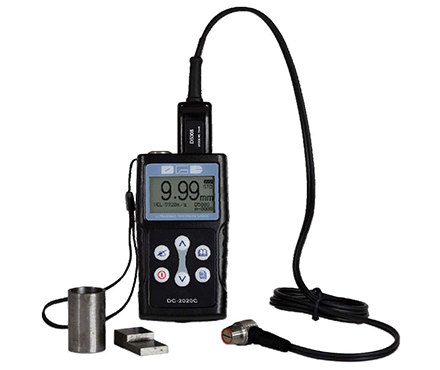
(4) Model 4: DC-2020C
Display: 128X64 LCD dot matrix LCD display (with LED backlight)
Number of digits: 4 digits
Measuring range: 0.65mm~400.0mm
Indication accuracy: ±0.01mm or ±0.1mm
Measurement accuracy: low accuracy: 0.65mm ~ 99.9mm ±0.1mm
100.0mm ~ 400.0mm ≤0.3%Hmm
High accuracy: 0.8mm ~ 9.99mm ±0.04mm
10.00mm ~ 99.99mm ±(0.1%+0.04)mm
100.0mm ~ 400.0mm ≤0.3%Hmm
Note: H is the measured thickness value
Sound velocity range: 1000~9999m/s
Measurement cycle: 2 measurements/sec for normal measurements
Rapid measurement of 10 times/second
Data storage: 5,000 groups
Data output: USB
Auto power off: 1 minute, 3 minutes, 5 minutes optional
Power supply: two No. 7 (AAA) batteries, which can work continuously for no less than 48 hours.
Operating environment: operating temperature: -20°C~50°C
Storage temperature: -20°C~50°C
Dimensions: 116mm(L)×64mm(W)×27mm(H)
Weight: 220g (including battery)
(5) Model 5: DC-2030C
Display: 128X64 LCD dot matrix LCD display (with LED backlight)
Number of digits: 4 digits
Measuring range: 0.65mm~400.0mm
Indication accuracy: ±0.01mm or ±0.1mm
Measurement accuracy: low accuracy: 0.65mm ~ 99.9mm ±0.1mm
100.0mm ~ 400.0mm ≤0.3%Hmm
High accuracy: 0.8mm ~ 9.99mm ±0.04mm
10.00mm ~ 99.99mm ±(0.1%+0.04)mm
100.0mm ~ 400.0mm ≤0.3%Hmm
Note: H is the measured thickness value
Sound velocity range: 1000~9999m/s
Measurement cycle: 2 measurements/sec for normal measurements
Rapid measurement of 10 times/second
Data storage: 3000 groups
Data output: USB
Auto power off: 1 minute, 3 minutes, 5 minutes optional
Power supply: two No. 7 (AAA) batteries, which can work continuously for no less than 48 hours.
Operating environment: operating temperature: -20°C~50°C
Storage temperature: -20°C~50°C
Dimensions: 116mm(L)×64mm(W)×27mm(H)
Weight: 220g (including battery)
(6) Model 6: DC-3000
Display: 128X64 LCD dot matrix LCD display (with LED backlight)
Number of digits: 4 digits
Measuring range: 0.65mm~400.0mm
Indication accuracy: ±0.01mm or ±0.1mm
Measurement accuracy: low accuracy: 0.65mm ~ 99.9mm ±0.1mm
100.0mm ~ 400.0mm ≤0.3%Hmm
High accuracy: 0.8mm ~ 9.99mm ±0.04mm
10.00mm ~ 99.99mm ±(0.1%+0.04)mm
100.0mm ~ 400.0mm ≤0.3%Hmm
Note: H is the measured thickness value
Sound velocity range: 1000~9999m/s
Measurement cycle: 2 measurements/sec for normal measurements
High-speed measurement of 10 times/second
Auto power off: 1 minute, 3 minutes, 5 minutes optional
Power supply: two No. 7 (AAA) batteries, which can work continuously for no less than 48 hours.
Operating environment: operating temperature: -20°C~50°C
Storage temperature: -20°C~50°C
Dimensions: 116mm(L)×64mm(W)×27mm(H)
Weight: 220g (including battery)
(7) Model 7: DC-3020
Display: 128X64 LCD dot matrix LCD display (with LED backlight)
Number of digits: 4 digits
Measuring range: 0.65mm~400.0mm
Indication accuracy: ±0.01mm or ±0.1mm
Measurement accuracy: low accuracy: 0.65mm ~ 99.9mm ±0.1mm
100.0mm ~ 400.0mm ≤0.3%Hmm
High accuracy: 0.8mm ~ 9.99mm ±0.04mm
10.00mm ~ 99.99mm ±(0.1%+0.04)mm
100.0mm ~ 400.0mm ≤0.3%Hmm
Note: H is the measured thickness value
Sound velocity range: 1000~9999m/s
Measurement cycle: 2 measurements/sec for normal measurements
High-speed measurement of 10 times/second
Data storage: 5,000 groups
Data output: USB
Auto power off: 1 minute, 3 minutes, 5 minutes optional
Power supply: two No. 7 (AAA) batteries, which can work continuously for no less than 48 hours.
Operating environment: operating temperature: -20°C~50°C
Storage temperature: -20°C~50°C
Dimensions: 116mm(L)×64mm(W)×27mm(H)
Weight: 220g (including battery)
3. Measurement principle
The ultrasonic pulse is passed through the couplant by the probe to the measured body, and part of it is surfaced by the objectSurface reflection, the probe receives the echo reflected from the ground of the measured object, and accurately measures the ultrasonic waveThe return time is calculated and the thickness is calculated, which is then displayed numerically.


5. Preparation before measurement
[5.1] Instrument preparation
Please refer to the following standard configuration for newly purchased instruments, check the instruments and accessories, and please timely when it is incompleteContact the manufacturer; If the instrument is damaged, do not use it and contact the manufacturer as soon as possible.
The main unit is DC-1000C
One probe D5008
COUPLANT 75ML IN A BOTTLE
Instrument case 1
One copy of the manual
No. 7 battery 2 cells
[5.2] Probe selection
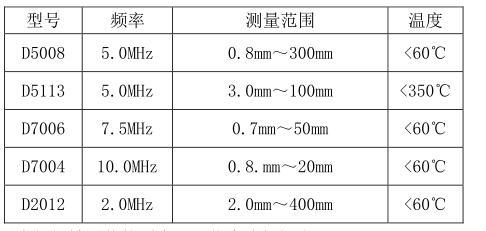
The user selects the probe according to the thickness and shape of the measured body.Model D5008 Probe: This probe can be selected in a variety of situations. For example, the measuring surface is flator a large arc, and the thickness of the test body exceeds 50mm.
Model D5113 probe: for the measurement of materials with temperatures less than 350°C.
Model D7006 probe: mainly used for thin-walled and small-cambered measurements.
Model D7004 probe: mainly used for thin-walled and small-curved measurements.
Model D2012 probe: Mainly used for the measurement of coarse-grained materials such as cast iron.
[5.3] Treatment technology of the surface of the measured object
If the surface of the test object is rough or severely corroded, please treat it with the following methods:
1. Use rust remover, wire brush or sandpaper to treat the surface of the measured body;
2. Use more couplant on the surface of the test body;
3. Measure multiple times near the same point.
6. Functional application of the instrument

2. Systematic deviation: When replacing a new probe or due to other reasons, the measurement deviation is causedIf you are not able to eliminate this deviation using the "Auto-Calibration" function (if you are confident that this deviation is not caused by a deviation in the velocity value), you can use the "Probe Calibration" functionThis deviation is eliminated. The method used is detailed in 6.6
3. Calculation deviation: due to the diversity of materials, the same material has different content and differenceprocess, which leads to a change in the velocity of sound value, which ultimately leads to the measurementDeviation. If the deviation caused is not sufficient to affect the accuracy of the measurement. You can ignore itOutline; If the deviation affects the accuracy of the measurement, the exact sound velocity of the material needs to be obtainedvalue, at which point the instrument can be provided using the "Sound Velocity Measurement" function. How to use:See 6.4.3.2 for details


6.5.3 Sound velocity measurement
When there are high requirements for the accuracy of the measurement data, or when measuring materials with unknown sound velocity values,Be sure to use this feature.In terms of the factors that affect the measurement accuracy of the instrument, the deviation of the set sound velocity value varies with the measurementThe thickness increases. Therefore, in order to ensure the accuracy of measurement, when measuring the sound velocity value of materials,Use a test block that is closer to the upper limit of the measured thickness. That is: if you just want to get notKnowing the sound velocity value of the material, you don't need to pay attention to the thickness of the test block; But if there is a need for measurement accuracyIf you want to find it, you should choose a thicker test block as much as possible.The steps for sound velocity measurement are as follows:
(1) Obtain a piece of material that needs to determine the sound velocity value, try to keep the measuring surface parallel to the bottom surface, and use other measuring tools (such as calipers) to measure the thickness of this test block;
(2) After calibration, the instrument measures this test block to ensure the reliability of the measurement and obtains a thickness value;


6.7.2 Gain setting
In the user's measurement environment, different materials, the same material in different states, are all Accurate and stable measurements will have different effects, so different inspections are requiredThe working state of the instrument is adjusted to meet more measurements in different detection environments.For a variety of materials and conditions, the instrument can use an automatic gain adjustment method, but the needleFor special measurements, it is necessary to adjust the working state of the instrument. For this instrument provides fourDifferent ways of gaining work: automatic, low, medium, high.
Automatic mode: matching different probes can meet most of the measurement needs;
Low gain: This method can be used for materials with high scattering and low attenuation;
Gain: Can be used for a wide range of measurements;
High gain: For materials with high attenuation.

6.7.5 Vendor information
Users can view the details of this machine when entering the project.
Display the company's website, phone number, machine software version number, and probe factory number.
7. Measurement application technology
[7.1] Measurement method
A variety of reference measurement methods are available:
1. Single-point measurement method, at any point on the measured body, use the probe to measure, and the displayed value is thickDegree value.
2. The two-point measurement method uses a probe to measure twice at the same point of the measured body, the probe is divided by 90 degrees, and the smaller value is the thickness value.
3. Multi-point measurement method, take multiple measurements in a circle with a diameter of about 30 mm, whichever is the smallestThe value is the thickness value.
4. Continuous measurement method, using a single-point measurement method, continuous measurement along the designated line, and its interval is not smallat 5 mm, the minimum value is the thickness of the measured body.
[7.2] Pipe wall measurement method
When measuring, the probe split surface can be measured along the axis of the tube or the axis of the vertical tubeMeasure. If the pipe diameter is large, the measurement should be measured in the direction of the vertical axis; The diameter of the pipe is small, and it should beMeasured in two directions, the smallest value is the thickness value.
8. Maintenance and precautions
[8.1] Power supply check
When the power supply voltage is low, the instrument displays a low voltage symbol, which should be replaced in time as requiredbattery, so as not to affect the measurement accuracy. The backlight should not be turned on for a long time so as not to consume power too quicklyPool power. If the instrument is not used for a long time, take the battery out of the battery compartment to avoid the battery being damaged by the batteryLeakage erodes the circuit board.
[8.2] Precautions
1. General precautions
Avoid strong vibration of the instrument and probe; Avoid placing the instrument in an excessively wet ringin the environment; When inserting and unplugging the probe, the movable jacket should be pinched and applied force along the axis, and the probe should not be rotated.to avoid damaging the probe cable core.
2. Precautions should be taken in measurement
(1) When measuring, it is a good measurement only when the measurement indicator appears and is stable.
(2) If there is a large amount of couplant on the surface of the test body, when the probe leaves the surface of the test body,The couplant can cause false detections, so at the end of the measurement, the probe should be quickly removed from the body surfaceFace.
(3) If the probe is worn, the measurement value will be unstable, and the probe should be replaced.