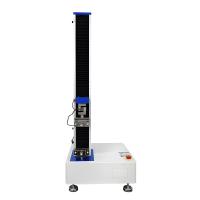
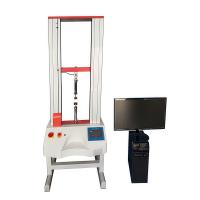
In the tensile performance test of materials, elastic modulus, yield strength and tensile strength are the core indicators to characterize the mechanical properties of materials, and the three reflect the deformation and bearing capacity of materials from different dimensions.
modulus of elasticity
Also known as Young's modulus, it is an index that measures the ability of a material to resist elastic deformation and intuitively reflects the "stiffness" characteristics of the material. This index needs to be determined in the linear elasticity stage of the stress-strain curve, in which the stress of the material is directly proportional to the strain, and can be completely restored to its original state after unloading without permanent deformation. During the test, the extensometer is used to accurately measure the small deformations in the specimen gauge to ensure that the data is in a linear interval. The higher the modulus, the smaller the deformation of the material under load, which is suitable for scenarios with high rigidity requirements such as aerospace parts and building load-bearing components.
yield strength
It is the critical stress value of the transition from elastic deformation to plastic deformation of the material, which marks the "plastic deformation resistance" of the material. For materials with obvious yield platforms, such as mild steel, the stress value corresponding to the yield platform can be directly taken as the yield strength. For most plastics, high-strength alloys and other materials without obvious yield platforms, the plastic elongation strength of 0.2% is used for determination, that is, the stress value corresponding to the permanent plastic deformation of the specimen of 0.2%. In engineering design, the allowable stress of mechanical parts is usually based on yield strength to avoid irreversible plastic deformation of components during service and ensure structural stability.
Tensile strength
Also known as the strength limit, it is the maximum stress that the material can withstand during the tensile process, corresponding to the peak stress of the stress-strain curve. The maximum load during the test should be selected for calculation, combined with the initial cross-sectional area of the specimen. This index reflects the "maximum bearing capacity" of the material, but it should be noted that it is not equivalent to the actual bearing limit of the component. For brittle materials such as cast iron and ceramics, the tensile strength is the breaking strength, and the material will break directly after reaching this stress. For plastic materials such as steel and copper, the tensile strength is often higher than the yield strength, and the material will be necked after reaching the tensile strength, and then the stress will drop until it breaks.
The correlation and complementarity of the three indicators jointly construct a complete evaluation system for the mechanical properties of materials. The elastic modulus determines the elastic deformation response of the material, the yield strength divides the boundary between elastic and plastic deformation, and the tensile strength defines the ultimate bearing capacity of the material. In practical applications, it is necessary to combine the corresponding test standards and specification test processes, such as metal materials refer to ASTM E8 standard and plastic materials refer to ISO 527 standard, and strictly control sample preparation, loading rate and environmental conditions to ensure the accuracy of index calculation.
In summary, the three indicators of elastic modulus, yield strength and tensile strength provide a quantitative basis for the engineering application of materials from the three dimensions of stiffness, plastic resistance and ultimate bearing capacity. Accurate calculation and interpretation of the three indicators are the core prerequisites for accurately matching material properties and structural requirements.