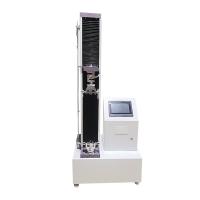
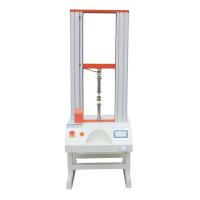
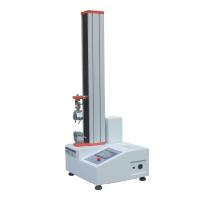
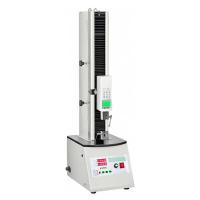
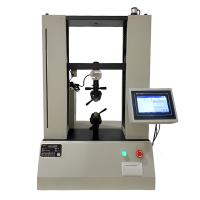
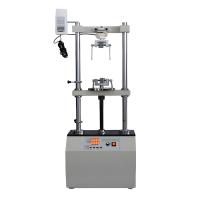
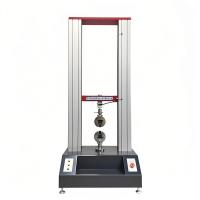
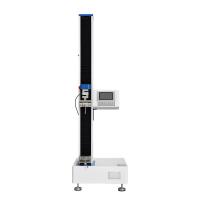
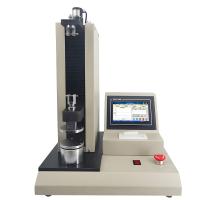
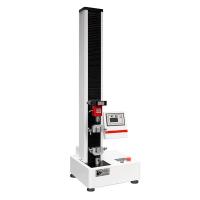
Tensile testing machine is the core equipment for material mechanical property testing, widely used in metal, plastic, rubber, textile, composite materials and other industries. Many users only look at the price and appearance when selecting a model, ignoring key parameters, and are prone to problems such as inaccurate data, frequent failures, and non-standard data in the later stage. This article sorts out points from a practical perspective to help you avoid selection misunderstandings.
1. Test range and sensor accuracy
The larger the range, the better, the breaking force of the specimen is recommended to be controlled at 20%~80% of the range, and 10%~20% margin is reserved to avoid overload damage to the sensor. The general test selects a level 1 accuracy sensor, and the high-precision detection priority is 0.5 level and above to ensure stable and reliable force collection from the source.
2. Force measurement accuracy and standard compliance
The accuracy of force measurement directly determines the validity of the test report, and it is necessary to pay attention to indicators such as value error, repeatability, and return error. The equipment should comply with national standards and international standards such as GB/T 228 and ISO 6892, and have the functions of force value calibration, overload protection, and peak maintenance to avoid invalid tests due to substandard accuracy.
3. Speed control stability
Different materials have very different test speed requirements, flexible materials need to be low and stable, and rigid materials need to be precise and constant speed. It is recommended to choose a model with a speed range of 0.001~500mm/min and support stepless speed regulation, with servo motors and ball screws to ensure smooth operation, no jitter and no lag.
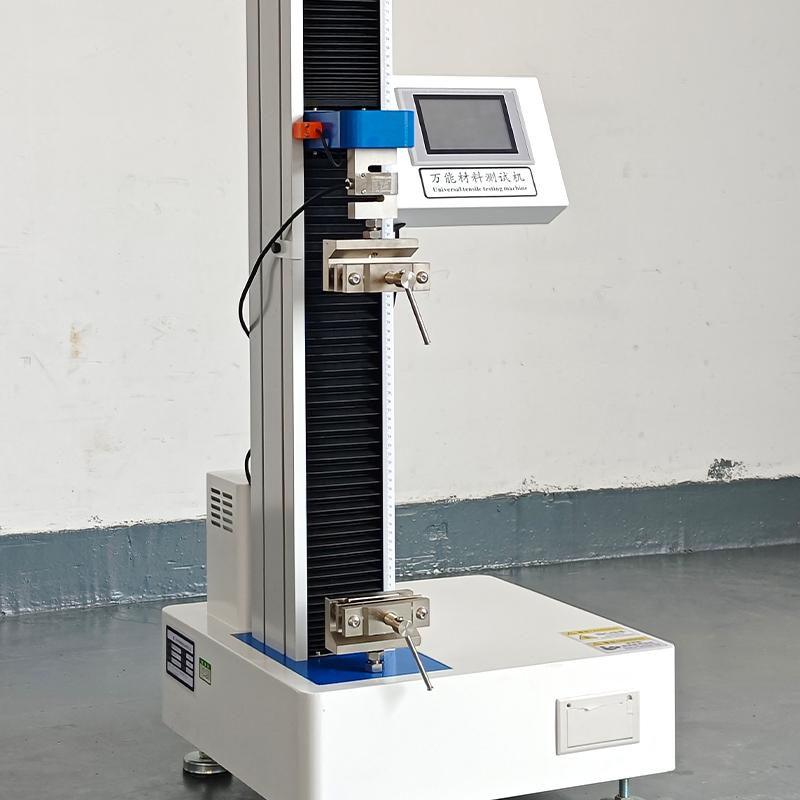
4. Fixture adaptability and material
Wrong selection of fixtures is a common pit, which can lead to slippage, pinching, and abnormal fracture positions. wedge-shaped automatic clamp for metal specimens; Pneumatic flat fixtures for film and plastic with anti-slip structure; Special tooling for textiles and cables. Priority is given to rust-resistant and wear-resistant stainless steel or high-strength alloy materials.
5. Displacement and deformation measurement accuracy
Only looking at the displacement and not looking at the extensometer will lead to inaccurate elongation data. The displacement resolution of the equipment should not be less than 0.001mm; When accurate deformation testing is required, a high-precision electronic extensometer must be selected to meet the standard requirements of small deformation and fixed elongation.
6. Control system and software function
Software features determine usage efficiency and data compliance. Regular equipment should support test program customization, automatic calculation, data storage, report export, multi-standard switching, data traceability and authority management, and can meet scenarios such as factory inspection, R&D testing, and third-party audit.
7. Safety protection and structural protection
The equipment must have functions such as overload protection, over-travel protection, emergency stop, and power failure protection. When used in harsh environments for a long time, it is also necessary to pay attention to the anti-rust, sealing, and dustproof design of the fuselage to improve the life and safety of the equipment.
8. After-sales and cost-effective
Don't just pursue low prices, choose brands with timely response, sufficient accessories, and easy maintenance. Perfect after-sales reduces downtime, reduces long-term usage costs, and achieves a truly cost-effective price.
summary
The selection of tensile testing machine is not a simple procurement, but a system engineering that matches materials, standards and working conditions. Only by focusing on the eight core parameters of range accuracy, force measurement standards, speed stability, fixture adaptation, deformation measurement, software functions, safety protection, and after-sales guarantee can we avoid common pitfalls such as only looking at price, blind selection, and parameter mismatch. Choosing the right equipment can not only ensure the accuracy and reliability of test data, but also improve testing efficiency, extend the service life of equipment, and provide solid support for material research and development, quality control and product safety.