Corrosion mainly includes corrosion caused by natural media and corrosion caused by industrial media, natural media include air, water, soil, etc., the corrosion caused by it is widespread, and industrial media is produced in the industrial production process, such as acid, alkali, salt and various organic substances, etc., causing corrosion is more serious. At the same time, the objects of medium corrosion are also different, in addition to steel and metal, there are also plastic, rubber, wood, concrete, leather, paper, etc.
The coating plays a role in protecting the coated object, and is often exposed to various corrosive environments and is eroded by corrosive media from natural and artificial sources. The corrosion resistance of the coating is mainly determined by the structure of the coating, and it is also closely related to the thickness of the coating, the supporting system and the quality of construction management. Due to the ever-changing corrosion conditions, the materials and application ranges of various coated objects are different, which makes it difficult to evaluate the corrosion resistance of coatings, and corrosion resistance is one of the most complex topics in the research and production of coatings.
There are several main methods to evaluate the corrosion resistance of coatings:
(1) Physical observation of the coating is applied to the whole or part of the coated object, and the coating damage process and the corrosion of the coated object are observed for a long time in the actual use process to determine the corrosion resistance of the coating, but the method involves a large area, the time is very large, and it is difficult to realize.
(2) The hanging film simulation test will make the coating into a model instead of the physical simulation test, the method is more objective, but the test cycle is still very long, such as the Japanese JIS standard stipulates that the test anti-rust performance time is up to 2 years. Some heavy anti-corrosion coating systems have been tested for more than 8 years.
(3) laboratory simulation accelerated test includes salt spray test, damp heat test, water resistance test, sulfur dioxide resistance test, etc., is the commonly used method at present, the test cycle is short, the efficiency is high, but can only get a relative, limited conclusion, it is only comparable to the same type of coating products, and can not be used for the evaluation of different systems of coatings, because the corrosion in the actual environment is the result of the comprehensive action of a variety of factors, so the simulation test results sometimes have a certain gap with the actual situation. It is feasible to use this method as a control product quality, but at the same time, it is necessary to compare several tests to evaluate the corrosion resistance of the coating with its comprehensive properties. At present, more accurate simulation test methods are still being studied at home and abroad.
Salt spray test
Salt spray test is a common method to test the corrosion resistance of coatings, mainly including neutral salt spray test, acetate spray test and copper accelerated acetate spray test (CASS test). Among them, the neutral salt spray test is the most widely used in the salt spray resistance test of coatings, and the domestic standards mainly include GB/T1771-91 (equivalent to the international standard IS07253-1984), ASTMB117-1973 (1979) and the corresponding Japanese, German, French standards, etc.
The acetate spray test corrodes faster than the neutral salt spray test, which shortens the test cycle. Table 21-25 compares the two. The neutral salt spray test can be used as a means to test the quality of the pigment or coating system and the electrophoretic paint film.

GB/T1771-91 "Determination of neutral salt spray resistance of basecoats and varnishes" stipulates the salt spray test method as follows.
(l) Equipment
The test equipment is a salt spray Test Chamber, which is mainly composed of a paint spray room, a clean compressed air supply device and a test solution storage tank. The spray chamber contains thermostatic control elements, nozzles, salt spray collectors, test solution tanks, etc. (Related Instruments: Air Compressor)
The volume of the salt spray box is usually greater than 0.4m3, and the spray pressure is kept at 70~170kPa. The structure of the salt spray box needs to ensure:
(1) The droplets accumulated on the roof or box lid will not drip onto the sample for testing;
(2) The droplets dropped on the sample should not be returned to the solution tank for re-atomization; (3) The material of the structure does not affect the corrosiveness of salt spray. It is important to note that there may be a critical pressure at which the corrosiveness of the salt spray increases abnormally, such as periodic fluctuations in air pressure in the range of 3.4 kPa, resulting in an exponential increase in the corrosivity of the atomized salt spray from the nozzle operating at an average pressure of 110 kPa. In order to avoid this phenomenon, the fluctuation range of spray pressure is controlled to ±0·7 kPa, which minimizes the possibility of nozzle operation at "critical pressure".
(2) Test solution
The preparation method of sodium chloride solution for neutral salt spray test is (50±10) g/L [IS0 standard is (50±5) g/L] chemically pure sodium chloride distilled water or deionized aqueous solution, and the pH value is 6.5~7.2 at 25 °C. If the salt solution prepared with water containing saturated carbon dioxide is used at room temperature, the pH value will increase due to the spray temperature of 35 °C in the salt spray test, as part of the carbon dioxide escapes by heating. The solution can be to prepare a sodium chloride solution by slightly lowering the pH value when preparing the brine, or heating the distilled water above 35 °C or boiling, and then cooling to room temperature, so that the pH value of the solution will not change much when sprayed at 35 °C. The test solution should be filtered before being injected into the equipment tank to prevent solids from clogging the nozzle.
(3) Sample preparation
The test sample usually uses the required polished steel plate, the size of which is 100mmx150mm, if no scratches are required, the 70mnX150mm sample can also be used (IS0 is 100mmx150mm). The test plate should be prepared in accordance with the provisions of GB/T1765-79, and the thickness should be measured with a Thickness Gauge or micrometer (related instrument: Thickness Gauge), unless otherwise specified, it should be kept for at least 16h at least 16h under the conditions of temperature (23±2) °C and relative humidity (50±5)%, air circulation and direct exposure to sunlight, and then put into the test as soon as possible. The back and perimeter of the specimen are coated with the test product or coating system, or with a product that is more resistant to corrosion than the test product. If the specimen needs to be scratched, use a single-edge cutter to cut through the coating to the substrate, and make the scratch greater than 20mm from any edge of the test plate, (4) Salt spray test of the specimen
The position of the specimen in the salt spray chamber shall meet the following conditions.
(1) The tested surface of each test plate is facing upward, supported or suspended at 15°~30° from the vertical direction, and better parallel to the direction of the horizontal salt spray flow through the salt spray box.
(2) The samples cannot be in contact with each other, nor can they be in contact with the box.
(3) The placement of each test sample should be able to ensure that the salt spray settles freely on all the samples, and the salt solution condensed on a sample cannot drip on other samples, the temperature in the spray chamber is (35 soil 2) °C, and at least two clean salt spray collectors should be placed in the atomization exposure area, one is placed near the entrance of the spray, and the other is placed away from the spray population, and its position requires that only the salt spray is collected, not the liquid dripping from the sample or other parts of the room, and the area of each collector is 80m2, After 24 hours, the solution of each collector was calculated, and 1~2mL/h of salt solution with a concentration of (50±10) g/L and pH value of 6.5~7.2 should be collected per 80m2 area.
4) Salt spray test of samples
The position of the specimen in the salt spray chamber shall meet the following conditions.
(1) The tested surface of each test plate is facing upwards, supported or suspended at 15°~30° from the vertical direction, and is better parallel to the direction of the horizontal salt spray flow through the salt spray box.
(2) The models cannot be in contact with each other, nor can they be in contact with the box.
(3) Each test sample should be placed in such a way as to ensure that the salt spray settles freely on all the samples, and the salt solution condensed on one sample cannot drip onto other samples, the temperature in the spray chamber is (35 soil 2) °C, and at least two clean salt spray collectors should be placed in the atomization exposure area, one is placed near the entrance of the spray, and the other is placed away from the spray population, and its location requires that only salt spray be collected, not the liquid dripping from the sample or other parts of the room, and the area of each collector is 80m2, After 24 hours, start to calculate the solution of each collector, per 80 m2 of area, should be collected at a concentration of (50±10) g/L, pH 6. 5~7.2 salt solution 1~2mL/h.
(5) Inspection of the test board
The test plate should be visually inspected periodically, but the surface of the sample should not be damaged, and the inspection time should not exceed 60min in any 24h cycle, and the test plate should not be allowed to be dry.
At the end of the specified test cycle, the test plate is removed from the box, the test plate is rinsed with clean water to remove the residual test solution on the surface, and the surface damage of the test plate is immediately inspected, such as blistering, rust, reduced adhesion, and the spread of corrosion from scratches.
Damp heat test
The damp heat test is also a method to test the corrosion resistance of the coating, and the main test process is the destruction of the coating by saturated water and vegetarian gas. It is generally performed at the same time as the salt spray test. The damaging effects of saturated water vapor on the coating are mainly as follows. (1) The osmotic effect of water on the coating film. Water molecules pass through one or more layers of the paint film, accumulate between the paint film and the paint film, causing initial blistering, and then develop further to reach between the paint film and the substrate, causing blistering, and at the same time, the contact between water and metal causes electrochemical corrosion. (2) Because the paint film itself contains some hydrophilic groups, and some pigments and fillers have a tendency to absorb water, the paint film itself also absorbs some water, which makes the paint film soft, expands, and reduces the binding force, resulting in blistering.
Generally, when the relative humidity is low, the coating adhesion does not change significantly, but as the relative humidity increases to ≥90%, the coating adhesion decreases significantly. The higher the temperature and the greater the relative humidity, the faster the paint film will be destroyed. The increase of temperature in the damp heat test has a greater impact on the test structure than the increase of humidity, because the high temperature increases the energy of water molecules, enhances the penetration force, and increases the thermal movement of the polymer chain in the coating, weakens the intermolecular force, resulting in the increase of the gap between the molecular chains, which is conducive to the penetration of water molecules. Therefore, the higher the temperature, the faster the corrosion rate, and the shorter the test period, but too high temperature sometimes distorts the test, and the change is too fast to distinguish between the good and bad of the sample. The conditions for performing the damp heat test are shown in Table 21-26.

The equipment used in the test is a temperature and humidity control chamber. It has two sets of heating and humidification systems, through the difference between the temperature of the dry thermometer and the humidity thermometer in the box, respectively control the heating and humidification, to achieve the required relative humidity, there are many kinds of damp heat test methods recommended at present: high temperature and high humidity short cycle, temperature and humidity alternating test cycle and constant temperature and humidity test cycle, etc., from the actual test situation, although the period is short, the destruction is fast, but in some cases it will be too fast to distinguish the advantages and disadvantages of the model, and even distort the truth of the test. The test cycle of temperature and humidity alternation, due to the low temperature and high humidity stage, makes the water vapor condense on the surface of the paint film, which is conducive to the penetration of moisture into the inside of the paint film and accelerates the destruction of the paint film, but too much condensation will form a layer of water film on the paint film, resulting in too much dissolution of soluble substances in the paint film, which is inconsistent with the actual damp heat situation, CHINA's current damp heat test standard GB/T1740-79 adopts the constant temperature and humidity test cycle method, the temperature is (47±1) °C, and the relative humidity is (96±2)%, The same method was used in the American ASTMD2247, where the temperature was (38±1) °C, the relative humidity was 100%, and there was condensation on the sample at all times. There are also some foreign standards that use high temperature short period and temperature and humidity alternating test cycle, and the constant temperature and humidity test method is prepared according to the corresponding standard, such as GB/T1765-79 or ASTMD609, and the original state of the sample is recorded. Hang the sample vertically on the model rack so that the front of the template does not touch. The release person is pre-adjusted to a temperature and Humidity Chamber with a temperature of (47±1) °C and a relative humidity of (96±2)%. When the specified temperature and humidity are reached, the test time is calculated. There should be no condensation on the surface of the sample during the test. The continuous test was checked once for 48 hours. After two inspections, they should be checked every 72 hours. After each inspection, the sample should change its position, and the last inspection should be carried out according to the time specified in the product standard, and the inspection time without product standards can be determined according to the specific situation, and the inspection and rating of the sample is mainly to observe whether the coating is blistered, rusted and peeled off, and rated according to the degree of damage.
Water resistance test
The water resistance of the coating is related to the water solubility of the polar groups, pigments, fillers, additives, etc. contained in the film-forming resin, and is also affected by the surface treatment method and degree of the coated object and the drying conditions of the coating.
At present, the commonly used methods for determining water resistance are: room temperature immersion test method [GB/T1733-93, water temperature is (23±2) °C; ASTMD870-1973, the water temperature is (37.8 soil 1) °C], the boiling water test method (GB/T1733-93), the accelerated water resistance test method (GB/T5209-85, IS01521-1973), etc.
(1) Room temperature immersion test
Add distilled water or deionized water to the glass Water Tank, adjust the water temperature to the specified temperature, and maintain the temperature throughout the test, put three test plates into it, soak 2/3 of each test plate in water to the specified time to take it out, blot it dry with filter paper, check whether there is any discoloration, discoloration, blistering, wrinkling, falling off, rust and other phenomena and recovery, at least two of the three test plates should meet the product standard requirements are qualified,
(2) Boiling water resistance test
Add distilled water or deionized water to the glass Water Tank, keep the water in a boiling state, put three test plates in it, soak 2/3 of each test plate in water to the specified time and take it out, and check and evaluate the test plate according to the previous method.
(3) Accelerate the water resistance test
GB/T5209-85 (with reference to the international standard IS01521-1973) for the determination of the water resistance of paints and varnishes - immersion method, is carried out in a suitable size (suitable size is 700mmX400mmX400mm), equipped with a lid and a constant temperature heating system in the Water Tank, the distilled water or deionized water with a conductivity of less than 2μS/cm is added to the dregs, the mixing system of the water adopts oil-free compressed air or pump circulating stirring, and the water temperature at each point is constant at (40±1) °C. Put the test plate with a size of 150mmx700mmx (0.5~1.2) mm and the back and edges properly protected into the tank, keep the sample 3/4 soaked in water, and then start the circulation or ventilation of the water in the tank. Adjust the water temperature to (40±1) °C and maintain that temperature throughout the test. Regularly take samples to check and adjust the conductivity of the water in the tank so that it is not more than 2μS/cm.
At the end of the specified test cycle, the test plate is removed from the tank and used with filter paper. The damage can be detected by soaking up the water traces. When inspecting the indicators of adhesion reduction, brittleness, discoloration, loss of light, rust and other indicators after the coating test, the test board should be moved into a constant temperature chamber [temperature (25±1) °C, relative humidity 60% ~ 70%], placed for 24 hours after inspection, with a non-corrosive paint stripper carefully removed on the surface of the test board a 150mmX30mm coating, exposed the substrate and checked out the metal corrosion phenomenon, in order to facilitate reference, the exposed part should be protected by appropriate transparent coating.
Moisture sulfur dioxide corrosion resistance test
(1)overview
Organic coatings in the chemical environment are often corroded by chemical gases such as sulfur dioxide, resulting in premature failure of the coating. The International Standards Organization has developed the IS03231 "Determination of the resistance of basecoats and varnishes to moisture sulfur dioxide", and the United Kingdom, France and other countries have also developed corresponding standards.
IS03231 specifies methods and equipment for the determination of the resistance to moisture sulfur dioxide of pigments, varnishes and related products, which allows the use of different amounts of sulfur dioxide, preferably 0.2 L of sulfur dioxide for coatings with a thickness of ≤ 40 μm.
Before carrying out the sulfur dioxide resistance test of the coating, the parties to the test shall determine the following according to national standards, documents or through consultation:
(1) Material and surface treatment of the bottom plate; (2) the construction process of the coating on the substrate;
(3) Coating system, number of layers, thickness;
(4) The drying conditions and time of the painted sample before the test;
(5) Test conditions and time, including sulfur dioxide used (≤ 0.2L, 1L or other quantities);
(6) Test methods to evaluate the corrosion resistance of coatings and factors to be considered.
(2) Equipment
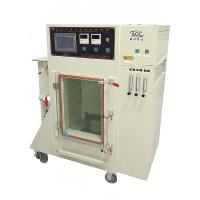
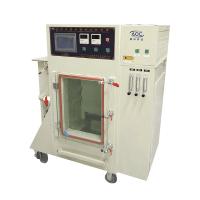
Generally, the airtight box with a volume of (300±10) L, the door can be tightly closed, and equipped with a temperature regulating device, a heating device, a sample holder, a gas induction tube and other components, and a typical sulfur dioxide Test Chamber is shown in Figure 21-44 and Figure 21-45.

The box is made of a temperamental material, and the bottom and lower part of the box wall are heat-resistant, and can hold at least 2.5L of sulfur dioxide-dissolved water without leakage. The shape of the Test Chamber can have some changes, but it is necessary to avoid the moisture condensation on the lid of the chamber dripping onto the test plate in the chamber, so that the top of the chamber and the horizontal plane are about 12° inclination, which can meet the requirements.
The temperature control device consists of a temperature sensor mounted on the upper part of the chamber and a thermometer that reads from the outside of the chamber, with the mercury ball of the thermometer 150 mm from the top and door of the chamber and 250 mm from the nearest wall of the chamber.
The heating device should be able to raise the temperature in the Test Chamber to (40±3) °C within 1.5 hours and maintain this temperature.
The gas induction pipe is located about 50mm above the bottom of the chamber, and the gas enters the Test Chamber through the inlet pipe, and there is a pressure reducing valve at the top of the Test Chamber or near the top, and the gas in the chamber is discharged through this valve when the gas is overpressurized. In addition, there is a drain faucet at the bottom of the Test Chamber. Bottled liquid sulfur dioxide is a commonly used gas source, and sodium sulfite can also be used to react with sulfuric acid to produce dioxide outside the box. Sulphur gas, with appropriate regulators and measuring instruments (e.g. flow meters) to measure the amount of gas in the Test Chamber.
Sample holders can be coated with paint or made of amorous materials. The bracket should be of sufficient size to accommodate a test plate with a total surface area of 0.5 m2,
(3) Preparation of samples
According to the corresponding standard, the typical sample of the test coating product, the bottom plate is usually 150mmX100mmX1.2mm polished steel plate, after pretreatment, the sample is coated according to the specified process, dried or cured, and the coating thickness is determined.
(4) Test steps
(1) The test equipment is installed in a clean environment, (23±2) °C, and the relative humidity is (50±5)% to avoid direct sunlight and strong airflow interference.
(2) Add (2 soil 0.2) L of distilled water to the tank, and each time it is heated in the future, the water in front should be discharged first, and the water should be re-added. (3) After introducing a specified amount of sulfur dioxide, the heating device is started and the air temperature is raised to (40±3) °C within about 1.5 hours, and the temperature is maintained until the end of the whole cycle of 8 hours. After that, stop the heat and leave the door open or raise the sheet to the top of the board. After another 16 hours, the test board will be taken out of the box for inspection. Put the test plate into the box again, change the water and repeat the specified number of test cycles. Usually the test cycle is carried out uninterrupted, but if there is an interruption, such as a holiday, it should be noted in the record.
(4) It should be noted that the same sulfur dioxide should be introduced in each test cycle, and the area of the sample in the box should be basically the same. When doing the comparative test, the total area of the sample in the box should be the same; In dispute or when pivotal trials are conducted, the total area of the sample is (0.5±0.1) m2.
(5) Final inspection
At the end of the specified number of test cycles, remove the test plate from the box, dry it with absorbent paper and immediately inspect it for blistering or other signs of damage. After leaving the test plate open at room temperature for 24 hours, check the test plate again for adhesion, rust spots, discoloration, brittleness or other specified characteristics. If you need to check whether there is corrosion on the bottom plate, you can remove the coating according to the regulations. After the test is completed, the test report is written according to the corresponding standards and test results.