The entire spin-coating film-forming process can be divided into two overlapping stages: slurry spreading and flaring liquid, and solvent evaporation and curing. Centrifugal force dominates fluid discharge, solvent evaporation continuously changes slurry viscosity, and together they determine the thickness and uniformity of the final dry film. After the slurry drops onto the center of the stationary substrate, the turntable accelerates, and the liquid flows from the center to the edges under centrifugal force, causing excess material to be thrown out of the substrate, causing the wet film thickness to drop rapidly. The magnitude of centrifugal force is determined by rotational speed and rotation radius. The higher the speed, the greater the centrifugal driving force per unit area, and the faster the liquid is discharged outward, allowing more slurry to be discharged in the same time and forming a thinner wet film.
The centrifugal liquid spinning stage is not continuous without limit; the solvent inside the slurry continuously diffuses and volatilizes into the environment. As solvent content decreases, the slurry viscosity gradually increases, and fluid fluidity continues to deteriorate. When viscosity reaches a critical value, liquid flow basically stops, the film thickness is locked, and subsequent thinning is no longer relied on centrifugal force; only the residual solvent slowly evaporates, and the wet film shrinks to form the final dry film. This critical point is the intersection of two factors. If the solvent evaporates quickly, the slurry thickens prematurely, and the feed liquid loses fluidity before being fully centrifuged. Ultimately, the dry film becomes thicker and more prone to pinholes and rough surfaces. If the solvent evaporates very slowly and the slurry remains low viscosity for a long time, the centrifugal liquid spinning cycle is extended, and the film thickness can be made thinner, but the feed liquid tends to accumulate at the base edge of the substrate, forming a noticeable thick edge, and flow patterns may also appear during the drying stage.
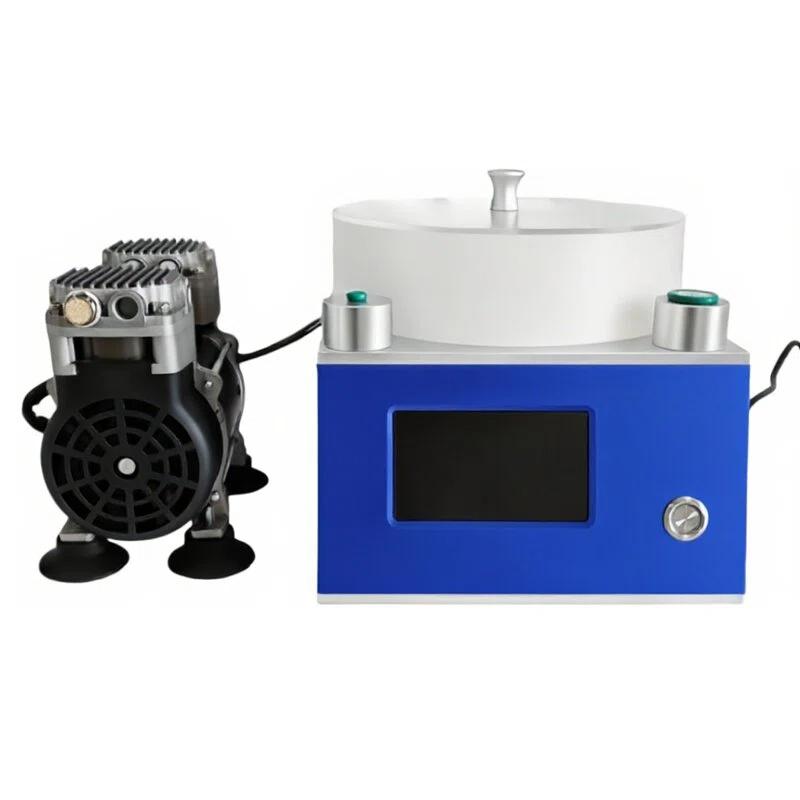
Within the process debugging range, when other conditions remain unchanged, increasing the rotational speed increases centrifugal force, usually reducing the film thickness accordingly. This is the most commonly used parameter adjustment logic in spin coating processes. However, this trend has its limits. When the rotational speed is increased to a higher level, the centrifugal liquid transfer time window is compressed, the weight of solvent evaporation increases, and further increasing the speed will significantly slow the reduction in film thickness, or even stop ceasing. The initial viscosity of the slurry itself also changes the balance between the two. High-viscosity slurries have poor fluidity and are not easily shaken off at the same speed. If the film is thicker, higher rotation speeds or longer spinning times are generally required; Low-viscosity slurry flows easily and is more sensitive to centrifugal action; even slight changes in rotational speed can cause significant differences in film thickness.
Environmental conditions also indirectly change the film formation result corresponding to centrifugal force through evaporation rate. When the ambient temperature is high and ventilation is strong, the solvent evaporates faster, effectively terminating the liquid spinning process early. At the same speed, the film thickness increases; At higher humidity, polar solvent volatilization is suppressed, slurry flow time increases, film thickness tends to be thinner, and the risk of edge defects increases. When optimizing formulations and processes, centrifugal force cannot be adjusted solely by rotation speed; the volatilization rate must be matched by the solvent's boiling point and ratio. For volatile systems, the maximum speed should be appropriately reduced to shorten the high-speed maintenance time and avoid rapid surface crusting; The non-volatile system can increase the rotational speed, ensuring that excess slurry is fully dispensed and reducing thickening of edges. The essence of film thickness stability is to control the relative relationship between centrifugal discharge rate and solvent evaporation rate, ensuring that the material liquid spreads evenly during the flow phase, stopping flow and curing at the right time, and reducing surface defects and thickness deviations between batches.



