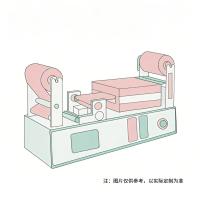
In roll-to-roll desktop coating operations, film surface bubbles are a common defect, mostly not due to defects in the slurry itself, but due to inadequate degassing, insufficient feed intake, unstable film movement, or improper coating matching. In actual production, many people only adjust coating speed and drying temperature, neglecting pre-degassing and pipeline exhaust, which leads to repeated bubble problems and a poor yield rate.
During slurry mixing, air is most easily drawn in, especially high-speed stirring, when the stirring paddle exposes the liquid surface, and repeated pouring, which can introduce a large number of microbubbles. Foam with higher viscosity floats slowly and is not visible to the naked eye, but after machine application, bubbles gradually emerge from the film surface, curing to form pinholes and bubbles. After normal slurry preparation, it must be left to defoam. Slurry with high viscosity requires longer standing time. If conditions permit, vacuum degassing can be used. Control the defoaming time to prevent rapid solvent evaporation, which could cause changes in the slurry solid content and viscosity drift. Stirring at low speed and evenness throughout the process, keeping the paddle fully submerged in the liquid surface and reducing air roll at the source.
The intake air in the feeding system is the main cause of strip-shaped bubbles and intermittent bubbles. Tabletop coil-to-roll machines are mostly supplied by pump or pressure. Loose pipeline joints, residual pipeline sections, and air accumulation in the die head cavity can all continuously introduce air during the coating process. After each machine start, material change, or tube change, the entire material path must be thoroughly drained of air until the die head discharges liquid continuously without interruption or bubbles before starting production. Frequent pump start-stop and unstable feeding pressure can also cause negative pressure suction. During production, try to maintain a steady and continuous feeding rate to minimize stops and stops midway.

Unstable membrane movement and tension mismatch are the core causes of large bubbles and localized cavitations. If the unwinding tension is too low, the film substrate becomes loose, jitters side to side, and wrinkles. When the substrate approaches the coating head, air may escape, and the slurry cannot fully adhere to the substrate, resulting in large areas of air bubbles. Excessive tension can stretch the substrate, causing deformation and uneven thickness of the film surface. All guide rollers and pressure rollers must remain parallel and free of eccentricity. The roller surfaces must not be coated with dust or glue debris, as foreign objects can cause substrate bounce and poor adhesion. The coating gap must also match the thickness of the substrate; if the gap is too large, the paste will not be compacted and air will not be fully expelled; If the gap is too small, it can easily scrape the film or cause filament, which also affects coating quality.
Mismatches between coating speed and slurry wettability can also cause bubbles. If the coating speed is too fast, the slurry cannot be wetted or spread in time, and air cannot be expelled from the film gap in time, and is directly sealed inside the wet film. Too slow speed may provide good exhaust performance, but it can easily cause flow patterns, thick edges, and deviations in thickness. Slurry with different viscosities should match the corresponding travel speed; for high-viscosity slurries, reduce speed appropriately to ensure level exhaust; Control the uniform speed of low-viscosity slurry to avoid overly rapid spreading and air trapping.
Improper drying techniques can lock in bubbles. If the first drying stage is too high or heats up too quickly, the wet film surface will instantly form crust, causing internal bubbles that cannot float and overflow, sealing all inside the coating and forming dense pinholes and bubble pits after cooling. The first stage of drying after coating must be low-temperature pre-drying to allow sufficient degassing and leveling time for the film surface, followed by gradual heating and curing to prevent premature drying and caking.
Direct airflow at the workshop coating station can also cause hidden bubbles and poor local film surfaces. Direct airflow at the outlet causes rapid evaporation of local solvents, pre-shaping the film surface, and locking in unvented air. In daily production, avoid direct air ducts to maintain stable airflow in the coating area.
Actual inspection can quickly distinguish bubble types: scattered independent bubbles are basically slurry that has not defoamed; Longitudinal long air bubbles are basically the pipeline and die head intake; Irregular bubbles in the formation are basically caused by film shaking or poor adhesion and air clamping. As long as the slurry is properly degassed, the pipeline is thoroughly vented, tension roller system is calibrated, coating gap matches are matched, and low-temperature pre-drying is done, the film surface bubble problem in roll-to-roll coating can basically be completely resolved.