Nowadays, when doing thin film spin coating R&D, many people often fall into the trap of only looking at the maximum speed of the spin coater and ignoring the motor configuration. Although the speed parameters seem identical, the film surface and data repeatability produced by ordinary motors and servo motors are on a completely different level, and the gap between long-term experiments and formulations is very obvious.
Most conventional rotary coating machines on the market use DC or stepper motors, which belong to open-loop control. Simply put, the device only issues speed commands but does not monitor the true rotational speed of the turntable in real time. During spin coating, the situation is constantly changing—slurry is thrown out, substrate is slightly eccentric, and wet film weight changes can all cause load fluctuations. Ordinary motors cannot withstand such dynamic changes, causing the speed to fluctuate and become unpredictable, especially during initial acceleration and final deceleration, where vibration is particularly noticeable.
The key to spin-coating film formation is not the maximum rotational speed, but the consistency of the spreading rhythm in the first few seconds and the acceleration throughout the process. The acceleration curve of ordinary motors changes every time they start, with shear force fluctuating between high and low, and the rhythm of slurry leveling, solvent evaporation, and film layer shaping all deviate each time. The final results are uneven film thickness, radial lines, and localized flaring. The same formula can't be tested on the same day with data matching, making rigorous formula comparisons impossible.
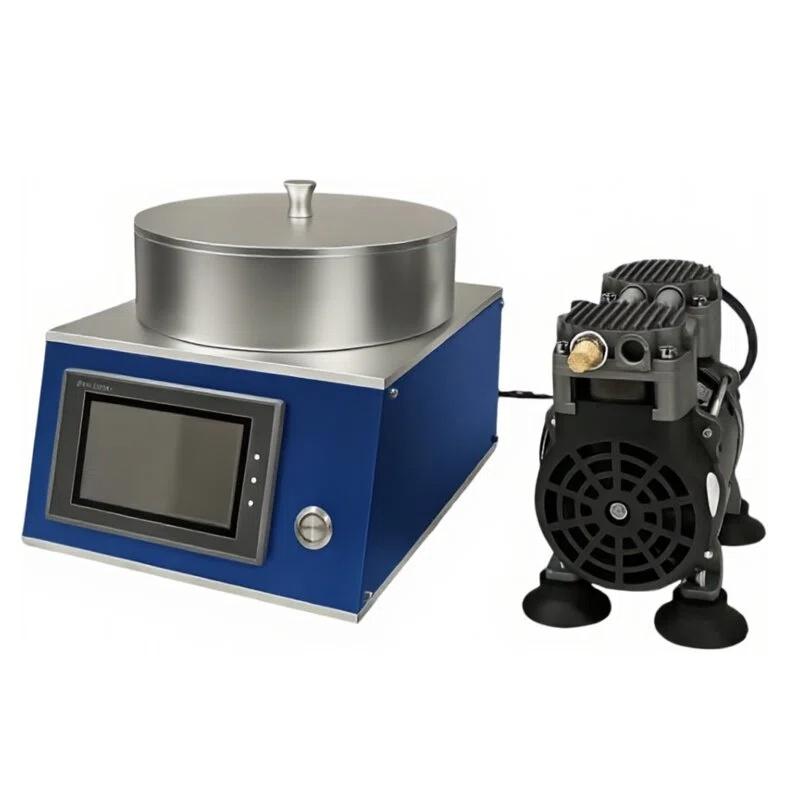
The greatest advantage of servo motors is closed-loop real-time feedback and built-in speed measurement correction. No matter how the load changes, the system compensates for torque and speed in milliseconds. Throughout the process, speed, acceleration, and deceleration are all locked to the set parameters, running very smoothly with almost no jitter or speed drift. With each sample preparation, the centrifugal and shear forces on the slurry are exactly consistent, and the leveling process and evaporation rhythm are highly consistent, eliminating experimental errors caused by equipment from a hardware perspective.
Especially the currently commonly used segmented processes—low-speed film laying, medium-speed leveling, high-speed shaping—and multi-speed variation require extremely high equipment continuity. Switching gears in ordinary motors can cause brief stalls and speed gaps, directly disrupting the wet film leveling state and causing defects. The servo motor can seamlessly switch speeds, with each process stage stable and controllable. The film thickness deviation after multiple sample preparations is minimal, maximizing data repeatability.
Overall, ordinary motors can only meet basic and rough sample preparation needs and are suitable for basic tests where uniformity and repeatability are not required. As long as it's about functional films, formulation debugging, additive screening, and data benchmarking, servo motors are a must-have. It's not just about higher speed, but about more stable dynamic control and stronger process consistency, truly ensuring that every experiment is driven solely by the formula and process, not the equipment itself.



