Leveling
Leveling is an important item in the construction performance of coatings. Leveling refers to the ability of the coating film to flow from an irregular and uneven surface to a flat and smooth surface after construction. Paint leveling is the combined effect of gravity, surface tension and shear. The premise of leveling is whether the coating can wet the surface of the workpiece, that is, whether it has good fluidity. This performance is related to the composition, performance and construction method of the coating (solvent and volatilization speed of the solvent; the adjustment of the viscosity of the coating; The size of the spraying air pressure; the amount of paint output; the spray distance, spray width, temperature and humidity of the construction environment; the thickness of a film, etc.) and so on. If a proper amount of additives (leveling agent) such as silicone oil and cellulose acetate are added to the coating, the leveling property of the coating film can also be directly improved.
The leveling of the paint affects the quality of the film formation. If the leveling property is too poor, the traces on the surface of the coating film will not easily disappear, resulting in coating defects; if the leveling property is too good, the coating film will easily produce defects such as sagging and flow marks.
The detection method of leveling is carried out according to the national standard "GB1750-79 (confirmed in 1989) paint leveling method". Divided into brushing method and spraying method. The paint is brushed or sprayed on the flat surface of the base plate, and the time (min) required for the disappearance of brush lines and the formation of a smooth surface is expressed. Its general provisions and determination methods are as follows:
(1) General provisions
Materials and equipment
①Tinplate: smooth surface, 50xl20X(0.2~0.3)mm;
②Brush: 25~35mm wide;
③Spray gun and stopwatch.
(2) Determination method
① Brushing method: According to the provisions of GB1727-79 "General Preparation Method of Coating Film", under constant temperature and humidity conditions, use a paint brush to prepare a paint film on a tinplate plate. When brushing, it should be painted vertically and then horizontally quickly, and the brushing time should not exceed 2~3min. Then paint a line in the middle of the template longitudinally from side to side (with brush marks but not showing the bottom). While the paintbrush leaves the sample, press the stopwatch to measure the time required for the brush mark to disappear and form a smooth surface.
②Spraying method: According to the provisions of GB1727-79 "General Preparation Method of Coating Film", prepare a coating film on the tinplate, and then quickly place the sample under constant temperature and humidity conditions, and observe from the time the coating film is prepared to the time when the coating is finished. The time required for the film surface to develop a completely smooth (no orange or goose peel) state.
It is generally required that the leveling time of the coating is compatible with the drying time of the coating film. If the leveling time is longer than the drying time, the paint will dry before leveling completely, forming defects such as accumulation and orange peel; if the leveling time is shorter than the drying time, the coating film will easily have defects such as sag, sag, and wrinkles.
Sagginess
Drooping means that the paint is coated on a vertical surface. Under the influence of gravity, before the wet film is dry, part of the surface of the wet film tends to flow down, forming a thinner upper part, thicker lower part, or a severe spherical or corrugated shape. The phenomenon. Strong sagging is one of the manifestations of poor construction of the coating and should be avoided as much as possible. The sagging speed of the coating is inversely proportional to the viscosity of the coating and proportional to the square of the coating film thickness. If the sagging property of the paint does not meet the standard requirements, it will be difficult to obtain a flat and uniform paint film after drying, which will directly affect the appearance quality of the paint film and the protective performance of the coating. Therefore, the sagging of the coating needs to be tested. The general detection method is to apply a certain thickness of coating film on the test panel, place the test panel vertically, observe the flow and fall of the wet film, record it, and check whether it meets the requirements of the product.
For the determination of the sagging of various types of automobile spray paints, cold-rolled steel sheets (350mmx300mmxlmm) for automobiles are used. When measuring, drill 8 flb holes on the diagonal, and the edge of the hole is not trimmed, and it is in the shape of a knife edge. The surface of the measuring board should be free of oil and rust, placed vertically (inclination less than 5°), and sprayed evenly from top to bottom with a paint with normal working viscosity. After standing for 1min, spray again from the third hole downwards. By analogy, different coating thicknesses from top to bottom are formed, until the edge of a certain hole and the hole below appears paint sagging. When spraying, the air pressure and the amount of sprayed paint should be controlled until the edge of the third to fifth holes begins to sag, and the paint should be sprayed at least twice. After standing for 10 minutes, dry according to the technical requirements of the coating, and measure the thickness of the coating film corresponding to the hole where the coating starts to sag, which is the sagging data, and the unit is expressed in microns (µm).
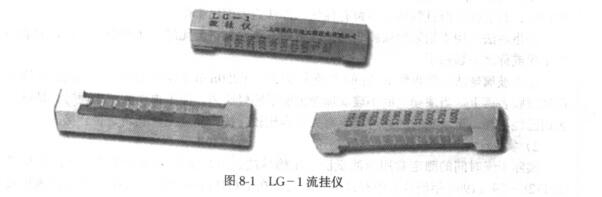
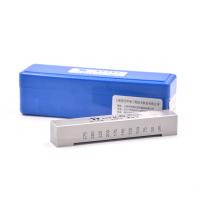
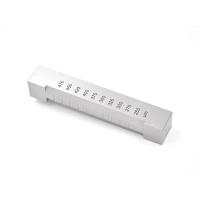
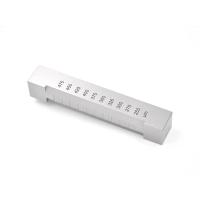
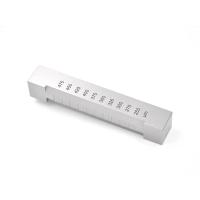
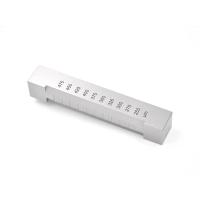
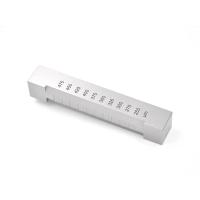
The detection of sagging performance is carried out according to the national standard (] B9264-88 "Determination of sagging performance of colored paint" inspection method, and the sag performance Tester is used for detection. The sagging performance Tester is shown in Figure 8_1, and its measurement range (coating film Different thickness values) are 50~250µm, 250~475µm, etc.