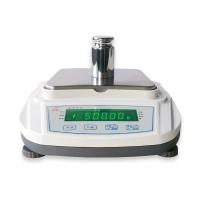
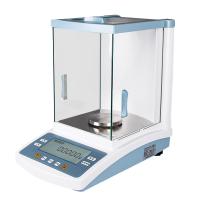
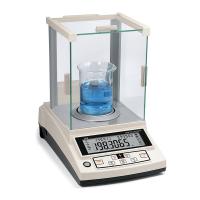
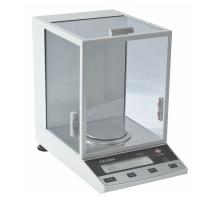
Analytical balance is a laboratory precision instrument and equipment. In the process of operation and application, it is necessary to be careful and operate in accordance with the application rules of analytical balance, so as to ensure accurate weighing without causing damage to the balance.
1. The structure of the electro-optical analytical balance
Electro-optic analytical balance is also called semi-automatic electro-optic analytical balance, and its structure is shown in Figure 3-1.
2. How to use the electro-optical analytical balance
(1) Inspection and preparation before weighing
Take off the dust cover, fold it flat and put it on top of the balance box. Check whether the balance is normal, whether the balance is level, whether the weighing disc is clean, whether the ring code index disc is at the "000" position, whether the ring code is dislocated, whether the lifting lug is falling off or shifting, etc.
Check and adjust the empty pan zero of the balance. Use the balance screw (coarse adjustment) and fine adjustment screw (fine adjustment) to adjust the zero point of the balance, which is one of the basic contents of the weighing exercise of the analytical balance.
(2) weighing
When rapid weighing is required, or when it is suspected that the object to be weighed may exceed the maximum load, a pallet balance (platform scale) can be used for rough weighing. Group titles are generally not advocated.
Place the object to be weighed in the center of the left pan of the balance, and close the left door of the balance. Add and subtract weights on the right panel according to the principle of "from big to small, cut in the middle, and try weight step by step". When trying the weight, the balance should be half opened, and the direction of the pointer offset or the moving direction of the scale projection should be observed to judge the weight of the left and right plates and whether the added weight is appropriate and how to adjust it. Note: The pointer is always biased towards the light disc, and the scale projection always moves towards the light disc. First determine the weight above gram (use tweezers to pick and place), and close the right door of the balance. Then adjust the ring codes of the 100mg group and the 10mg group in turn, starting from the middle dose (500mg and 50mg) each time. After confirming the ring code of the 10mg group, fully turn on the balance and prepare for reading.
(3) Reading
After the weight is determined, fully open the balance knob, and the reading can be taken after the scale stops. The mass of the object to be weighed is equal to the total weight plus the scale reading (both in grams). When the scale reading is 9~10mg, you can add a 10mg ring code, read the negative value of the scale from the screen, and subtract this reading from the total weight when recording.
(4) Restoration
After the weighing data is recorded, close the balance, take out the material to be weighed, put the weight back into the weight box with tweezers, return the ring code index disk to the "000" position, close the doors on both sides, and cover the dust cover , and register in the balance registration book.
(5) Precautions for using the balance are as follows

1) Open and close the balance knob, put and take the object to be weighed, open and close the side door of the balance, add and subtract weights, etc., all actions should be light and slow, and do not use too much force or too fast, so as not to cause the balance parts to dislocate or damaged.
2) When adjusting the zero point and reading the weighing reading, pay attention to whether the side door of the balance is closed; the weighing reading should be recorded in the experiment report or the experiment record book immediately. After adjusting the zero point and the weighing reading, the balance should be closed at hand. Adding and subtracting weights or putting and taking weighing objects need to be carried out when the balance is closed (single-pan balances allow weights to be adjusted in a half-open state). Do not fully open the balance without adjusting the weights. 3) For hot or cold objects to be weighed, they should be placed in a desiccator until their temperature is consistent with the temperature of the balance room before weighing.
4) The front door of the balance is only used for installation, maintenance and cleaning, and should not be opened at ordinary times.
5) Place color-changing silica gel in the balance box as a desiccant. If the color-changing silica gel turns red, it should be replaced in time.
6) It is necessary to use the specified balance and the weight attached to the balance. If the balance is found to be abnormal, it should be reported to the instructor or laboratory staff in time, and do not handle it by yourself.
7) Pay attention to keep the balance, balance platform and balance room safe, clean and dry.
8) There must not be any medicines left in the balance box. If there are medicines left behind, they can be cleaned up in time with a brush.
9) After using the balance, cover the balance cover and cut off the power of the balance. Finally, register in the balance use record book, and ask the instructor to sign.