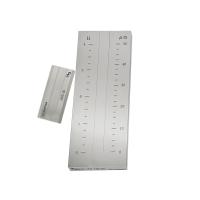
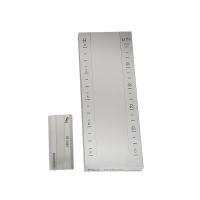
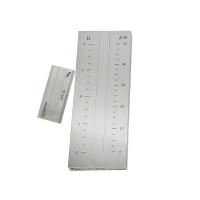
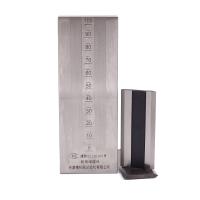
The function of the Fineness gauge is mainly to detect the size of the particle fineness of coatings and inks. Due to the simple and fast operation of the Fineness gauge, it plays a great role in the particle measurement of coatings and inks. However, there are certain errors in the use of the Fineness gauge, mainly due to the subjectivity of the user's operation and evaluation criteria, so it is only used for rough measurement.
What is fineness?
Fineness depends not only on the actual size of the individual particles, but also on how well they are dispersed. The so-called fineness refers to the degree to which solid powdery substances such as pigments and fillers mixed in the linking family are dispersed.
Do you have to measure the fineness?
The fineness of the ink is related to the performance of the ink, such as tinting power, hue, stability, etc., and also affects the rheological properties of the ink, which is directly related to its economic benefits, so the fineness of the ink is a very important quality index.
If the ink fineness is too coarse, it will cause drawbacks such as ink stacking and paste, and the tinting power and hue of the ink will also deteriorate; if the ink is too thin, the fluidity will be too large, and it will flow after printing. This flow will lead to network expansion, affecting the quality of printed products.
The fineness and thickness of the ink will also affect its dispersibility. When the dispersibility of the ink is not satisfactory, its printing performance will not be satisfactory, as the surface of the printed matter is not smooth, smooth and soft enough, and it will produce a "block" like feeling, thus greatly reducing the printing effect.
Therefore, detecting the fineness of ink is an important job for most ink manufacturers. So any ink factory needs to use a Fineness gauge, and the Fineness gauge has a great role.
Operation principle of Fineness gauge:
The Fineness gauge is a stainless steel plate with grooves or double grooves on the surface, and the depth of the grooves varies from the maximum at one end to the zero value at the other end.
Place the sample, scrape the sample film in the groove with a scraper, and measure the size of the sample particles from the lines generated in the film.
The corresponding depth of the groove is marked on the plate to read out the size of the measured particle.
Reference standard for Fineness gauge:
JJG (Chemical) 018-96 "Fineness gauge" and its GB/T1724-93 standard.