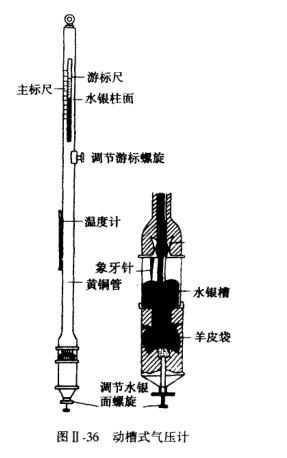
 The instrument used to measure atmospheric pressure is called a barometer. There are many types of barometers, and the most commonly used in chemical laboratories is the dynamic tank barometer.
1. Structure
The structure of the moving tank barometer is shown in Figure II-36. It uses a glass tube with a length of 90 cm to close one end. The tube is filled with mercury, and the open end is inserted upside down into the lower mercury tank. The mercury in the tube And there are rectangular small windows on opposite two sides, and a vernier scale that can slide up and down is arranged in the window, and the vernier scale can be moved up and down by turning the vernier screw. The bottom of the mercury tank is a sheepskin bag, and the height of the mercury surface can be adjusted by means of the mercury surface screw at the lower end. The height of the mercury surface should just touch the tip of the ivory needle fixed on the top of the mercury tank. This mercury surface is the "zero point" for measuring the height of the silver column. ", which is the "zero point" of the main scale on the brass tube.
2. How to use
(l) Read the temperature. Start by reading the temperature from the thermometer attached to the barometer.
(2) Adjust the height of the mercury surface. Slowly turn the mercury surface spiral at the bottom, so that the mercury surface in the mercury tank is just in contact with the tip of the ivory needle. When adjusting, the action should be light and slow. You can use the reflection of the white porcelain plate behind the mercury tank to observe the height of the mercury surface. The mercury surface is well adjusted. Finally, wait for 30 seconds to observe the contact between the mercury surface and the ivory needle tip again, if there is no change, continue to the next step.
(3) Adjust the vernier scale. Turn the vernier screw so that the lower edge of the vernier is higher than the mercury column, and then slowly descend until the lower edge of the vernier is tangent to the convex surface of the mercury column. When observing, the eyes should be at the same time as the lower edge of the vernier and the convex surface of the mercury column. One by one on the horizontal plane.
(4) Read the atmospheric pressure. First read the scale near the lower end of the vernier scale from the main scale, which is the integer part of the atmospheric pressure, and then find the scale line from the vernier scale that coincides with a certain scale of the main scale, and the value of this scale is the fractional part of the atmospheric pressure , the unit is kPa.
3. Calibration of barometer readings
Since the scale of the barometer is based on the sea level altitude of 0°C and latitude 45°, and the instrument itself has errors, the readings of the barometer need to be corrected for temperature, latitude, altitude, and instrument errors before they can be used.
(l) Instrument calibration. The reading error caused by the inaccuracy of the instrument itself is called instrument error. The instrument is equipped with a calibration table when it leaves the factory. The value read from the barometer should be calibrated by this table first. If the value in the table is positive, this value should be added to the reading; if the value in the table is negative, then This value should be subtracted from the reading.
(2) Temperature correction. Temperature will affect the mercury density and the length of the brass scale. After considering these two factors, the following formula can be used to correct: