 1. What is the definition of the angle of repose of powder coating? How to measure the angle of repose?
 1. What is the definition of the angle of repose of powder coating? How to measure the angle of repose?
(1) Definition
The paint powder sample flowing naturally from the mouth of the funnel forms bond accumulation on the plane, and the central angle formed between the plane and the powder cone accumulation is called the angle of repose.
(2) Instrument
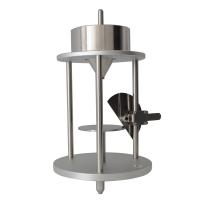
Funnel, funnel stand, disc and protractor (stand included). The mouth of the funnel should not be too large, about 5mm is better, because the size of the disc is not limited.
(3) Test procedure
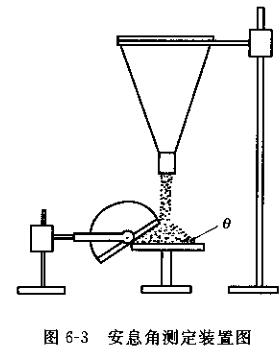
Place the instrument according to Figure 6-3. The mouth of the funnel is aligned with the center of the powder-receiving disc table, and the distance from the disc should not be too high. Then slowly pour the powder into the funnel, and then flow from the funnel to the powder-receiving disc table to accumulate. , until the disk table is full and overflows from the edge of the disk, and keep the 0 angle at the maximum, Figure 6-3 The diagram of the device for measuring the angle of repose, and then measure the value of θ with a protractor.
Repeat 3 times and take the average value, which is the angle of repose.
If the powder to be deposited is irregular in shape, it can be measured according to the two lines of the vertex and the edge of the disc.
2. What is the definition of powder coating particle size distribution? How is particle size distribution determined?
(1) Definition
The size range of powder coating particles and the proportions of particles of various sizes in the total amount are called particle size distribution.
(2) Equipment
Sieve: The size of the sieve and its hole size should comply with the provisions of GB6003-85 "Test Sieve". It is recommended to use a national-shaped sieve with a diameter of 200mm and a depth of 50mm. The hole size and quantity of the sieve should be selected according to the requirements.
Industrial balance: Sensitivity 0.5g.
Seal screen lid, catch pan and soft bristle brush.
(3) Test procedure
Weigh out 100g soil and 0.5g powder sample, which can be sieved by measuring sieve or single sieve.
① Stacked sieve screening: stack the selected group of sieves up and down according to the order of aperture size, with the smallest aperture below. The powder sample is poured into the top sieve.
②Single sieve: Pour the powder into the selected sieve with the smallest aperture for sieving, and then pour the leftovers into a sieve with a larger aperture for sieving, until all the sieves are used.
The stacked sieve or the single sieve is equipped with a feeding tray, and the cover is placed on it. It can be held with one hand during screening, and if it is too heavy, it can be installed on a cantilever hanger, and the screen surface can be kept at an inclination angle of 10°~20°. Lift the sieve lightly by hand, beat about 120 times per minute, place the sieve in a horizontal position after every 30 times, turn the sieve at an angle of 90°, and re-pat the sieve frame with your hands or give periodic vertical vibration, or you can hold it and shake it by hand . If the powder is not easy to sieve out, you can lightly brush the bottom of the screen with a brush to help the powder fall.
When sieving, l can be determined through experiments according to the powder type, composition and sieving method. When the penetration amount of powder within 1 minute is less than 1% of the feeding amount, it will be used as the end point of sieving.
After sieving, the sieve or pan and the powder in it can be weighed together, and then the mass of the sieve or pan itself can be subtracted; the powder sample can also be taken out and weighed separately, but care should be taken to brush off the adhering powder.
(4) Results
Calculate the percentage of the remaining powder on each sieve to the total powder sample, and indicate the loss percentage of the stacked mass (including the powder weight in the pan). The loss should not exceed 2%, otherwise the weighing process should be carefully checked and retested if necessary.