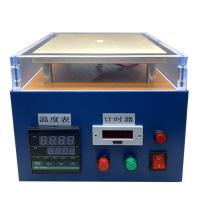
1. What is the definition of powder coating softening temperature? How to determine softening point?
(1) Definition
The softening temperature is the temperature when the powder coating just appears to melt, and the unit is expressed in degrees.
(2) Equipment
Hot plate: Use a köfler Hot Plate or a Hot Plate with similar performance, which is characterized by temperature conformation from one side to the other when heating. Generally, it is from room temperature to 200°C. Install a temperature scale along the Hot Plate, which can be calibrated by materials with known melting points (such as azobenzene 68°C ± 1°C, azobenzene 80°C ± 0.5°C, benzyl acid 122°C ± 1°C) or a thermocouple temperature measuring instrument. .
Paint brush: bristle length 12.7mm.
(3) Test procedure
Heat to equilibrate the Hot Plate temperature. Select a material with a known melting point close to the melting point of the material to be tested or use a thermometer to check the indicated value of the temperature scale.
Spread a small amount of the powder sample to be tested on the plate to form a thin and narrow powder belt, the belt length spans the temperature range of 20 °C, and after 1 minute so that the expected melting point is near the center of the temperature range, put Brush the unmelted powder from the high temperature side to the low temperature side, and then adjust the pointer to the position where the traces of melted powder just appeared, this temperature point is the softening point.
(4) Results
Take the middle value of the three measured values as the test result, and the other two values are also included in the report as a reference.
2. What is the definition of powder coating gel time? How to measure gel time?
(1) Definition
The gelation time refers to the powder coating, which is called gelation when it is spread to a certain thickness on a Hot Plate at a certain temperature and melted from the beginning until it cannot be pulled out or cannot flow. The period of time from the beginning of melting to generalization of the powder coating is called the gelation time, and the unit is expressed in s or min.
(2) Equipment
Hot plate: a picture-shaped brass plate with a smooth surface, thickness 15~20mm, diameter 120mm, or square 120mmx120mm, with a hole in the middle of the side with a diameter of 7mm and a depth of 65mm for inserting a thermometer. The Hot Plate is heated by an electric furnace, and the temperature can be controlled by a voltage regulator or other equipment. The temperature can be maintained at ±1°C (it is better to add a stainless steel plate with a thickness of 2mm and a size that can cover the electric furnace surface between the Hot Plate and the electric furnace to prevent powder or coating falling into the electric furnace).
Stopwatch or other timers: accurate to 0.2s.
Mercury thermometer: can measure 0~250℃.
Measuring spoon: lmL.
Stirring rod: the size is about 2mmx10mmx150mm, and one end is sharpened. It can be made of non-thermal conductive materials such as wood, bamboo, and PTFE board.
Metal putty scraper.
(3) Test procedure
There should be no forced ventilation around the Hot Plate, and it should be placed in a windshield surrounded by 3 sides with a height of 300mm. The temperature rise time of the Hot Plate is allowed to be at least 30 minutes. The constant temperature of the Hot Plate is determined according to the requirements. The surface of the Hot Plate is coated with a thin layer of release agent, and oil and rubber solution are added. Measure 1mL of powder sample on the Hot Plate, and use a spatula to quickly spread it within a diameter of about 50mm. Start timing when the powder melts, and use a stirrer to make bad movements in the melted fat. Pay attention to the flow state of the resin. When it cannot be drawn or flowed, it is regarded as a gelation point, that is, stop timing, and use a scraper to remove the resin on the board.
The test was repeated 3 times, and each time the error should not be greater than ± 5% of the mean value.
(4) Results
The gel time was taken as the median value of 3 measurements.