(1 Scope
This standard specifies a method for determining the density of powder coatings using a gas pycnometer. This method is applicable to all types of powder coatings. The test is very simple, but compared with the methods commonly used to determine density, the equipment required by this method is complicated.
The density of powder coatings can also be determined by the liquid displacement pycnometer method described in IS08130-3. The instrument of this method is relatively simple, but the liquid replacement pycnometer method is easy to get wrong results. Especially in the following two situations: one is that the powder coating is swollen after the used replacement liquid contacts the powder coating; the other is that the replacement liquid cannot completely replace the air between the powder particles. The determination speed of liquid replacement pycnometer method is slow and the accuracy is low, and it is only used when it can get the same result as gas comparison pycnometer method.
(2) Principle
When the sample is added to the measuring container, the volume of the weighed sample is calculated from the volume of gas displaced in the measuring container. The measurement purpose can be achieved by the equilibrium pressure difference formed by gas displacement. The density is then calculated from the mass and volume of the sample.
(3) Material
Air, if required, use ammonia, stored in cylinders, industrial grade.
Other gases may also be used if the test product is not affected and the deviation of the method is noted in the test report.
(4) Instrument
The gas comparison hydrometer can be used to measure the density manually or automatically, and it should meet the following requirements.
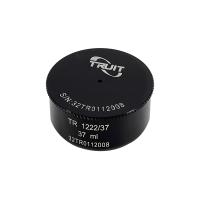
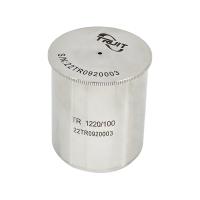
The basic design of a typical gas comparison pycnometer using air as a medium is shown in Figure 6-l2. It consists of two cylinders (A and B) with pistons of exactly equal dimensions. Cylinders can be connected by valves and differential pressure gauges. The sample contained in the 50mL beaker is placed in cylinder B. The two pistons move with equal range, and the result is a pressure difference between cylinders A and B. Then move to the re-stabilized equal pressure to measure the piston (range) in cylinder B, and read it from the gauge. The change in final volume is equal to the sample volume.
The measured gas exchange capacities of the cylinders shall prove to be equal within 0.5% (relative value). The measured volume interval indicated on the scale should not be greater than 1% of the measured volume. Calibration of the scale shall be carried out by placing a reference standard of known volume and traceability in the instrument. The use of two reference standards of different volumes is sufficient to provide periodic calibration, but at least five reference standards of different volumes are required to begin to correct whether the scale is linear over its entire range.
(5) Sampling
Take a representative sample of the test product according to the method described in ISO842.
(6) Operation steps
The measurement should be carried out under the conditions of 23°C ± 1°C and 50%i5% relative humidity .
Adjust the instrument according to the manufacturer's instructions, especially taking into account the volume of the beaker. Check the instrument to ensure that there is no leaking from the instrument.
Weigh the empty beaker containing the sample to the nearest 1 mg, fill the beaker almost with the test product, and ensure that no powder sticks to the outer wall of the beaker. Weigh the beaker containing the sample to an accuracy of 1 mg to obtain the mass (m) of the sample.
Place the beaker and the sample in the instrument, and measure the volume of the sample according to the instructions of the instrument manufacturer. In order to ensure the consistency of the readings, the volume was determined repeatedly, and the average value (V) of the two volumes was calculated.
If the gas is dry, a slight change in density may be observed due to the drying of the sample.
If the difference between the two readings is greater than 2%, the result is discarded.
(7) Expression of results
Use the formula (6-7) to calculate the density pp of the powder coating at 23°C, expressed in g/mL:
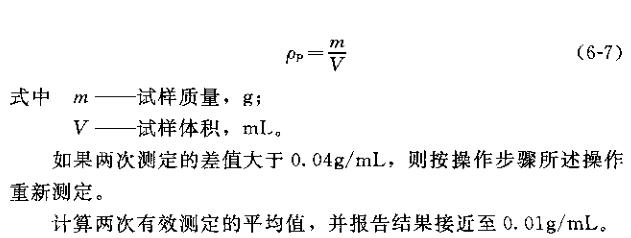
If the difference between the two determinations is greater than 0.04g/mL, proceed to the operation described in the operation steps and perform the measurement again.
Calculate the average value of two valid determinations, and report the results close to 0.0lg/mL.